
Iran demands end to Yemen blockade, urges immediate dialogue
 5 Min Read
Iran says the Yemeni people are entitled to sovereignty, dignity and freedom from blockade and intimidation, while urging a return to dialogue and respect for Yemen’s territorial integrity.
-
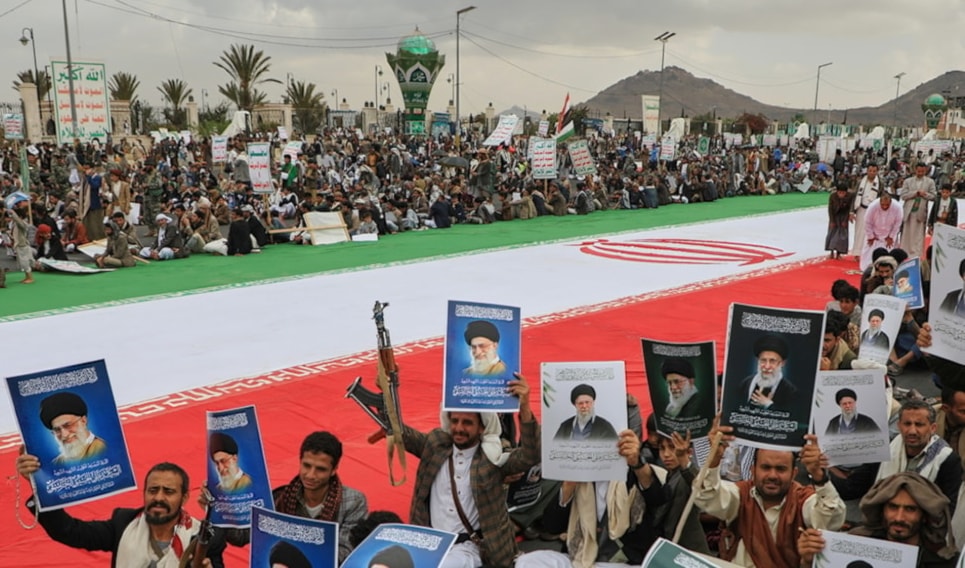
Yemenis hold posters of martyred Iranian leader Sayyed Ali Khamenei next to a giant Iranian flag as they protest the US aggression against Iran in Sanaa, Yemen, March 6, 2026. (AP)
Iran has called for the immediate resumption of dialogue over Yemen, saying the country’s issues cannot be resolved through a continued blockade or military confrontation.
In a statement issued on Thursday, the Iranian Ministry of Foreign Affairs reiterated Tehran’s position that Yemen’s independence, national sovereignty and territorial integrity must be respected and that the “illegal and inhumane blockade” imposed on the country must end.
The ministry said security and stability in West Asia and the Red Sea region could not be achieved without respecting the legitimate rights and dignity of the Yemeni people.
The statement added that the current developments in Yemen must be understood in the context of events unfolding over more than a decade.
Iran urges dialogue as West Asia faces escalating aggression
It stressed that the Yemeni people, as heirs to a “brilliant civilization and history,” have the right to live in dignity, free from pressure, intimidation and an unjust blockade, with their national sovereignty and territorial integrity fully respected.
Iran also emphasized the need to consider the interests of the Islamic Ummah, particularly as West Asia faces “unprecedented aggression, oppression, and expansionism” by the Zionist entity, with the complicity of the United States.
Furthermore, the statement called for the immediate resumption of dialogue under the agreed-upon roadmap and urged the implementation of its provisions, adding that Tehran was prepared to offer “any good offices” to help advance the process.
US seeks Red Sea control while outsourcing regional security role
In a related development, a senior US official, speaking to Al Mayadeen, said Washington was focused on protecting its core national security interests, including freedom of navigation in the Red Sea, while enabling regional partners to take the lead in addressing regional security challenges.
“The United States is focused on protecting our core national security interests — such as ensuring freedom of navigation in the Red Sea — while empowering our regional partners to take the lead in managing and resolving regional security challenges. We are in continuous dialogue with Saudi Arabia and the Republic of Yemen Government regarding regional stability,” the senior US official said in remarks to Al Mayadeen.
YAF take control of key areas, military sites in Mokha, west of Taiz
The Yemeni forces have taken control of key areas and military positions in the coastal district of al-Mokha, west of Taiz Governorate, Al Mayadeen's correspondent reported on Thursday.
In detail, our correspondent revealed that the Yemeni Armed Forces have taken control of Khalid Camp Base and Jabal al-Nar Camp, which serves as the command headquarters for military forces on the western coast.
This development comes as the YAF made advances in several areas, taking control of al-Wazi'iyah, al-Khokha, and Hays, before reaching the outskirts of the city of al-Mokha.
It is worth noting that the area of the districts of Hays and al-Khokha to the south of the coastal Hodeidah governorate on the Red Sea exceeds 1,050 square kilometers, local sources told Al Mayadeen.
The YAF advances come as the Saudi aggression across Yemen continues, with the aim of supporting and reinforcing Saudi military mobilizations on the ground.
Al Mayadeen's correspondent reported on Thursday that Saudi aircraft had carried out around 40 airstrikes over the previous several hours in the governorates of Taiz, Hodeidah, al-Jawf, and Marib.
Continued Saudi aggression warrants a response until it stops: Sanaa
The Yemeni Ministry of Foreign Affairs of Sanaa said on Thursday that continued Saudi aggression and violations of Yemen’s sovereignty warrant a response until the attacks stop.
In a statement, the Ministry said the Saudi regime’s continued airstrikes targeting Yemeni provinces and its violations of Yemen’s sovereignty necessitate a response until the aggression ends.
It asserted that the Yemeni Armed Forces are responsible for defending the country’s sovereignty, protecting its citizens, and responding to the sources of fire, adding that such actions are carried out in a manner that does not conflict with international law.
Saudi military build-up necessitated YAF response
The Ministry also said Saido Arabia's recent military build-up on Yemeni territory has necessitated a Yemeni Armed Forces' response.
It further accused Riyadh of using continued “wailing and outcry” to cover up ongoing crimes against the Yemeni people. It said the latest aggression included hundreds of airstrikes on several Yemeni provinces.
The Ministry also said Yemen “has not and will not pose a threat,” arguing that the country seeks to build relations based on mutual respect. It noted that Yemen was prepared to participate in a regional security system, particularly in protecting navigation, in partnership with coastal states.
The Ministry called on the international community to assess the course of events objectively and compel Saudi Arabia to stop targeting Yemen, violating its sovereignty, and tampering with its resources.
What you need to know
The accelerating developments follow the Yemeni Armed Forces’ announcement in July that the 2022 truce with Saudi Arabia had collapsed following Saudi Arabia’s aggression on Sanaa International Airport.
In response, the Yemeni forces targeted several Saudi economic facilities, including oil refineries operated by Aramco and Abha Airport.
They also imposed a maritime ban on vessels arriving in or departing from Saudi Arabia, as part of the “airport for airport and siege for siege” equation.
Recently, the Yemeni Armed Forces have been engaging in confrontations with Saudi-backed forces across several provinces, after launching preemptive strikes against their military mobilizations.


