
Iran exposed Israeli dependence on Washington: Israeli media
 3 Min Read
An Israeli senior diplomatic correspondent details how Iran out manoeuvred the Israeli regime in hours, leaving US, not "Israel", to dictate the terms of engagement.
-
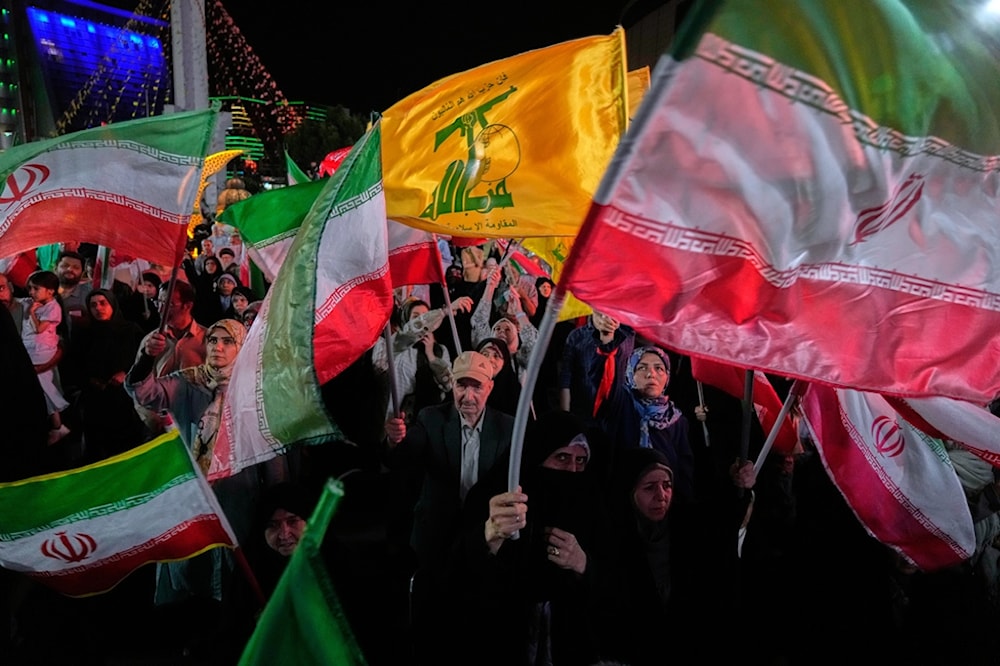
Iranian demonstrators wave their country's flags and the Hezbollah Resistance party flags in a demonstration, in support of the government and the armed forces, in Tehran, Iran, on June 7, 2026. (AP)
Israeli senior diplomatic correspondent Itamar Eichner has detailed how recent developments in the confrontation between "Israel" and Iran exposed the limits of Israeli strategic autonomy, with US intervention ultimately determining the course of escalation.
According to Eichner’s report in Yedioth Ahronoth, Israeli officials had been preparing for a broad military campaign against Iran, in parallel with confrontations with Hezbollah in northern areas and evolving Iranian deterrence calculations linked to Lebanon.
The report said "Israel’s" plan included potential strikes on Beirut’s southern suburbs, with the aim of provoking an Iranian response that could then be used to justify aggression on Iranian infrastructure and energy facilities.
However, the operation reportedly collapsed within hours after Iran announced readiness to halt military operations, a witty political decision that opened the door for US intervention to contain escalation.
US pressure on 'Israel'
Eichner reported that US President Donald Trump subsequently pressured Israeli Prime Minister Benjamin Netanyahu to halt further escalation and close the confrontation.
The report quoted sources describing Trump as having “folded Netanyahu and stopped the escalation with Iran.”
Israeli outlet Inyan Merkazi also reported that Trump conveyed a “clear and decisive message” to Israeli officials that Washington did not wish to see renewed war, citing concerns over regional escalation, energy security, and global economic stability.
CBS News, citing a US official, reported that the United States did not take part in Israeli strikes on Iran during the latest escalation and did not activate US defensive systems to intercept incoming Iranian missiles. This was however refuted by Al-Monitor which claimed that the US did fire interceptors from both land-and-sea-based systems.
Iran’s response and emerging equation
Eichner’s analysis said the episode reflected an emerging operational equation in which Iranian responses linked to Lebanon could trigger wider escalation dynamics involving US intervention to restrain further Israeli action.
Iran’s Khatam al-Anbiya command announced that military operations had been halted “for now,” while warning that they would resume if US-Israeli actions in Lebanon continued. Meanwhile, the Iranian Tasnim news agency reported that "Israel" and the United States had requested a ceasefire arrangement.
Gap between Israeli messaging and operational reality
The report said Israeli officials continue to maintain that attacks in Lebanon will proceed in response to rocket fire and that "Israel" will not allow external actors to dictate its rules of engagement.
However, Eichner wrote that the events reflected a divergence between public messaging and battlefield developments, stating: “Israel attacked, Iran responded, and it was the United States that determined when the round would be stopped.”
Eichner concluded that developments indicate a growing linkage between the Lebanese and Iranian arenas, with Iran seeking to integrate both within a unified deterrence framework.
The report added that the outcome of future escalation dynamics will depend in part on whether US intervention continues to act as a constraint on Israeli military decisions during confrontations involving Lebanon and Iran.
Read more: Ghalibaf: Iran ready to deter IOF aggression on Lebanon by any means


