
Iran seeks answers after downing drone tied to two regional states
 2 Min Read
Iran’s air defenses successfully intercepted a Chinese-made Wing Loong II drone, which is commonly used by Saudi Arabia and the UAE, not the US.
-
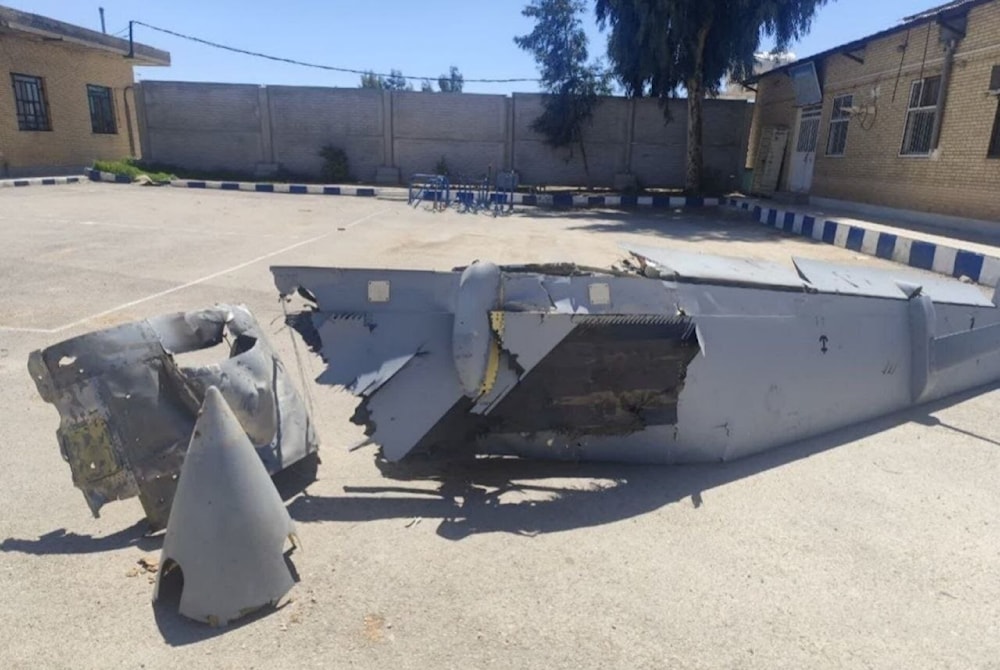
The remains of a Wing Loong II UAV shot down over Shiraz, Iran, April 3, 2026 (social media)
The Iranian armed forces had successfully shot down a drone over the city of Shiraz, Iran’s Foreign Ministry spokesperson, Esmail Baghaei, announced on Friday.
In a post on X, Baghaei asserted that the incident serves as “another (hard) evidence of direct participation & active complicity of some States of the region in US/Israel crime of aggression and war crimes against Iran.”
This drone was downed by our brave armed forces over beloved city of Hafiz and Saadi, Shiraz.
— Esmaeil Baqaei (@IRIMFA_SPOX) April 3, 2026
It could be another (hard) evidence of direct participation & active complicity of some States of the region in U.S./Israel crime of aggression and war crimes against Iran.… https://t.co/W25508hHT4
“Clarification is needed by either of the TWO STATES of the region that are the users of this drone!” he emphasized, without naming the states involved.
However, according to the monitoring platform Clash Report, this type of drone is operated by Saudi Arabia and the United Arab Emirates, not the United States.
BIG: Iran shot down a Chinese-made Wing Loong II drone near Shiraz.
— Clash Report (@clashreport) April 2, 2026
The drone is commonly used by Saudi Arabia and UAE, not the US.
If true, it suggests a Gulf state drone was operating over Iran, which would be a major escalation.
Source: @Osinttechnical pic.twitter.com/4H4OkDv4DR
Saudi Arabia spurs on US to attack Iran
Previously, Saudi Arabia has reportedly urged the United States to step up its war on Iran, according to a Saudi intelligence source cited by The Guardian. The source confirmed reporting by the New York Times that Riyadh views a US–Israeli aggression as an opportunity to reshape the regional balance of power.
Crown Prince Mohammad bin Salman is said to see the current war as a “historic opportunity” to limit Iran’s influence in the Middle East. Analysts suggest that while Saudi Arabia is not directly participating in the fighting, it is closely monitoring the situation and preparing for potential escalations.
The report notes that Riyadh has been responding to repeated Iranian drone strikes, including strikes on critical infrastructure such as oil refineries.
While some reports suggest encouragement of US strikes, Saudi officials have stressed that the kingdom is not acting impulsively. Their approach, according to analysts, balances readiness for escalation with ongoing diplomatic engagement to protect national interests.
The broader context indicates that Gulf states are navigating a complex regional war. While they publicly advocate stability and de-escalation, behind-the-scenes intelligence and diplomatic channels reveal a more nuanced posture toward the US-Iran confrontation.


