
Iran to US: Dialogue with respect, not threats, or firm response
 3 Min Read
Trump claims a US armada is heading toward Iran and urges talks under threat, as Tehran responds at the UN, warning Washington against military escalation.
-
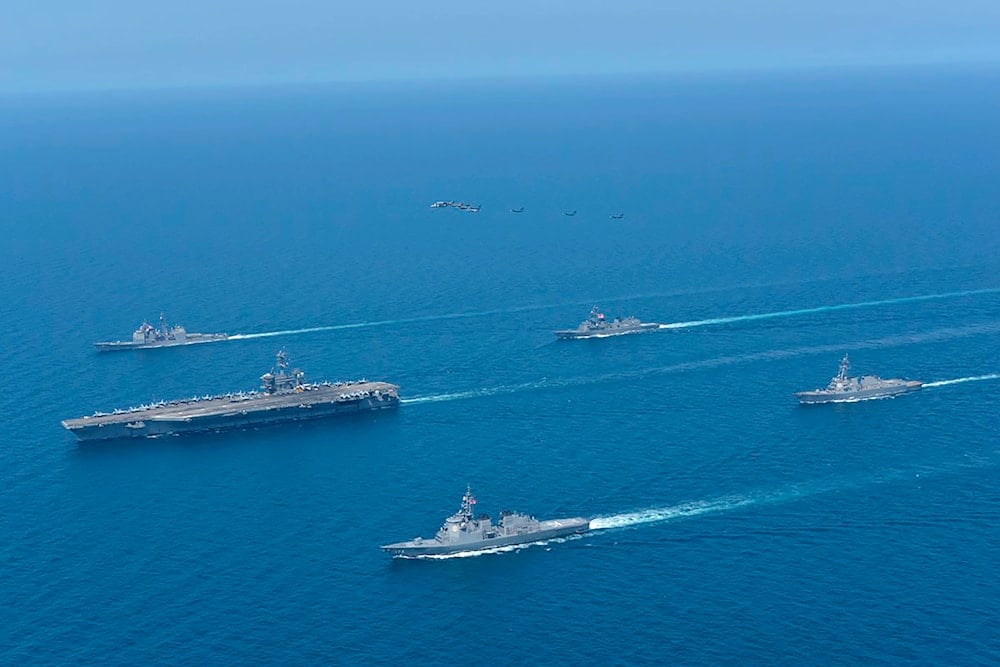
This photo shows USS Abraham Lincoln, left, and JS Kongo, front, sail in formation during a US-Japan bilateral exercise at the Sea of Japan on April 12, 2022.
Iran responded sharply through its mission to the United Nations to a threat made by US President Donald Trump, rejecting what it described as US intimidation while signaling conditional openness to diplomacy. In a statement, the Iranian Mission to the United Nations recalled past US military interventions in the region, saying Washington had “blundered into wars in Afghanistan and Iraq,” costing more than $7 trillion and resulting in the deaths of over 7,000 American troops.
The Iranian mission said Tehran “stands ready for dialogue based on mutual respect and interests,” but warned that if pressured militarily, Iran would defend itself. “If pushed, it will defend itself and respond like never before,” the statement said.
Last time the U.S. blundered into wars in Afghanistan and Iraq, it squandered over $7 trillion and lost more than 7,000 American lives.
— I.R.IRAN Mission to UN, NY (@Iran_UN) January 28, 2026
Iran stands ready for dialogue based on mutual respect and interests—BUT IF PUSHED, IT WILL DEFEND ITSELF AND RESPOND LIKE NEVER BEFORE! pic.twitter.com/k3fVEv1rus
Tehran has consistently rejected talks conducted under threat, insisting that any dialogue must be based on equality and mutual respect rather than coercion.
Trump threatens Iran
US President Donald Trump has issued a fresh warning to Iran, claiming that a large US naval force is moving toward the country and urging Tehran to accept negotiations on its nuclear program or face military consequences.
In a post published on Truth Social, Trump said a “massive armada” was heading toward Iran, describing it as larger than the fleet previously sent toward Venezuela and led by the aircraft carrier Abraham Lincoln. He claimed the force was “ready, willing, and able to rapidly fulfill its mission, with speed and violence, if necessary.”
Trump said he hoped Iran would “come to the table” to negotiate what he described as a “fair and equitable deal” that would include “no nuclear weapons,” warning that “time is running out.” He also referenced “Operation Midnight Hammer,” a prior US attack on Iran, and warned that any future strike would be “far worse.”
“The next attack will be far worse,” Trump wrote. “Don’t make that happen again.”
Escalating tensions
Trump’s remarks come amid reports that the USS Abraham Lincoln aircraft carrier strike group has entered the region, accompanied by F-15 and F-35 fighter jets, refueling tankers, and air defense systems. The deployment, viewed as a direct show of force, further escalates Washington’s aggressive posture toward Tehran.
According to Axios, the White House continues to threaten military action against Iran, while openly entertaining the possibility of regime change in Iran.
“They want to make a deal. I know so. They called on numerous occasions,” Trump claimed, without offering any confirmation from Iranian sources.
Trump’s comments reflect the contradictions in US rhetoric, combining threats of overwhelming military force with vague claims of diplomatic outreach.
US demands and military build-up reveal broader agenda
Washington's reported conditions for any agreement with Iran include:
- The removal of all enriched uranium,
- A cap on long-range missile stockpiles,
- An end to support for regional resistance movements,
- And a ban on independent uranium enrichment.
Tehran has repeatedly rejected such unilateral conditions, asserting its right to self-defense and sovereign policy-making.
US officials, meanwhile, continue to claim that Iran's nuclear sites were severely damaged during last year’s 12-Day War, a period in which Washington and “Israel" coordinated a preemptive attack against Iran.


