
Iran-US MoU officially finalized after Presidents' signature: Baghaei
 4 Min Read
Iranian Foreign Ministry spokesperson Esmail Baghaei says the Iran-US memorandum of understanding has been officially finalized following digital signatures by the presidents of both countries.
-
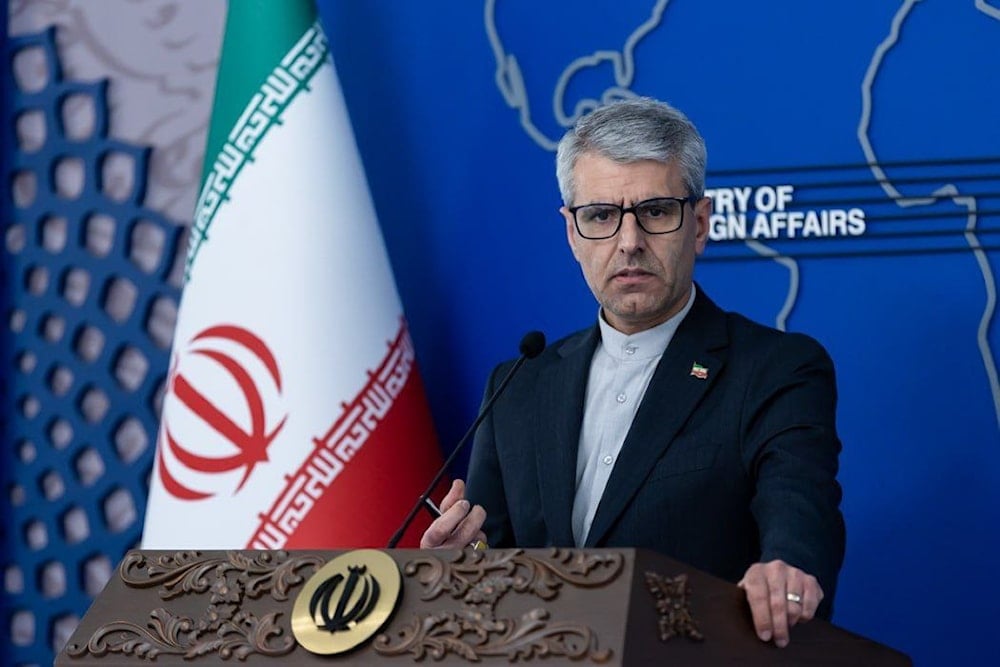
This undated photo shows Foreign Ministry spokesman Esmail Baghaei at a press conference. (Iran MFA)
Iranian Foreign Ministry spokesperson Esmail Baghaei announced that the memorandum of understanding between Iran and the United States has been officially finalized after being signed digitally by the presidents of both countries.
Speaking to reporters on Wednesday, Baghaei said the Islamabad Memorandum of Understanding had already been signed by the time of his remarks, adding that the two sides had agreed to complete the process electronically rather than through a formal ceremony.
"As I speak with you now, the text of the Islamabad memorandum of understanding has probably been signed by the presidents of Iran and the United States," Baghaei said at the start of the conference, later confirming that it was officially signed.
He explained that the agreement was signed digitally and that no signing ceremony would be held in Switzerland, although plans for negotiation teams to remain in Geneva were still in place. According to Baghaei, presidential signatures elevate the political weight of the agreement and increase the costs associated with any future violation.
"When the memorandum is signed by the presidents of the two countries, violating it will have a higher cost," he said.
The spokesperson added that the text had now been fully finalized and reflected all major issues that had been discussed throughout the negotiation process.
"The text of the Iran-US memorandum of understanding is now officially finalized because both parties have signed it," Baghaei said, adding that "there has been nothing left unsaid during this time."
Lebanon central to memorandum
Baghaei stressed that Lebanon remained a key component of the agreement, noting that references to the country appear multiple times in the first clause of the memorandum.
"The Islamic Republic of Iran has shown that it never leaves its friends alone under any circumstances," he said. "For us, a ceasefire and the end of the war in Lebanon were and remain as important as they are for Iran."
He added that the memorandum explicitly refers to respect for Lebanon's territorial integrity and national sovereignty. Addressing concerns over implementation, Baghaei said reaching an agreement did not mean Tehran had forgotten previous experiences with failed commitments.
"Signing a ceasefire agreement at this stage does not mean that we have forgotten the past or the costly lessons we have learned," he said.
"Our work is now harder than before because implementing international agreements is always much more difficult than drafting them, especially with parties that do not adhere to their commitments."
Baghaei said Iran's diplomatic team, backed by public support, had secured an agreement that protects the country's interests, while emphasizing the need to ensure the other side fulfills its obligations.
Talks addressed sanctions, assets and reconstruction
The foreign ministry spokesperson revealed that negotiations extended beyond the memorandum itself and included parallel discussions on several key economic issues.
"We did not only negotiate the memorandum," Baghaei said. "Simultaneously with the text, we separately negotiated the release of Iran's blocked assets, the discussion on damage reconstruction, and the lifting of oil sanctions."
The memorandum includes provisions related to sanctions relief, the release of frozen Iranian funds, and a broader framework for economic reconstruction and development.
Continued Israeli attacks would violate US commitments
Commenting on Lebanon, Baghaei warned that continued Israeli military aggression would be viewed as a breach of the commitments undertaken by Washington under the agreement.
"If the Zionist regime's aggressions against Lebanon continue, it will be a violation of the counterpart's commitments in the agreement," he said.
Baghaei noted that while Iran recognizes differences between the United States and the Israeli regime in terms of methods and approaches, Washington bears responsibility for ensuring compliance with the commitments outlined in the memorandum.
"The Zionist regime does not want to give the slightest opportunity to any diplomatic process," he said, adding, "However, it is the responsibility of the US to force the Zionist regime to respect the US commitments to Iran in this document."


