
Iran warns US: ‘You have tested us, do not test us again’
 3 Min Read
Iran’s Armed Forces warn regional states against enabling US aggression, saying Tehran will target the source of any aggression.
-
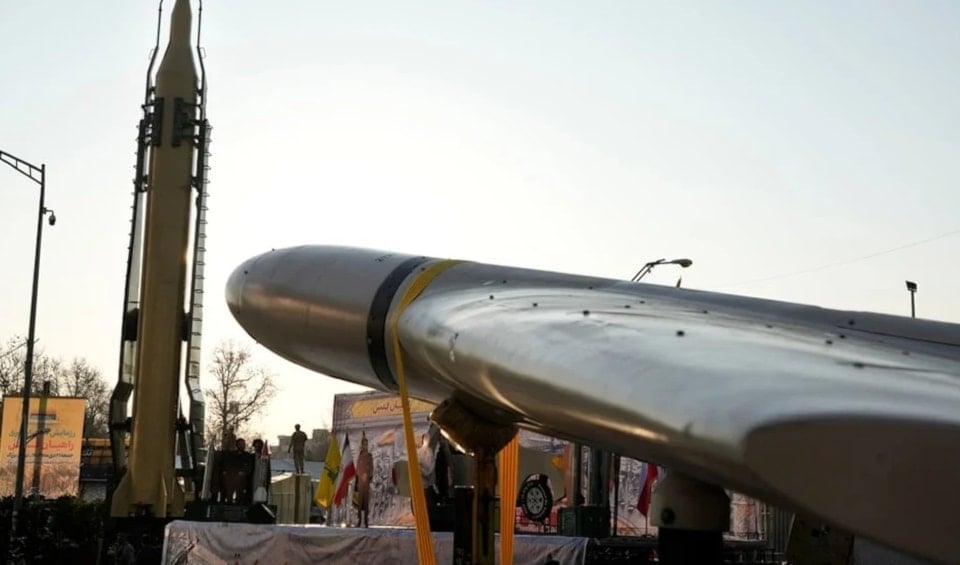
Iranian domestically built missiles and drones are displayed during the Basij paramilitary force parade in Tehran, Iran, January 10, 2025 (AP)
A joint statement issued Monday by the General Staff of the Iranian Armed Forces and the Central Khatam al-Anbiya Headquarters warned that Iran would not tolerate any aggression, saying it would respond with a much heavier response, while stressing that Tehran respects the national sovereignty of neighboring countries.
The statement noted that some regional countries have officially pledged not to allow their territory, airspace, or coastal waters to be used by the US military to launch any aggression against Iran. However, it said the US military continues to use the territory and airspace of those countries for attacks against Iran despite previous warnings.
US forces have no choice but to leave the region
Addressing countries that facilitate US aggression against Iran, the statement warned that the Iranian Armed Forces would “overwhelmingly target the source of any aggression.”
“We warn you, you have repeatedly tested the strong resolve of our armed forces and our brave and steadfast people, so do not test it again,” the statement stressed.
It further emphasized that “the aggressor US military has no choice but to leave the region.”
The warning came as Iranian military officials continued to signal that Tehran’s response to any further US action would be forceful, while leaving the door open to a course aimed at deterrence rather than renewed escalation.
Iran’s Naqdi: US won’t risk another war if it acts rationally- Excl.
In an interview for Al Mayadeen, Brigadier General Mohammad Reza Naqdi, Senior Advisor to the Commander-in-Chief of the IRGC, said Monday that the United States would not enter another war with Tehran if Washington sought to make a “rational decision” in line with its interests.
Naqdi said most commanders currently in Tehran favor an offensive military doctrine, which is “very interesting, feasible, and highly effective operationally.”
Naqdi attributed the halt in the war to Washington’s inability to continue, the losses it had sustained, and the strikes it had come under.
Iran’s immediate priority
Asked about Iran’s immediate priority, Naqdi said, “Our priority is neither war nor negotiations; the issue is to reach deterrence.”
“We were certain and confident of victory, but we did not expect victory to be achieved this easily,” he said, adding, “Even if they built a concrete wall around Iran and stationed guards along it, Iran would remain steadfast and strong.”
Iran’s advantage and weapons capabilities
Elsewhere in his remarks, Naqdi said Iran’s key advantage in the war was its ability to manufacture all of its weapons domestically.
He said Iran’s facilities had been rebuilt in highly secure locations and were operating with modern and advanced technologies, while achieving higher production rates.
He also said Tehran has hundreds of cities and industrial complexes, as well as the ability to conceal and disperse its production through various methods, both underground and above ground.
Furthermore, Naqdi said the air defenses of Iran’s adversaries had collapsed under the intensity of the Islamic Republic’s drone and missile attacks, adding that even Iran’s older weapons had proven effective against them.


