
Iran warns US over new missiles, broader Gulf maritime response
 3 Min Read
Iran says Washington received a clear warning from its new missiles as Tehran signals a revised military posture toward US ships and bases.
-
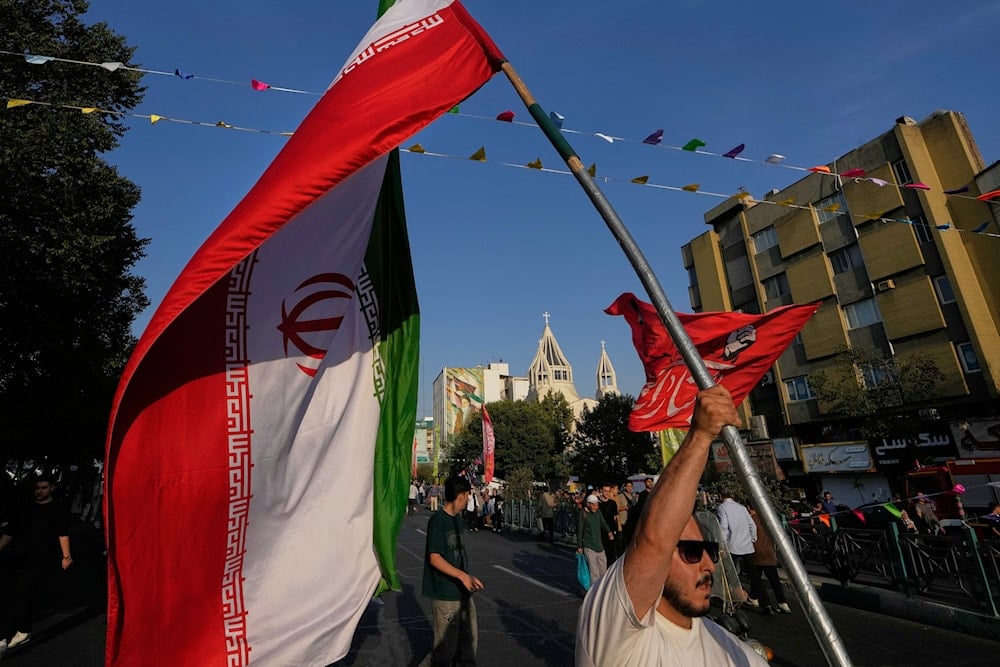
A man holds an Iranian flag during a street celebration marking Prophet Muhammad's birthday, with St. Sarkis Armenian Cathedral in the background, in Tehran, Sunday, Aug. 30, 2026 (AP)
Iran has issued a fresh warning to Washington over its newly developed missiles, with the secretary of the Supreme National Security Council, Mohsen Rezaei, saying Tehran has fundamentally reassessed its operational posture toward US military vessels and bases.
Rezaei said Washington had received a "clear warning" through Iran's new missiles, amid escalating tensions and military confrontations between Tehran and the US in and around the Persian Gulf.
He added that Iran would respond to economic warfare by establishing a maritime exclusion zone extending across the Gulf toward the area of the blockade.
The Iranian official said Tehran had also undertaken a fundamental review of its operational approach toward US ships and military bases, signaling an expansion of Iran's military and maritime response.
'Strike our assets and you get struck'
Iranian Parliament Speaker Mohammad Bagher Ghalibaf warned Washington on Monday that any attack on Iranian assets would draw retaliation, responding directly to a threat from US War Secretary Pete Hegseth to sink Iran's oil tankers.
Hegseth said on Saturday that the US Navy would destroy and sink Iranian oil tankers if Iran fired on US ships, claiming that Iran's tanker fleet was defenseless since Iran has no navy or air force, and that US aircraft, ships, and submarines under CENTCOM and USPACOM could strike them all.
Ghalibaf replied in a post on X that the region's oil and gas production chain "is sprawling, accessible, and exposed," noting that US oil and gas companies operating in the same waters and facilities share that exposure.
"Strike our assets and you get struck," he said. "We've already proven it. Ask the bases that are no longer viable."
Taeb says enemy has failed to honor its commitments
Earlier on Monday, Sheikh Hossein Taeb, head of Iran's Basij Organization, said the enemy had failed to honor its commitments, noting that funds owed to Iran had not been transferred, its control over the Strait of Hormuz had not been recognized, and threats against the country were continuing.
Taeb stressed that Iran would base its decisions on concrete action, not promises, and called for every commitment to be fulfilled in a manner that guarantees the rights of the Iranian people.
He said the enemy could not disregard its commitments, issue threats, and then expect Iran to relinquish its rights, adding that the Iranian people would accept neither threats nor dictates nor negotiations that erode their country's rights.
"The strength of the Islamic Republic of Iran rests on the convergence of three elements: the blood of the martyrs, wise leadership, and the will of a people who refuse to surrender," Taeb said, adding that this strength had reshaped regional and global equations and that no great power could impose its will on the Iranian people.


