
Iranian unmanned speed boats pose challenge to US Navy in Hormuz
 3 Min Read
Iran’s fleet of fast attack boats constitutes a challenge the US Navy in the Strait of Hormuz, highlighting Tehran’s asymmetric naval warfare strategy.
-
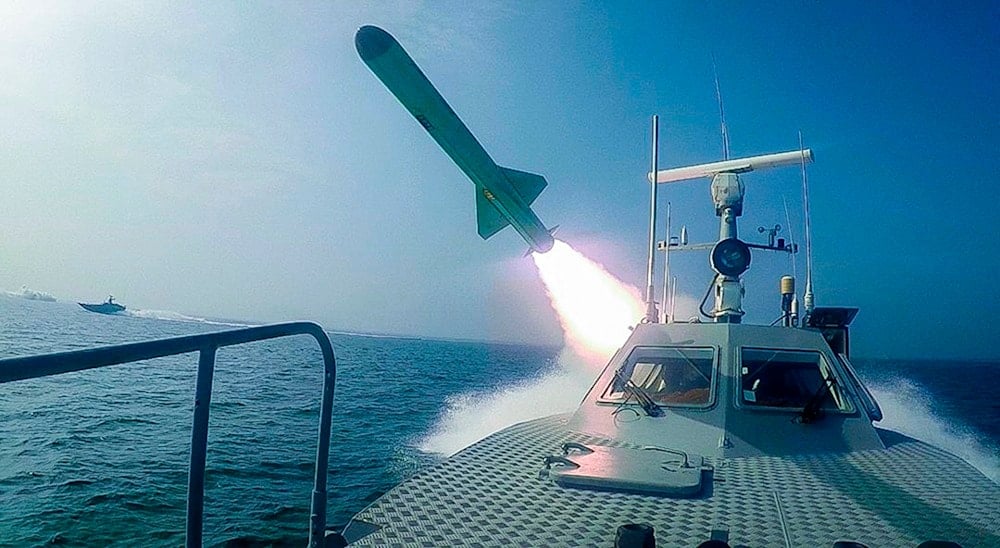
In this photo released Tuesday, July 28, 2020, an Islamic Revolution Guard Corps speed boat fires a missile during a military exercise (AP)
Iran’s fleet of small, fast attack boats remains a stubborn military challenge for the US Navy, capable of harassing US warships and targeting commercial shipping despite US and Israeli airstrikes that allegedly destroyed many of Tehran’s larger vessels, military officials and experts said.
While US airstrikes destroyed many of Iran’s larger warships early in the US-Israeli aggression, Iran retains a significant number of smaller craft, according to military officials. Those vessels can be armed with shoulder-fired missiles and machine guns or used to deploy naval mines.
Iran deployed such craft in its recent retaliatory attack on US guided-missile destroyers in the Strait of Hormuz, US Central Command said. At least one frigate was hit by fire from a speedboat, officials said. On Monday, US military helicopters destroyed six Iranian boats during an operation in the Strait, Central Command added.
Military experts estimated that Iran possessed hundreds of speedboats before the war. As of April, roughly 60% of those boats remained intact, according to one military analyst.
Like Iran’s one-way attack drones, the small boats are central to Tehran’s doctrine of asymmetric warfare, which relies on cheaper, more expendable systems to challenge a technologically superior adversary.
Iran's unmanned vehicle doctrine goes to sea
Iran’s fast-attack “mosquito fleet,” operated by the Islamic Revolution Guard Corps Navy, consists of small, high-speed vessels designed for swarm tactics in the narrow Strait of Hormuz. The boats can reach speeds up to 60 knots (110 km/h), making them difficult to track and intercept.
Key models include the Tondar-class, armed with four Noor or Ghader anti-ship missiles with ranges of 120 kilometers, and the mass-produced Peykaap-class, derived from North Korean designs delivered in 2002. The Peykaap carries two anti-ship missile launchers and has a crew of just three.
The Seraj-class, capable of 75 knots, is armed with 107-millimeter rocket launchers and heavy machine guns. The Zolfaghar-class, a 17-meter hybrid vessel that entered service in 2015, can submerge for up to five minutes to evade radar and carries two 324-millimeter torpedoes.
Iran has also deployed unmanned explosive drone boats. On March 1, 2026, a crude oil tanker off the coast of Oman was hit by a naval drone, killing one crew member, days before another tanker near Iraq’s Khor al Zubair port suffered a similar attack.
The boats operate from hidden coastal bases and can be rapidly reconfigured from patrol to offensive missions, frequently laying naval mines. Iran maintains an estimated stockpile of 5,000 to 6,000 mines, and footage released by Iranian state media in March 2026 showed underground facilities packed with suicide drone boats, anti-ship missiles, and mines ready for deployment.


