
Iraq authorizes PMF and armed forces to exercise self-defense amid esc
 3 Min Read
Iraq authorizes PMF and armed forces to respond to attacks, files complaint to the UN Security Council, and reinforces sovereignty amid escalating regional tensions.
-
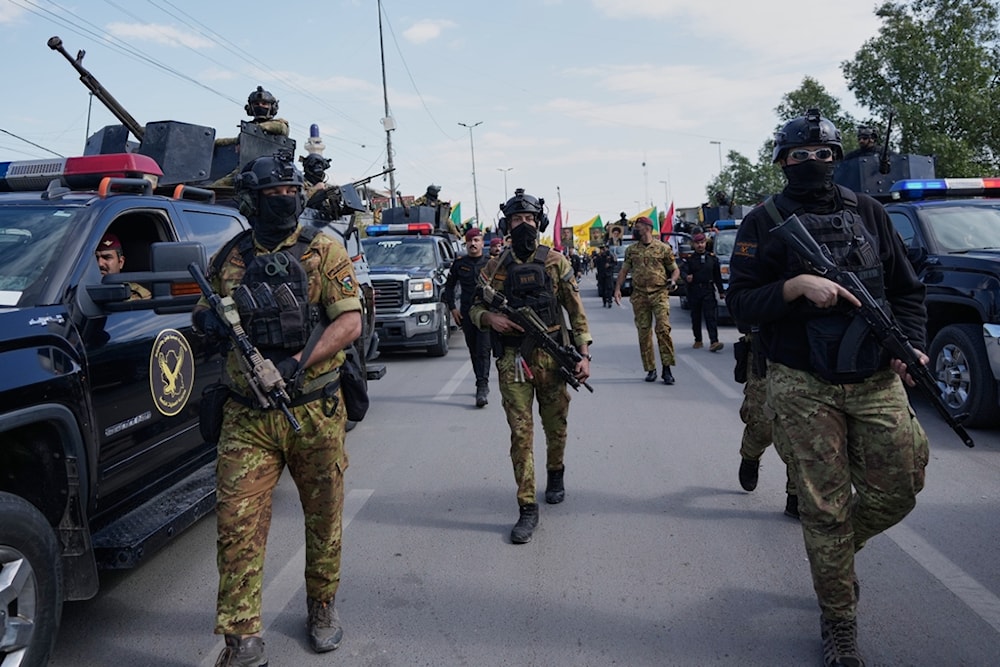
Members from the Popular Mobilization Forces attend the funeral of fighters from Kataib Hezbollah, who were killed in a U.S. airstrike in Babil province southwest of Baghdad, Iraq, Thursday, March 5, 2026 (AP Photo/Hadi Mizban)
Iraqi Prime Minister Mohammed Shia' Al-Sudani chaired an emergency session of the Ministerial Council for National Security on Tuesday to assess the repercussions of the ongoing escalation in the region due to the US-Israeli war on Iran, and its impact on Iraq’s sovereignty.
In a significant development, the council authorized the Popular Mobilization Forces (PMF) and other security agencies to act under the principle of the right to respond and self-defense against military attacks targeting their positions.
The decision affirmed that Iraq’s armed forces, across all formations, are entitled to respond using all available means to counter serious violations of national sovereignty.
The meeting emphasized that security institutions continue to perform their duties in maintaining stability in accordance with the constitution and the law. It underscored that the PMF represents a key pillar of Iraq’s national security framework, stressing the importance of protecting its personnel while ensuring full adherence to legal boundaries.
Read more: Iraq’s top officials congratulate Sayyed Mojtaba Khamenei on election
Diplomatic escalation and UN complaint
On the diplomatic front, the council directed the Ministry of Foreign Affairs to submit a formal complaint to the United Nations Security Council, calling for condemnation of the attacks and immediate measures to halt them.
The government also decided to summon the US chargé d’affaires and the Iranian ambassador to deliver official protest notes following attacks targeting PMF positions in Anbar and Kurdistan Region guard headquarters in Erbil.
The council stressed that the Iraqi state, through its constitutional institutions, retains exclusive authority over decisions of war and peace. It warned that any party or individual attempting to undermine this authority will face strict legal consequences.
Security leadership was also instructed to pursue those responsible for attacks on diplomatic missions and state institutions, emphasizing that “no one is above the law.”
Read more: Six Peshmerga killed, 22 injured in attack on Erbil headquarters
Ongoing attacks and regional tensions
The Islamic resistance in Iraq continues its operations against "enemy bases in Iraq and the region, in adherence to religious duty and in retribution for the blood of the martyr leader Ali al-Husseini Khamenei."
Meanwhile, the US-"Israel" aggression continues to target PMF positions in Iraq, resulting in casualties, including among senior figures.
Allowing the Iraqi resistance to join the national army fully opens up the Iraq front against US bases and interests in its land, allowing all the factions to join the fight against the US-Israeli coalition alongside Iran and Lebanon's Hezbollah.
Read more: Iraq accelerates withdrawal of US-led coalition forces


