
IRGC chief vows justice for victims of US attack on Iranian wedding
 5 Min Read
Iran’s IRGC chief Ahmad Vahidi vows that those responsible for a deadly US attack on a wedding ceremony in Sirik will face consequences.
-
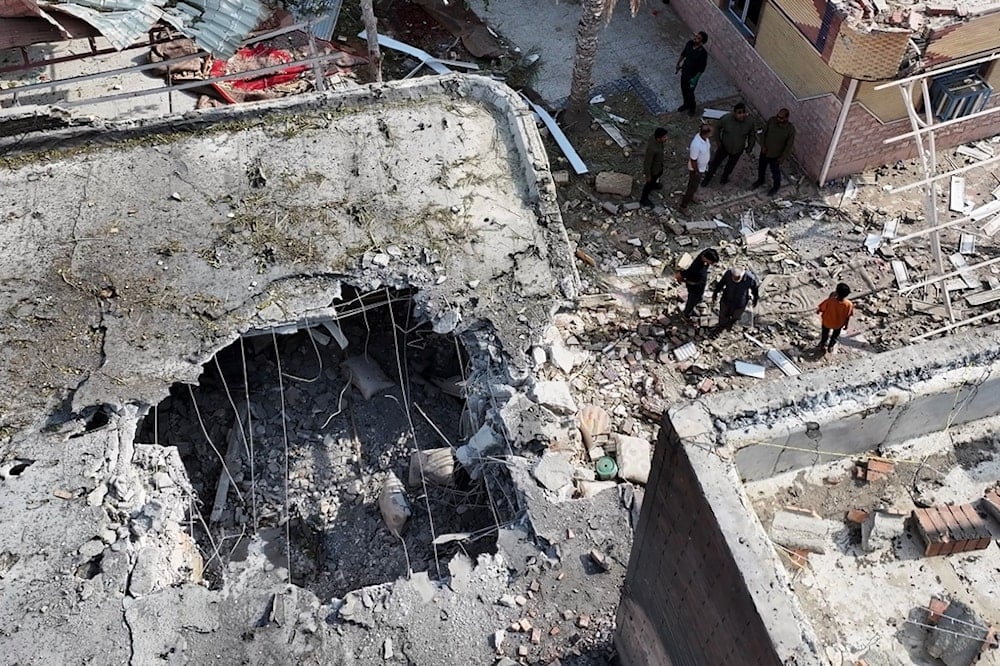
People inspect damage and debris at a building hit by a US attack while a wedding celebration was taking place there, in Kuhestak, southern Iran, Wednesday, Sept. 2, 2026. (Morteza Akhoondi/Tasnim News Agency)
Iranian Islamic Revolution Guard Corps (IRGC) Commander Major General Ahmad Vahidi has vowed that the deaths of victims martyred in the US attack on a wedding ceremony in Iran will not go unanswered, stressing that the IRGC and Iran's armed forces will continue protecting the country's security.
In a message to the families of those martyred in the attack, Vahidi said the incident had once again exposed "the malicious and satanic face of America in a terrorist and inhumane act."
Vahidi said that the attack on the wedding ceremony and the targeting of innocent civilians was "a terrorist and inhumane act," saying the "horrific" crime demonstrated "the depth of the hostility of the enemies of the Revolution and the Islamic system and their deep-rooted hatred."
He added that the attack also demonstrated their "inability and incapacity to confront the greatness of the steadfastness of the people of this land and their iron will."
US forces stationed at bases in Kuwait reportedly struck a residential house in Sirik while a wedding ceremony was taking place, killing four people, including a child, and injuring nearly 70 others.
Read more: US attack on wedding in Iran leaves four martyred, including children
'The blood of the martyrs will not be in vain'
Vahidi stressed that the blood of those killed "will never be in vain," adding that it would reach those responsible for the attack and those who ordered it "without the slightest doubt."
He also stressed that the IRGC and Iran's armed forces are "the protectors of the sanctity of the blood of our dear ones and all the martyrs of Iran."
The IRGC commander said the Corps and Iran's other armed forces would continue, "with all their strength and steadfastness," to protect the security of the Iranian people and the country.
The IRGC said US forces had directly targeted around 70 people during the wedding ceremony, stating that the attack is a war crime.
IRGC retaliated on the same night
Addressing the response to the attack, the IRGC said it had retaliated against the attackers on the same night, using its capabilities to eliminate personnel affiliated with the US Central Command, CENTCOM.
The IRGC also warned the American people that they should stand against their military to avoid "the day of revenge of the oppressed."
On Wednesday, the IRGC announced that it had launched a missile and drone attack targeting the headquarters and residence of the US commander at Ali Al Salem Air Base in Kuwait, saying the operation killed several enemy personnel.
A history of US attacks on wedding ceremonies
The IRGC accused the United States of a longstanding pattern of attacks on wedding gatherings, saying the latest attack in Kuhestak, Sirik, was not an isolated incident. In its statement, the IRGC cited a series of attacks in Afghanistan, Iraq, Yemen, and Iran, including a 2002 bombing of a wedding in Afghanistan that killed more than 100 people, a 2004 strike in Iraq that killed 42, and a 2008 attack in Afghanistan that killed 47 people, including the bride.
It also pointed to a November 2008 wedding bombing in Afghanistan that killed 37 people, including 23 children, a 2012 attack in Logar Province that killed 18 people, including nine children, and a 2015 bombing of a wedding in Yemen that killed 131 women and children.
The IRGC said the September 1 attack in Kuhestak followed the same pattern, accusing US Central Command (CENTCOM) of directly striking a wedding gathering involving a family from Kuhestak in Sirik County. According to the IRGC, around 70 people were targeted, with four killed and seven of the wounded reportedly in critical condition.
The attack drew reactions from the public, international media, prominent figures, and some US media outlets, after which the IRGC said US military and government officials attempted to deny that the attack had deliberately targeted civilians.
The Iranian force rejected those denials, accusing US leaders of having “once again resorted to lies instead of apologizing” and demanding that Washington answer to the international public over what it called a “dark record” of attacks on weddings. The IRGC questioned whether the incidents it listed could all be dismissed as accidental mistakes, arguing that the repeated attacks demonstrated a broader pattern of aggression against civilians.
The IRGC also linked the latest attack to its wider confrontation with US forces, saying it had already carried out a retaliatory operation against CENTCOM personnel. It later announced a missile strike on a US Marine Corps facility at Camp Titin in Jordan, stating that the attack killed a large number of US forces and destroyed military facilities and attack helicopters. The force warned of further consequences as US aggression and Iranian retaliation continued to expand across the region.


