
IRGC on Imam Khomeini's anniversary: Enemies must accept our rules
 3 Min Read
The IRGC says the “enemy must accept Iran’s new rules” in a statement marking the anniversary of Imam Khomeini's death.
-
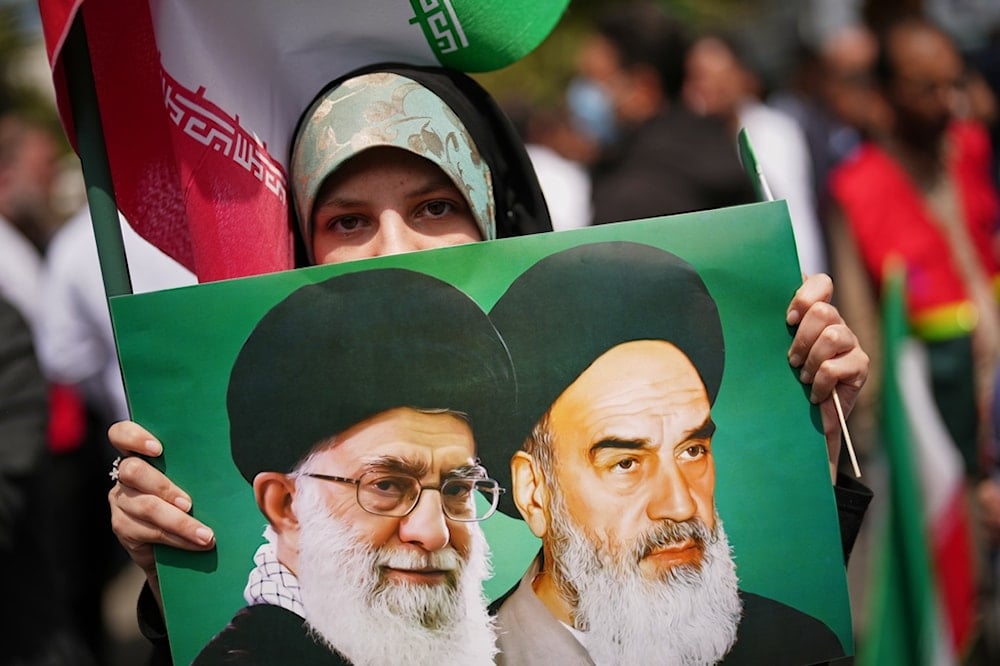
A woman holds a picture depicting Sayyed Ali Khamenei and Sayyed Ruhollah Khomeini during a government-sponsored protest attended by medical workers outside Imam Khomeini Hospital in Tehran, Iran, Monday, April 6, 2026. (AP)
The "enemy is compelled to accept Iran’s new rules,” the Islamic Revolution Guard Corps (IRGC) declared in a statement issued on the anniversary of the death of Imam Khomeini and the June 5 uprising, outlining its positions on domestic mobilization, regional strategy, and maritime security.
Showing support for the people, the IRGC said popular participation in the streets acts as both a support for the battlefield and “a bastion of diplomacy,” adding that it is a “necessary factor” in achieving a “complete and final victory.”
Iranians “will never submit” to fabricated narratives or false achievements attributed to adversaries, the statement affirmed.
Iran maintains control of Strait of Hormuz
The IRGC also stated that its adversaries are “compelled to accept the new rules” imposed by Iran and its armed forces, particularly in relation to the “intelligent management and control of the Strait of Hormuz.”
Yesterday, following months-long talks between the United States and Iran, Donald Trump admitted that an agreement with Iran could be "even better than a military victory," expressing optimism that a deal to extend the ceasefire and reopen the Strait of Hormuz could be reached within the next week.
Since the beginning of the war on Iran, the Islamic Republic has effectively utilized its geographic leverage and imposed full control on the world's most strategic waterway.
Just recently, Kazem Gharibabadi, Iran’s Deputy Foreign Minister for Legal and International Affairs, announced that Iran introduced new maritime regulations for the Strait of Hormuz, asserting that only Iran and Oman have the right to exercise sovereignty over its territorial waters.
Gharibabadi told Iranian state television that the new navigation rules are being implemented under wartime conditions and that Tehran will not allow any foreign interference.
Iran's principles reiterated
Reaffirming its broader regional outlook, the IRGC said resistance would continue until the “complete dismantling of the schemes of arrogance,” the expulsion of foreign forces from West Asia, and the realization of the liberation of al-Quds through the destruction of "Israel"
The statement stressed that these objectives are enduring principles guiding Iran’s resistance doctrine and regional posture.
Iran’s regional position has been reshaped by years of confrontation involving the United States, "Israel", and allied movements across West Asia. Rather than "weakening its influence," as adversaries claimed, these battles have shifted it toward a more direct form of deterrence, increasingly defining the balance of power.
The Islamic Republic has been unrelenting in its protection of regional countries currently confronting the US-Israeli aggression, particularly demonstrated in its continued closure of the Strait of Hormuz until the Israeli war on Lebanon and all other fronts is halted.
Two days ago, Iran halted the exchange of messages with the United States over the Israeli aggression on Lebanon and threats targeting Beirut and its Southern Suburb.


