
IRGC says it destroyed US bases in Jordan, Bahrain
 5 Min Read
The IRGC announced strikes on US military facilities in Jordan and Bahrain, saying the operations caused damage to aircraft facilities, command centers, radar systems, and fuel sites.
-
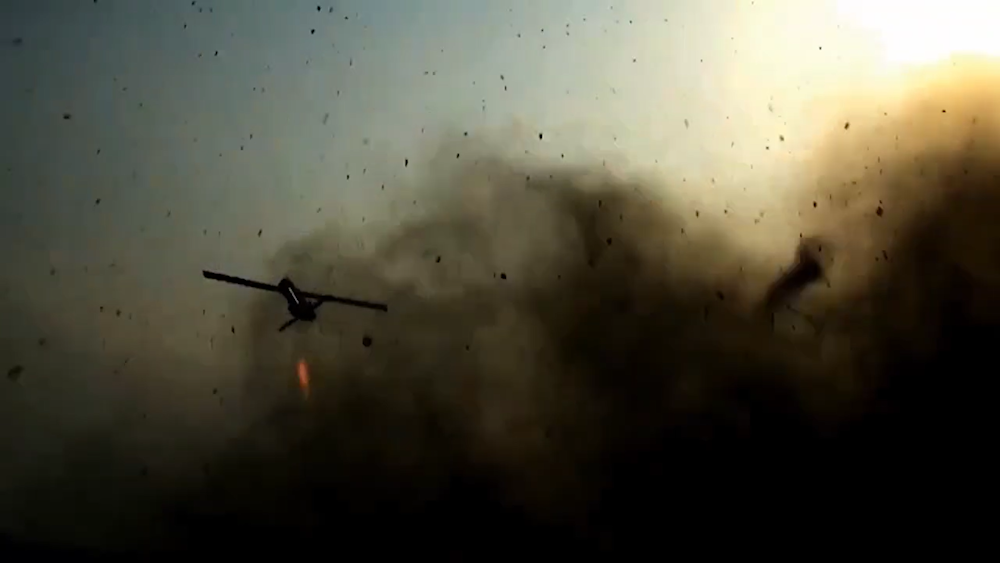
Screengrab from the third wave of Operation Nasr 2 showcasing drone strikes carried out by the naval forces of the Islamic Revolution Guard Corps, posted on July 14, 2026 (IRIB news)
Iran's Islamic Revolution Guard Corps (IRGC) announced on Thursday that fighters from its Aerospace Force had destroyed a hangar housing US fighter jets, in addition to a new US command and control center in West Asia.
In a military statement, the IRGC said the precision strike targeted a very large US military base in the Azraq area of Jordan, adding that the operation was successfully carried out using advanced Kheibar-Shekan ballistic missiles.
In a direct message to the Jordanian public, the IRGC addressed Jordanians, saying, "O proud people of Jordan, you are among those who have witnessed firsthand the crimes of America and the Zionists more than any other people".
The IRGC called on the Jordanian public to prevent their country from being used in aggression, adding, "Do not allow the use of the sacred land of Jordan, which is the birthplace of the footsteps of the prophets, to commit these crimes against children".
"Strike American interests with all your might and cleanse your land from the defilement of the American occupiers".
IRGC strike on US base in Bahrain
Additionally, the IRGC announced that its naval forces targeted the US base at Sheikh Isa in Bahrain, stating that the operation led to the destruction of air surveillance and detection radar systems, as well as a fuel storage and pumping station for fighter aircraft.
In a statement, the IRGC said the strike was carried out during the 10th wave of Operation True Nasr 2, saying that it came as a response to US attacks on coastal bases and civilian sites, including a children's cancer hospital and a water production facility "made to serve visitors of Karbala" in Iran's Ilam Province.
The IRGC added that the operation remains ongoing.
IRGC targets US military facilities in Kuwait
Earlier on Wednesday, the IRGC announced that it had targeted US bases in Kuwait.
The IRGC also addressed the Kuwaiti people, stressing that Tehran does not hold any hostility toward them, but rather respects them for their honor and dignity.
The group said the operation was a response to US crimes, stating that the United States launched a war more than four months ago after targeting the martyred Leader of Iran, Sayyed Ali Khamenei.
The IRGC stated that "the source of many attacks in this war is the bases of the occupying US forces located on the sacred land of Kuwait," adding that it expected the Kuwaiti people not to miss any opportunity to "destroy the aggressive American institutions and liberate Islamic lands from the bases of the occupiers."
During the night and early hours of Wednesday into Thursday, the United States carried out several attacks targeting Bandar Abbas port, the cities of Rask and Konarak in Iran's Sistan and Baluchestan Province, areas in Ahvaz, and locations around Qeshm Island.
The US aggression against areas in southern Iran has continued for days, while Iran has responded by targeting US bases, facilities, and strategic positions across the region.
Read more: IRGC says targeting US military infrastructure in region
Operations target US military infrastructure
The IRGC said its ongoing military operations are focused on destroying US offensive infrastructure across the region, while the Iranian army reaffirmed that the Strait of Hormuz will remain closed until Tehran's conditions are met.
IRGC spokesperson Hossein Mohebi warned Washington against assuming it could maintain the current war or turn it into a prolonged war of attrition. "The enemy should not think that it is capable of continuing the current equation of the fighting and turning the war into a war of attrition," he said.
Iranian army spokesperson Brigadier General Mohammad Akrami Nia said the strategic waterway will remain closed until its management is placed under Iranian authority. He added that reopening the strait depends on the United States ending hostile actions, complying with the terms of the memorandum of understanding, and recognizing Iranian laws governing the waterway.
The statements come as the United States continues attacks on ports and other locations across southern Iran, while Tehran responds by targeting US military bases, facilities, and strategic positions in the region. Iran has reclosed the Strait of Hormuz following US military movements in the area and President Donald Trump's decision to reimpose a naval blockade, with Trump saying US attacks will continue until he decides "that's enough".
Iranian chief negotiator Mohammad Bagher Ghalibaf said Tehran is engaged in an existential war with the United States, saying that Washington's objectives extend beyond changing Iran's government and include weakening the country itself. "We have never welcomed war, and we never will," Ghalibaf said, while stressing that Iran must remain prepared to defend its national security and interests.
Ghalibaf added that diplomacy remains an option alongside military readiness, saying Iran's approach to both war and negotiations must be based on national interests, security, and long-term considerations.
Meanwhile, Iranian Foreign Ministry spokesperson Esmaeil Baghaei said Tehran has suspended parts of its commitments after Washington failed to uphold its obligations, adding that Iran currently has "no agenda for negotiations" and is focused entirely on defense.


