
Israeli backlash as Trump announces Lebanon ceasefire
 4 Min Read
Israeli media report backlash and confusion after Trump announced a ceasefire in Lebanon, with officials citing lack of cabinet approval and rising anger.
-
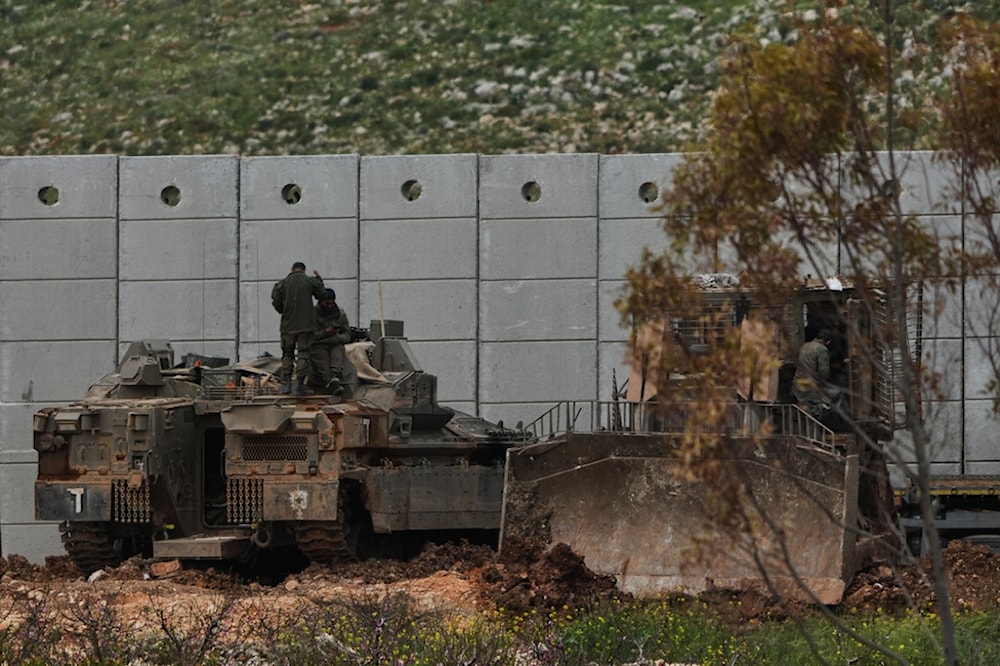
Israeli soldiers are seen along the Lebanese-Palestinian border area in northern occupied Palestine, Sunday, April 12, 2026 (AP)
Israeli media outlets reported widespread political backlash and confusion after US President Donald Trump announced a ceasefire in Lebanon, with criticism directed at both the process and its implications.
According to Israeli public broadcaster Kan, it was “notable” that the ceasefire was announced by the US president rather than Israeli officials.
Reports indicated that Israeli ministers were drawn into urgent consultations following Trump’s announcement, with discussions reportedly taking place via standard calls rather than formal channels.
Israeli daily Israel Hayom said Prime Minister Benjamin Netanyahu had failed to secure cabinet approval for the ceasefire a day earlier, suggesting Trump’s intervention helped push the move forward.
Meanwhile, Channel 13 reported that no formal cabinet vote had taken place, adding that Netanyahu told ministers the move came at Trump’s request.
Several Israeli outlets framed the ceasefire as a strategic setback, with Israel Hayom arguing that the move reinforces what it described as “Iranian protection” in the region and weakens previous Israeli achievements.
Political backlash inside "Israel"
i24NEWS reported that Iran had effectively succeeded in imposing a ceasefire in Lebanon through its understandings with the United States, reflecting broader regional dynamics.
Criticism also emerged from Israeli political figures, with Knesset member Hili Tropper stating that Israelis learned of the ceasefire through Trump’s post rather than through official government communication.
“Israelis received news of the ceasefire via Trump’s tweet, not from the cabinet or Netanyahu,” he said, criticizing what he described as a lack of transparency from leadership.
According to Channel 12, anger has grown in northern settlements over the ceasefire agreement.
The head of the Margaliot settlement, Eitan Davidi, described the development as “not a victory,” adding that it represents “shame and complete surrender to Iran and the United States.”
Trump announces ceasefire in Lebanon
Trump announced that a 10-day ceasefire in Lebanon is set to begin at 5:00 p.m. Eastern Time (12 a.m. Beirut time) on Thursday, following talks with Lebanese and Israeli officials.
In a post on Truth Social, Trump said he held discussions with Lebanese President Joseph Aoun and Israeli Prime Minister Benjamin Netanyahu, stating that both sides agreed to initiate a temporary truce.
"I just had excellent conversations with the Highly Respected President Joseph Aoun, of Lebanon, and Prime Minister Bibi Netanyahu, of Israel. These two Leaders have agreed that in order to achieve PEACE between their Countries, they will formally begin a 10 Day CEASEFIRE at 5 P.M. EST," Trump wrote.
Iran’s Hormuz Leverage, Not US Mediation, Drove Ceasefire Terms
The narrative promoted by Donald Trump that the Lebanon ceasefire emerged primarily from US-led mediation obscures the decisive role of Iran’s coercive leverage over the Strait of Hormuz, which Tehran explicitly tied to any de-escalation outcome.
Iranian pressure was central to pushing the ceasefire forward, not secondary to diplomacy, with officials indicating sustained follow-ups that forced movement toward a truce. At the same time, Iranian positions made clear that ceasefire conditions were inseparable from Hormuz: Tehran had already suspended or threatened maritime traffic in response to Israeli attacks on Lebanon under a “ceasefire for all or none” framework, directly linking regional calm to the security of the waterway.
More explicitly, Iranian officials reiterated that their ceasefire conditions were “clearly stated,” including demands tied to broader strategic guarantees and the status of Hormuz, rejecting any notion of unconditional de-escalation.


