
Jared Kushner: Face of US oligarchy or product of the system?
 8 Min Read
A critical reading of Foreign Policy argues that Jared Kushner's role in Ukraine diplomacy reflects not a new oligarchic distortion of US foreign policy, but a broader system where concentrated wealth, NATO expansion and longstanding imperial power structures shape Washington’s decisions.
-
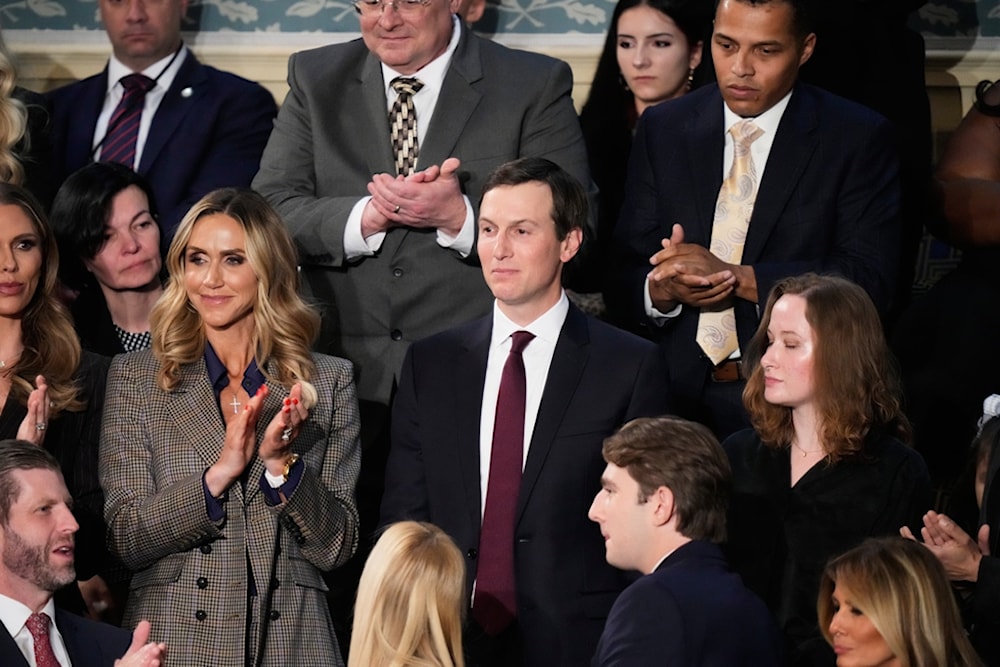
Jared Kushner listens to President Donald Trump's State of the Union address to a joint session of Congress in the House chamber at the U.S. Capitol in Washington, Tuesday, Feb. 24, 2026 (AP)
Jared Kushner’s increasingly prominent role in US diplomacy has prompted Foreign Policy to present the billionaire son-in-law of US President Donald Trump as the face of an emerging American oligarchy, pointing particularly to his involvement in negotiations over Ukraine.
But while Casey Michel, head of the Human Rights Foundation’s Combating Kleptocracy Program, raises questions about an unelected billionaire exercising substantial influence over matters of war and peace, his analysis risks treating Kushner as an exceptional intrusion of private wealth into US foreign policy rather than a highly visible product of structures that have long allowed economic power to translate into political influence.
Michel centers his argument on Kushner’s involvement alongside US envoy Steve Witkoff in efforts to negotiate a settlement between Moscow and Kiev in late 2025.
During a November phone call with Ukrainian President Volodymyr Zelensky, Kushner reportedly outlined conditions that included restrictions on Ukraine’s military capabilities, abandoning Kiev’s ambitions to join NATO, eventually easing sanctions on Russia and recognizing Russian control over Crimea and the Donbas.
Some territorial provisions reportedly concerned areas Russian forces had not seized.
Foreign Policy depicts these terms as sweeping concessions corresponding to longstanding Russian demands. That description, however, largely detaches Moscow’s position from the wider security confrontation surrounding NATO’s expansion and Ukraine’s increasing integration into Western military structures.
Russian proposals reportedly entered US framework
Questions over the origins of the proposed settlement intensified after journalists Christo Grozev and Michael Weiss reported that significant elements resembled an earlier document prepared by Russian officials.
Kushner and Witkoff met sanctioned Russian official Kirill Dmitriev in Miami in October 2025 for several days of “intensive discussions” concerning a possible framework for ending the war.
Grozev and Weiss subsequently reported that “many of its most controversial conditions were contained in a document” circulated earlier by Moscow.
They also identified “specific language that appeared almost exactly word-for-word in an earlier text—one drafted solely by Dmitriev,” according to Michel’s account.
Although changes were made between the two documents, the journalists said several of the “key concepts” appearing in the US proposal originated in the Russian text.
A leaked conversation was presented as further evidence that Russian officials sought to place their positions into the American negotiating process.
Dmitriev reportedly said he intended to “informally pass [Moscow’s document] on directly, saying that all this is informal. And they”, referring to Kushner and Witkoff, “can present it as their own.”
Michel sees the episode as evidence that unelected wealthy figures are acquiring extraordinary authority over US foreign policy while operating outside many of the accountability mechanisms applied to formal government officials.
Yet the question extends beyond Kushner himself.
Kushner exposes a system already shaped by concentrated wealth
Private wealth exerting disproportionate influence over US politics is not a development that began with the Trump family.
A widely cited 2014 study by political scientists Martin Gilens and Benjamin Page examined 1,779 US policy issues and concluded that economic elites and organized business interests had substantial independent effects on government policy, while average citizens had “little or no independent influence” after other factors were taken into account.
The researchers said their findings offered substantial support for theories of “Economic-Elite Domination” and “Biased Pluralism.”
The US campaign-finance system provides another mechanism through which economic resources can become political influence. Under Federal Election Commission rules, Super PACs may receive unlimited contributions from individuals, corporations, labor organizations and other political committees.
The relationship between private capital and state policy is particularly visible within the national-security establishment.
Research published by Brown University’s Costs of War project found that private companies received $2.4 trillion in Pentagon contracts between 2020 and 2024, equivalent to approximately 54% of the department’s discretionary spending over the period. Just five weapons manufacturers received $771 billion in contracts.
Seen against that background, Kushner may be less an anomaly than an unusually direct manifestation of a longstanding relationship between economic and political power.
His wealth, familial relationship with Trump, private investments and diplomatic authority make that relationship especially conspicuous. But corporate lobbying, political donations, military contracting and the movement of personnel between private industry and government have connected private economic interests to state policy across successive administrations.
Michel therefore identifies a genuine problem but risks personalizing something fundamentally structural.
Rather than asking only how Kushner acquired such influence, a wider critique would ask why the US political system contains so many institutional avenues through which concentrated economic power can acquire political access and shape policy in the first place.
NATO's role largely disappears from account
A similar limitation emerges in Michel’s treatment of the Ukraine conflict itself.
Russia is framed as an imperial power whose military and nuclear coercion poses the central danger to the international order. Yet considerably less attention is given to the expansion of the US-led military architecture that preceded the war.
Following the Soviet Union’s collapse, NATO expanded through Eastern Europe and eventually incorporated former Soviet republics.
At its 2008 Bucharest Summit, the alliance went further, formally declaring that Ukraine and Georgia “will become members of NATO.” NATO continues to identify that decision as the foundation of Ukraine’s eventual membership trajectory.
Moscow’s opposition to Ukrainian NATO membership and the alliance’s movement toward its borders therefore did not emerge after the war began.
Recognizing that security context does not require accepting every Russian action or denying Ukrainian political agency. It does, however, complicate a framework in which Russian expansionism is treated as the principal source of the crisis while US strategy and NATO enlargement are relegated to the background.
A critical anti-imperialist analysis would instead examine the confrontation as part of a struggle over the post-Cold War European order, involving both Washington’s attempt to expand a military alliance it dominates and Moscow’s effort to resist that expansion and maintain its own strategic position.
Nuclear warning overlooks Western precedent
Michel also argues that recognizing Russian territorial gains could encourage nuclear proliferation by demonstrating that a nuclear power can use coercion against a non-nuclear state and emerge with territorial rewards.
The danger is real, but the precedent is broader than Russia.
Ukraine relinquished the Soviet nuclear arsenal remaining on its territory and became a non-nuclear state under the Non-Proliferation Treaty, receiving security assurances through the Budapest Memorandum.
But Western interventionism has also given weaker states reason to question whether surrendering strategic deterrence guarantees their security.
Libya announced in December 2003 that it would eliminate materials, equipment and programs leading to internationally prohibited weapons, after which the International Atomic Energy Agency began verification of its previously undeclared nuclear activities.
Less than eight years later, NATO intervened militarily in Libya, and Muammar Gaddafi’s government was overthrown.
For states observing such precedents, the resulting lesson may not simply be that Russian nuclear coercion makes atomic weapons desirable. It may be that international guarantees offer limited protection when confronted with far stronger military powers, whether those powers are Russia or members of the Western alliance.
Michel therefore correctly raises the danger of nuclear proliferation while locating its origins too narrowly.
The same asymmetry affects his broader critique of imperialism. Russian expansion, coercion and great-power ambition are subjected to scrutiny, while NATO enlargement, US military interventions and Washington’s worldwide apparatus of bases, sanctions and economic power receive far less structural attention.
Kushner undoubtedly illustrates how extraordinary wealth and proximity to a president can provide an individual with remarkable influence over international affairs.
But if Kushner is the face of American oligarchy, he is not its origin.
A broader critique would see his rise as an especially visible consequence of a political system in which concentrated capital has long possessed mechanisms for converting economic power into political power, and of a foreign policy establishment where corporate interests, military power and geopolitical dominance have been intertwined long before Kushner entered the negotiating room.
Read more: Kushner emerges again as key player in Trump’s 'peace' talks: WP


