
Jordan joins regional states rejecting use of territory against Iran
 2 Min Read
The exchange comes as Washington orders a massive military buildup in the Gulf while multiple channels indicate openness to negotiations with Tehran.
-
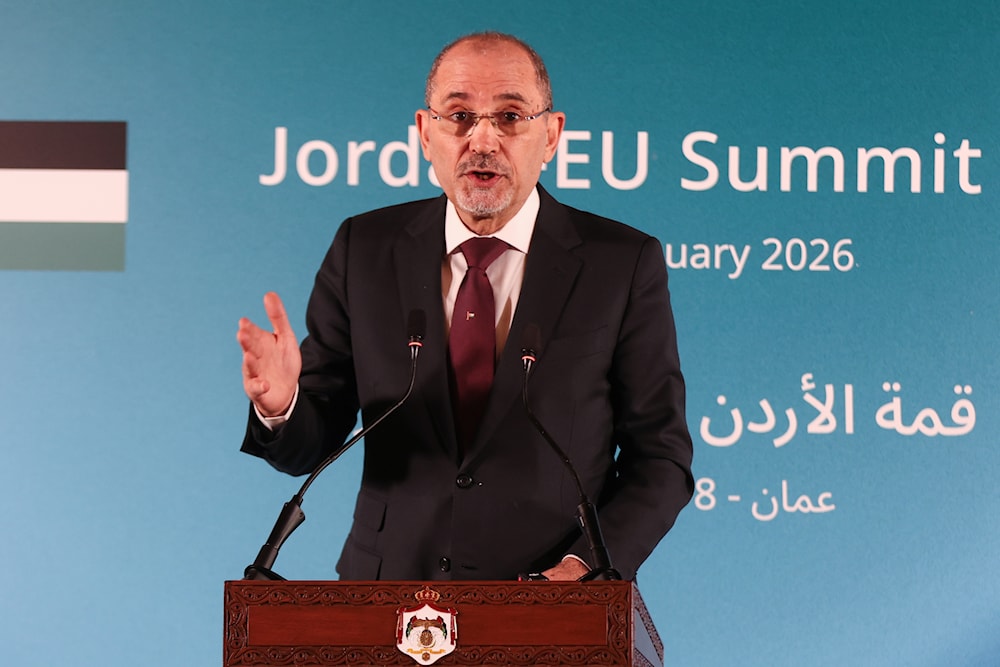
Jordanian Foreign Minister Ayman Safadi briefs journalists after the Jordanian European summit in Amman, Jordan, Thursday, Jan. 8, 2026 (AP)
The Jordanian Kingdom will not allow the use of its territory in any regional conflict, said Jordanian Foreign Minister Ayman Safadi.
Speaking to his Iranian counterpart Abbas Araghchi on Monday, Safadi said that Jordan "will not be a launching pad for any military action against Iran, nor a battlefield in any regional conflict.
During a phone call addressing regional developments and de-escalation efforts, Safadi emphasized the need to prioritize dialogue and diplomacy toward resolving the nuclear file and reducing tensions.
He underscored Jordan's commitment to respecting state sovereignty, warning that Amman would confront "with all available means" any attempt to violate its airspace or threaten its citizens' safety.
Read more: Analysis: Why is US using Jordan as main base in possible Iran attack?
Regional chorus grows against military action
Jordan joins a growing list of states publicly rejecting the use of their territory for strikes on Iran. Iraq has already said it "rejects the use of its territory, airspace, or territorial waters to launch military actions against any country," explicitly including Iran in this assurance. Pakistan also reiterated its "long-standing position" against allowing its land, airspace, or waters to be used in any attack on Iran.
The United Arab Emirates announced it "will not allow its airspace, territory, or territorial waters to be used for any hostile military action against Iran," while Saudi Arabia declared similar restrictions on its airspace and territory. Azerbaijan assured Tehran it would "never allow its airspace or territory to be used by any state to carry out military operations against neighboring Iran."
Senior Gulf officials have indicated that Gulf states collectively will not permit their facilities to be used to target Iran, signaling a coordinated regional stance.
The diplomatic maneuvering occurs against a backdrop of heightened US-Iran tensions. Trump administration officials have confirmed openness to negotiations through multiple channels, with Turkey, Egypt, and Qatar coordinating a potential meeting between White House envoy Steve Witkoff and senior Iranian officials in Ankara. Yet military planning continues, with Pentagon talks focusing on defensive and offensive scenarios in the event of war.
Read more: Trump 'hopeful' for Iran deal, as Pentagon, IOF plan for possible war


