
Lebanon-'Israel' talks not heading toward 'peace' agreement: Exclusive
 3 Min Read
The negotiations between Lebanon and"Israel" are aimed at security arrangements similar to the 1949 armistice, according to Al Mayadeen's sources.
-
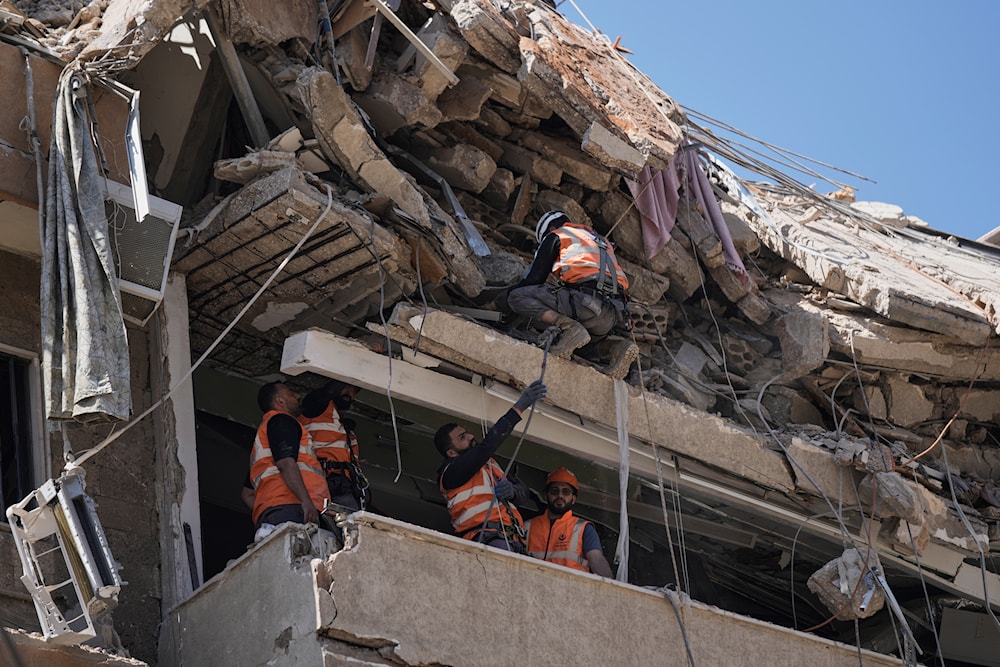
Rescue workers search through the rubble of a building destroyed in an Israeli airstrike the previous day in Dahiyeh, Beirut's southern suburbs, Lebanon, Thursday, May 7, 2026 (AP)
Ongoing talks between Lebanon and "Israel" are not heading toward a formal peace agreement but rather toward security arrangements similar in nature to the 1949 armistice model, according to information obtained by Al Mayadeen.
The proposed track aims to solidify security arrangements to preserve engagement lines and establish mechanisms to prevent a slide into a broader war between the two sides, informed sources told Al Mayadeen.
These developments come as Israeli aggression against Lebanon continues unabated. Occupation forces are persisting with shelling and targeting a wide range of towns and villages in southern Lebanon. This week, the aggression also reached Beirut’s Southern Suburb.
The military escalation is taking place simultaneously with a diplomatic push led by the United States. However, any talks are facing widespread popular rejection in Lebanon, where there is significant opposition to direct negotiations with the Israeli occupation.
It is worth noting that these ongoing attacks constitute a flagrant violation of the ceasefire agreement that took effect at midnight on April 16-17. That truce, announced by US President Donald Trump, was originally set for 10 days in its first phase but was later extended for three weeks.
The 1949 agreement: Peace or concession?
The 1949 Lebanese-Israeli Armistice Agreement was not a peace treaty or a normalization agreement but a technical military accord signed on March 23, 1949, designed to halt hostilities following the 1948 aggression.
Its primary goal was to reaffirm the existing international border as the ceasefire line, secure the withdrawal of Israeli forces from 13 occupied Lebanese villages, and establish a Mixed Armistice Commission to oversee violations.
The agreement had multiple caveats, the first of which was political: it deliberately avoided addressing the Palestinian refugee crisis, leaving the core grievance of the war untouched and ensuring that border communities remained deeply hostile.
The second failure was structural: by creating only a truce rather than a permanent peace, it lacked enforcement mechanisms.
Finally, the agreement failed to win public legitimacy. Arab nationalists and Palestinians condemned it as a betrayal, while many Lebanese viewed it as a fragile foreign-imposed arrangement that resolved nothing and merely postponed the next war.
The 1949 armistice was widely seen in Lebanon as an arrangement imposed under heavy external pressure, primarily from the United States and the United Kingdom, who were eager to stabilize "Israel's" northern border.
Seven villages
The seven villages of Qadas, Nabi Yusha, Malkiyeh, Salha, Hounin, Tarbikha, and al-Mansouri had deep ties to South Lebanon. Their residents held Lebanese citizenship even after the British-French border shift. But in 1948, these villages were ethnically cleansed.
The 1949 armistice saw Lebanon formally relinquish its claim to them. Today, only Hezbollah still demands the return of these villages, lands that were once Lebanese but were abandoned by their own government at the negotiating table.
For ordinary Lebanese, the 1949 armistice brought nothing but suffering. Border communities remained vulnerable to Israeli raids, Palestinian refugees expelled by "Israel" were abandoned to overcrowded camps, and the fragile truce did nothing to protect Lebanon from Israeli aggressions and occupation.


