
Moscow's top security official arrives in Havana to deepen ties
 3 Min Read
Washington's intensified sanctions, now costing the island $7.5 billion annually, are forcing Cuba into the very partnerships the US claims to oppose.
-
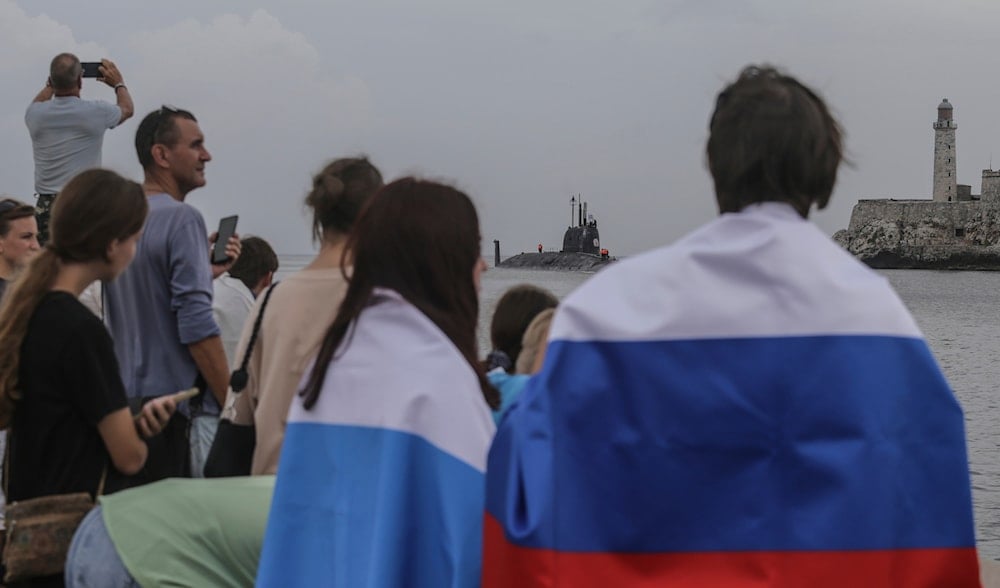
People wearing Russian flags watch the Russian Kazan nuclear-powered submarine arrive at the port of Havana, Cuba, Wednesday, June 12, 2024 (AP)
Russian Interior Minister Vladimir Kolokoltsev arrived in Havana on Tuesday for bilateral discussions on security cooperation, as Washington intensifies economic pressure on the Caribbean nation through a punitive sanctions regime now entering its seventh decade.
The visit comes amid heightened tensions following the Trump administration's aggression on Venezuela, which killed more than 80 people, including 32 Cuban security personnel. Trump has since warned Cuba to "make a deal" or face consequences similar to those inflicted on Caracas.
El General de Cuerpo de Ejército Lázaro Alberto Álvarez Casas, ministro del Interior y Víctor Koronelli, embajador de #Rusia, recibieron en el Aeropuerto Internacional José Martí a Vladímir Kolokoltsev, ministro del Interior de la Federación de Rusia, quien inició visita oficial. pic.twitter.com/RQKLMGpicD
— MININT_CUBA (@minint_cuba) January 20, 2026
Speaking to Russian state television upon arrival, Kolokoltsev condemned the US attack on Venezuela as "unprovoked armed aggression" that "cannot be justified in any way," adding that it demonstrates "the need to increase vigilance and consolidate all efforts to counter external factors." The Russian embassy confirmed the minister would conduct a series of bilateral meetings during his stay.
The diplomatic engagement reflects Moscow and Havana's deepening partnership since 2022, formalized through a March 2025 military cooperation agreement ratified by Russia's Federation Council last October. While operational details remain undisclosed, the pact establishes frameworks for joint exercises, arms supplies, and technical collaboration; a relationship driven largely by Washington's sanctions against the two sovereign nations.
US sanctions inflict unprecedented economic damage
US sanctions cost Cuba an estimated $7.5 billion between March 2024 and February 2025, constituting a 54% increase in economic damage compared to the previous year. Since 1962, the cumulative losses have reached $144 billion according to UN-acknowledged figures, with restrictions severely limiting access to medical supplies, food imports, financial services, and energy resources.
In January 2025, the Trump administration re-designated Cuba as a "State Sponsor of Terrorism" for the third time in five years, rolling back limited Biden-era concessions. The new measures implement the US' "total pressure" strategy, where Cuban banks are banned from operating in the United States, foreign financial institutions face secondary sanctions for doing business with Havana, and tourism restrictions have expanded through updated prohibited accommodation lists.
International opposition to embargo
Yet, these unilateral US measures face near-universal international condemnation. The UN General Assembly has voted annually since 1992, demanding embargo termination, with only Washington and Tel Aviv consistently opposing.
Despite formal exemptions, pharmaceutical and medical equipment procurement remains systematically obstructed. US regulations mandate cash-only payments for agricultural imports, denying credit that could stabilize food supply chains.
Remittance processing restrictions limit family transfers, a critical lifeline for ordinary Cubans, while energy sector sanctions have severed Venezuelan oil supplies that previously provided 35,000 barrels daily.
Energy crisis forces strategic realignment
Cuba's energy vulnerability has made Russian support critical to the island's survival. With Venezuelan oil supplies cut off, Havana now relies on Moscow for approximately 7,500 barrels daily, supplemented by 5,500 barrels from Mexico; volumes that fall far short of replacing the 35,000 barrels Venezuela previously provided.
To address the crisis, Russia has pledged $1 billion in investments by 2030, targeting repairs to Cuba's deteriorating energy infrastructure, industrial capacity development, increased agricultural exports, and manufacturing partnerships.


