
Mossad chief holds call with Syrian FM week before aggression
 4 Min Read
Mossad chief Roman Gofman reportedly spoke with Syrian FM Asaad al-Shaibani about Turkey’s military presence in Syria days before Israeli airstrikes.
-
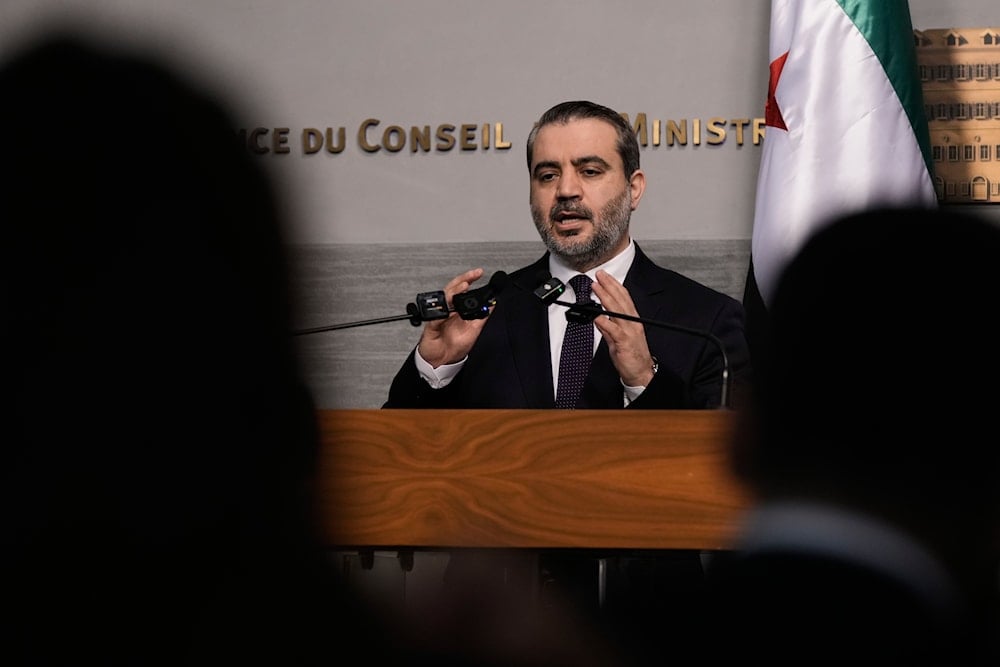
Syrian Foreign Minister Asaad al-Shibani speaks during a joint press conference with Lebanese Prime Minister Nawaf Salam, unseen, in Beirut, Lebanon, Thursday, July 2, 2026 (AP)
The head of "Israel’s" Mossad spy agency, Roman Gofman, held a phone call with Syrian Foreign Minister Asaad al-Shaibani last week during which they discussed Turkey’s military presence in Syria, three people familiar with the matter said, Reuters reported.
The call, which the sources said took place on August 14, came days before "Israel" launched airstrikes on a Syrian military airbase in the north of the country on Tuesday.
It marks one of the highest-level contacts yet between "Israel" and the new Syrian government since the fall of former dictator Bashar al-Assad in December 2014.
Netanyahu's office says Syria was on verge of breaching security understanding
Syria was "on the verge of breaching" a security understanding with "Israel" by allowing Turkish forces to deploy at an airbase near Aleppo, Israeli Prime Minister Benjamin Netanyahu's office claimed late on Tuesday.
The Israeli Prime Minister's office accused Damascus of ignoring repeated Israeli warnings against the move, saying that the deployment "would pose a threat to Israel's security."
"Israel and Syria agreed to a status quo in security matters, which Syria was on the verge of breaching by permitting Turkish troops to deploy at an airbase near Aleppo," the office said in a statement.
The statement came hours after Israeli aggression hit Syria's Abu al-Duhur military airbase in eastern Idlib, the first such strike on the base since Bashar al-Assad's fall in December 2024. Meanwhile, the Israeli military has not officially confirmed carrying out the attack.
Syria, Turkiye reject Israeli justifications for aggression on airbase
Syria condemned "in the strongest terms" the Israeli airstrikes on its Abu al-Duhur military airbase in matching letters to UN Secretary-General António Guterres and Security Council President Christina Markus Lassen, delivered by Syria's permanent representative to the UN, Ibrahim Olabi.
The letters said "the Israeli occupation entity is trying to undermine international efforts supporting Syria and turn back the clock" through "continued attacks on Syria's sovereignty, flagrantly disregarding international laws and norms, including the UN Charter and Security Council resolutions."
Damascus said the eight airstrikes on Tuesday constituted "unjustified aggression and a flagrant violation of Syria's sovereignty and territorial integrity, and a dangerous escalation threatening security and stability in the region," and reiterated its demand that "Israel fully implement the 1974 disengagement agreement" and withdraw from occupied territories.
Turkey separately rejected the justification offered by Israeli Prime Minister Benjamin Netanyahu's office, with its Presidential Communications Directorate saying in a statement that "the trivial claims put forward by the Israeli prime minister's office aim to legitimize the illegal Israeli airstrikes that target Syria's sovereignty and territorial integrity."
Ankara reaffirmed it "will continue to firmly cooperate with the Syrian government on a legitimate basis to establish peace, stability and prosperity in Syria" and "will never allow Syria's stability to be undermined," adding that the only way to achieve lasting peace is for Netanyahu to "abandon his aggressive and coercive policies and respect international law."
The strike at the center of it all
Israeli warplanes struck Abu al-Duhur in eastern Idlib early Tuesday in eight strikes that damaged the runway without causing casualties, the first attack on the base since Bashar al-Assad's fall.
US envoy for Syria and Iraq Tom Barrack said he was "deeply concerned" and called the strikes an "unnecessary escalation" that "does not advance regional stability," adding that Syria's transitional government "has not adopted a hostile stance" and "does not harbor proxy forces."
Jordan's Foreign Ministry called the attack "an unjustified act of aggression, a flagrant violation of Syria's sovereignty and territorial integrity, and a blatant breach of international law and the UN Charter," while Qatar's Foreign Ministry reiterated its solidarity with Damascus and support for Syria's sovereignty.


