
Paper won't bring you security: Iranian official to Saudi Arabia
 2 Min Read
Saudi Arabia, Turkey, and Pakistan sign the Mecca Defense Agreement as an Iranian parliamentarian questions whether the pact will provide security for the kingdom.
-
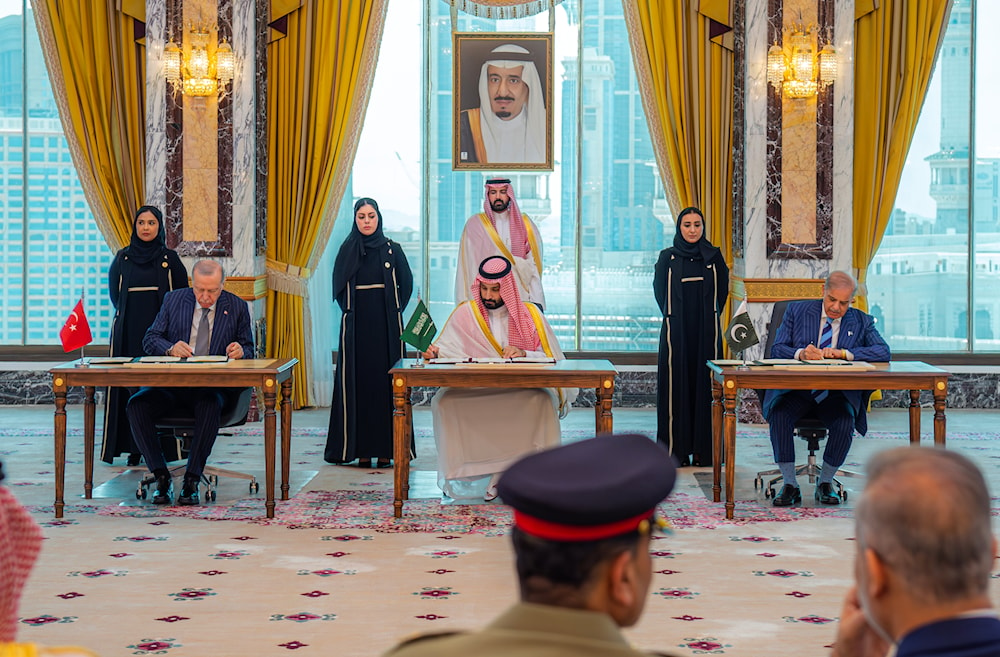
From left, Turkish President Recep Tayyip Erdogan, Saudi Crown Prince Mohammed bin Salman and Pakistani Prime Minister Shehbaz Sharif sign a trilateral defense agreement in Mecca, Saudi Arabia, Friday, Aug. 7, 2026 (AP)
An Iranian parliamentarian has criticized the newly announced Mecca defense agreement between Saudi Arabia, Turkey, and Pakistan, stating that the accord will not provide security for the kingdom.
سعودیها باید بدانند که توافق کاغذی با ترکیه و پاکستان برای آنها امنیتآور نیست، همانطور که سالها شیردهی یکطرفه به آمریکاییها برایشان امنیت نیاورد. سیاستهایتان را اصلاح کنید تا نیاز نباشد از دیگران #گدایی_امنیت کنید.
— ابراهیم رضایی (@EbrahimRezaei14) August 7, 2026
In a post on X commenting on the agreement, Iranian National Security Committee spokesperson Ebrahim Rezaei warned Saudi Arabia, saying they "should know that a paper agreement will not bring them security, just as years of unilateral dependence on the United States did not provide it for them."
Rezaei also offered advice to Saudi officials in his post, saying, "Correct your policies so that you are not forced to beg others for security."
Saudi, Turkey, Pakistan sign joint-defense agreement
Saudi Arabia, Turkey, and Pakistan signed a joint defense agreement in Mecca on Friday, formalizing a trilateral security bloc among three Sunni Muslim-majority US allies, according to Reuters.
Under the pact, dubbed the Mecca Joint Defense Agreement, an attack on any one of the three signatories will be treated as an attack on all, the countries said in a joint statement. The agreement is framed as a collective-deterrence mechanism meant to shore up regional security, though the three governments have not disclosed the specific obligations each side has taken on.
A Turkish official told Reuters the pact is purely defensive, is not aimed at any particular state, remains open to other countries in the region, and does not supersede existing bilateral or multilateral arrangements Ankara, Riyadh, or Islamabad already hold.
The deal caps roughly a year of talks first flagged by Reuters in January, when Turkish Foreign Minister Hakan Fidan said Ankara was pushing for a wider regional security platform.


