
Pentagon 'raids' payroll as Trump's Iran war eats Navy's budget
 7 Min Read
The US Navy is facing mounting financial strain from the prolonged war on Iran, forcing it to redirect funds from payroll and routine operations.
-
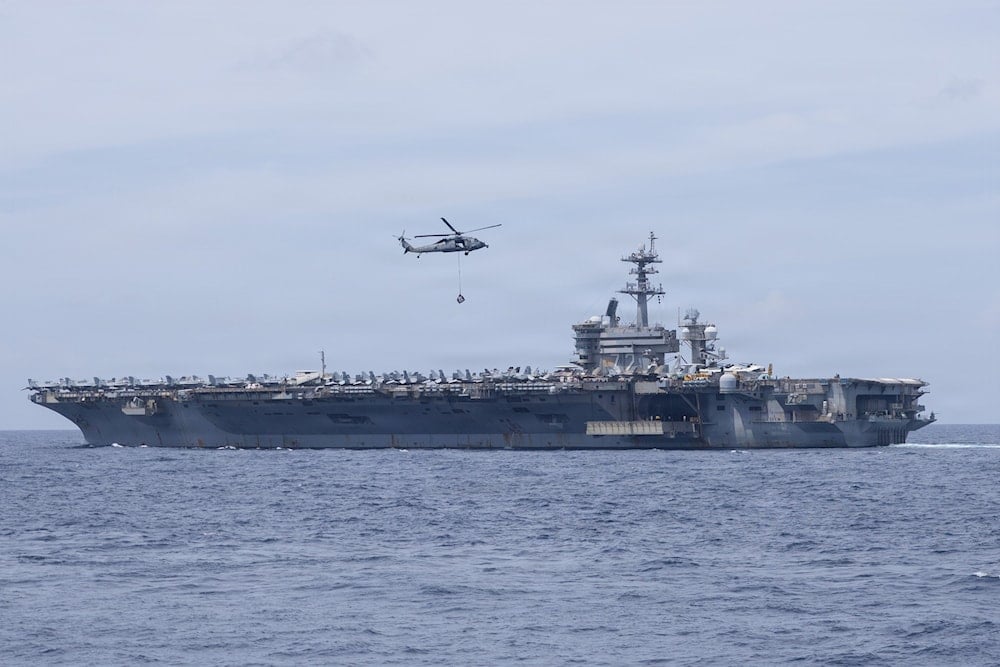
The USS Abraham Lincoln conducts a vertical replenishment with the USNS Henry J. Kaiser in the South China Sea on January 17, 2026 (US Navy)
The United States Navy is facing mounting financial pressure as Washington's prolonged war on Iran consumes billions of dollars in operational spending, forcing the service to redirect funds originally allocated for payroll and other military requirements, according to documents obtained by The Guardian.
The financial strain comes alongside growing pressure on US weapons inventories and military infrastructure, with months of combat operations, naval deployments, and Iranian retaliatory strikes placing additional demands on Pentagon resources.
A Pentagon memorandum reviewed by The Guardian reportedly warned of "shortfalls in payroll" accounts after the department resorted to "raiding" them to finance ongoing military operations.
Harlan Ullman, a retired US naval officer and member of the National Commission for the Future of the Navy, described the situation bluntly.
"The piggy bank is broken," Ullman said, stressing that he was speaking in his personal capacity rather than on behalf of the commission.
Two sources familiar with the Navy's financial situation also told the newspaper that some non-urgent maintenance work at shore installations has been postponed as available funding becomes increasingly constrained.
Navy shifts funds to sustain Iran operations
The financial pressure began building after US President Donald Trump launched the war on Iran on February 28.
The Navy played a central role in the initial attacks and later became heavily involved in enforcing Washington's naval blockade, significantly increasing operational costs beyond what had been anticipated when the 2026 military budget was approved.
One Navy official briefed on efforts to manage the shortfall said money has been moved between accounts as the service attempts to meet both combat requirements and routine obligations.
"The money for payroll," he said, "was robbed to pay for overseas contingencies and is being backfilled by money that hasn’t been spent. They are backfilling payroll so we get enough money in our paycheck."
The Navy's fiscal year 2026 budget totals nearly $300 billion, but those funds are divided into congressionally designated categories covering personnel, weapons procurement, shipbuilding, operations and maintenance.
Federal law restricts how extensively the Pentagon can transfer money between those accounts, making it increasingly difficult for the service to finance costs that were not included in its original spending plan.
Concerns about the military's liquidity problems have already emerged in Congress.
During a Senate Appropriations Committee hearing on July 21, Senator Susan Collins said, "I’m told some military services face near-term solvency challenges."
A congressional staff member later told The Guardian that the Navy was among the services Collins had been referring to.
The Navy, however, denied that its maintenance and operational accounts had been exhausted.
"The Department of the Navy," a spokesperson said, "is actively managing its resources to meet current pay obligations on time. We continue to work closely with Congress to address ongoing operational demands and sustain our personnel and readiness throughout the fiscal year."
Readiness concerns grow inside Pentagon
Despite the Navy's public assurances, officials and defense analysts cited by the newspaper said concerns over the financial situation are widely understood within the service.
"They’re just not speaking publicly about it," said Todd Harrison, a defense analyst at the American Enterprise Institute. "And I suspect that is a deliberate decision of the civilian leaders in the Pentagon, starting at secretary, that this is for political reasons, that they don’t want to look like they’re damaging future military readiness over a war that is becoming increasingly a political liability."
Senior Navy officials had warned months earlier that financing the war would eventually force difficult decisions.
In May, Chief of Naval Operations Adm. Daryl Caudle told Congress that the military's existing budget had never been designed to absorb the cost of the Iran campaign.
"The FY ’26 budget didn’t bake in Epic Fury," Caudle said. "I do fear that I’ll have to start making decisions in the July timeframe on how I do force generation. That could make differences between how I do exercises, how I do routine operations in order to make sure that I … have the funds necessary to continue the war effort for Epic Fury."
Those warnings were echoed by US Secretary of War Pete Hegseth, who pressed lawmakers in July to approve additional funding.
Without further appropriations, Hegseth warned, "we face critical shortfalls".
He told Congress that the war on Iran had already cost approximately $35.7 billion, though The Guardian noted that it remained unclear whether that figure represented the full financial cost of the conflict.
Emergency funding faces uncertain path
The Trump administration subsequently requested $67 billion in emergency Pentagon funding, without specifying how much would be directed toward the Navy.
The House of Representatives has separately approved a $1.15 trillion defense spending package and legislation authorizing another $73 billion for the Iran war, but both measures face uncertain prospects of becoming law.
The funding dispute is further complicated by the fact that Congress never passed an authorization for the war.
Ullman contrasted the situation with the US wars on Iraq and Afghanistan, when lawmakers routinely provided supplemental military funding following congressional authorization of the conflicts.
"There is no authorization to use force in this case. Is Congress obliged to pay for a conflict it did not authorize?" he said.
The growing financial strain also comes as the US military faces pressure on its weapons inventories following months of intensive operations against Iran.
According to the report, the conflict has depleted key US munitions while Iranian retaliatory attacks have inflicted damage on strategically important American military installations across the region.
Trump's naval ambitions collide with wartime costs
The Navy's funding difficulties stand in contrast to Trump's repeated promises to dramatically expand US maritime power.
Trump has frequently invoked former President Theodore Roosevelt, whose administration oversaw the expansion of the US Navy and the deployment of the so-called Great White Fleet around the world.
The current administration has instead promoted plans for what it calls a "Golden Fleet", including proposals for enormous "Trump class" warships that would rank among the largest battleships ever built by the United States.
Trump has also personally intervened in naval procurement decisions, including repeatedly calling for aircraft carriers to return to steam-powered and hydraulic catapult technology rather than electromagnetic launch systems.
Yet, according to officials and contractors cited by The Guardian, the immediate challenge facing the Navy is no longer expanding the fleet but finding sufficient resources to sustain a war whose duration and ultimate objectives remain uncertain.
One former military officer now employed by a Navy contractor summed up the situation in stark terms.
"They’re fucked. They shot all their weapons; they trashed all their ships; they ran out of their money."
Read more: US Navy stretched by war on Iran as aircraft carrier leaves Pacific


