
Pentagon eyes deep-cover spies for economic warfare on China, rivals
 5 Min Read
The Pentagon is reportedly considering a deep-cover spy program to advance economic warfare against China and other US rivals, although it denies the initiative exists.
-
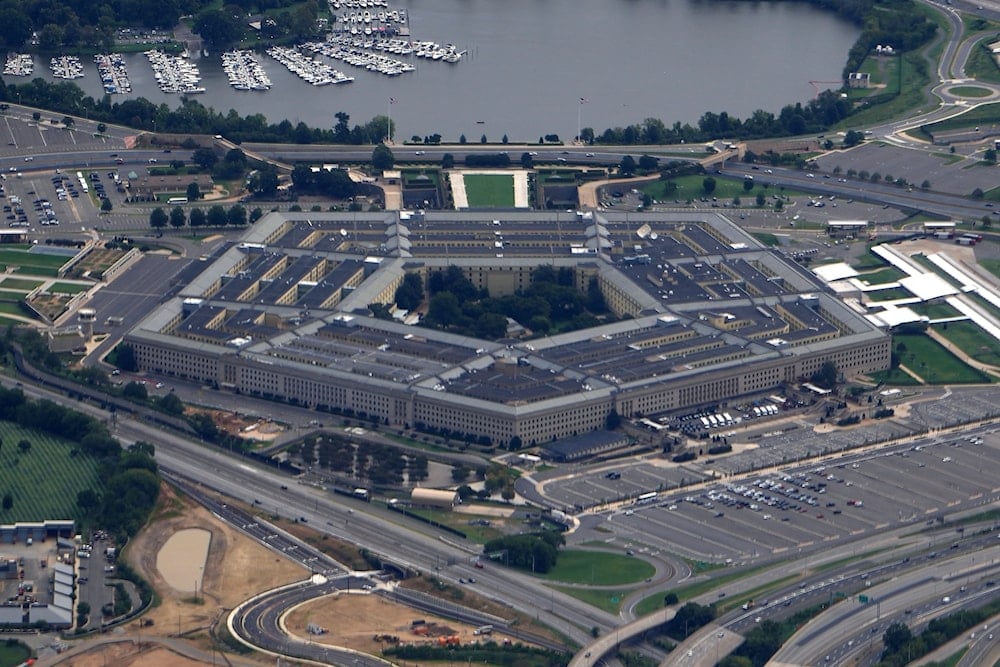
The Pentagon is pictured as Air Force One with President Donald Trump on board flies over Washington en route to Alcoa, Tenn., Saturday, Sept. 26, 2026 (AP)
The Pentagon is weighing an expansion of deep-cover espionage to support Washington’s economic warfare against China and other US competitors, The Washington Post reported, as the Trump administration increasingly mobilizes intelligence capabilities and public funds in pursuit of strategic and commercial advantage.
Citing six people familiar with the initiative, the newspaper said US operatives would work under business or other private-sector identities, concealing their government affiliation. The proposed program would add a clandestine component to a broader campaign encompassing trade restrictions, technology controls, and investments in critical resources.
Sources described the initiative as being in the planning stage, with no operations underway. Its institutional home and legal framework remain unsettled, and congressional committees do not appear to have been briefed, according to the report.
The Pentagon denied that such an initiative was underway.
“This query appears to be built on information that is simply not true,” deputy press secretary Jacob Bliss said. “Whoever is feeding you these claims are either badly misinformed or deliberately leading you astray to paddle [sic] their fantasies.”
Economic warfare extends into intelligence operations
The reported plans come amid an increasingly explicit US focus on using intelligence capabilities to advance economic competition.
CIA Deputy Director Michael Ellis said in September that Washington was broadening espionage against Chinese companies working in artificial intelligence, biotechnology, and advanced semiconductors, according to the newspaper.
Former CIA deputy director David S. Cohen has separately advocated removing a longstanding restriction on sharing economic secrets obtained through espionage with US companies developing advanced technologies.
“We have been collecting economically sensitive information for years and years,” Cohen told the newspaper.
“We should not be hung up on whether we should be providing [U.S. companies] a commercial advantage,” he added, while acknowledging the need for oversight to prevent favoritism or corruption.
Cohen said he had no knowledge of the Pentagon initiative. His proposal nevertheless illustrates a wider debate in Washington over using intelligence gathered abroad to benefit domestic corporate interests.
Pentagon funds strategic resource investments
Alongside the reported clandestine preparations, the Pentagon has already established an Economic Defense Unit to pursue economic objectives through publicly announced investments.
A memorandum from Deputy Defense Secretary Steve Feinberg described the unit’s mission as “deterring, denying, disrupting, and helping to defeat adversaries through economic means,” according to the report.
The office has announced hundreds of millions of dollars in mining and refining investments, including $750 million in Pentagon funding to help secure a major rare earth deposit in Brazil.
Its director, George Kollitides, previously worked at Cerberus Capital Management, the private equity firm co-founded by Feinberg.
Another former Cerberus employee, veteran CIA officer Tom Rakusan, is reportedly overseeing the proposed deep-cover expansion as a senior advisor to Feinberg. Rakusan joined the investment firm after retiring from the CIA in 2021 and followed Feinberg to the Pentagon in 2025.
People familiar with the discussions said the Economic Defense Unit had initially been considered as a possible home for the espionage initiative. One source said that option was abandoned amid mounting press and congressional scrutiny of the unit’s investments.
Unclear oversight and competing intelligence agencies
The proposed expansion has also exposed friction over the Pentagon’s growing intelligence ambitions.
“Rakusan just wants to build his own CIA down in the Pentagon,” a former senior CIA official familiar with the discussions told The Washington Post.
According to the report, planners have considered either creating a separate deep-cover unit or expanding existing military intelligence capabilities. The CIA has traditionally resisted other agencies conducting human espionage without coordination through its overseas station chiefs.
Questions also remain over which legal authorities would govern the proposed activities. Former officials described a possible “Title 60” arrangement, a joking reference to a nonexistent hybrid of the military’s Title 10 authorities and the Title 50 framework governing intelligence agencies.
A risky expansion under commercial cover
Former officials warned that deep-cover operations face considerable practical obstacles, including biometric identification, traceable digital records, and military service histories that can undermine assumed identities.
Officers working under nonofficial cover also lack diplomatic immunity if detained.
The Pentagon’s previous commercial-cover operations have produced mixed results, while the CIA’s own deep-cover ranks have diminished as experienced officers retire without sufficient replacements, according to the newspaper.
The reported initiative would seek to expand those capabilities in service of Washington’s economic confrontation with its competitors, even as its structure, oversight, and operational viability remain unresolved.
Read more: China condemns CIA economic espionage remarks ahead of Trump-Xi summit


