
Poll shows Germans increasingly wary of expressing opinions
 3 Min Read
A new survey shows most Germans feel compelled to self-censor amid tightening debate over Palestine, deep dissatisfaction with the country’s political direction, and falling support for Chancellor Friedrich Merz.
-
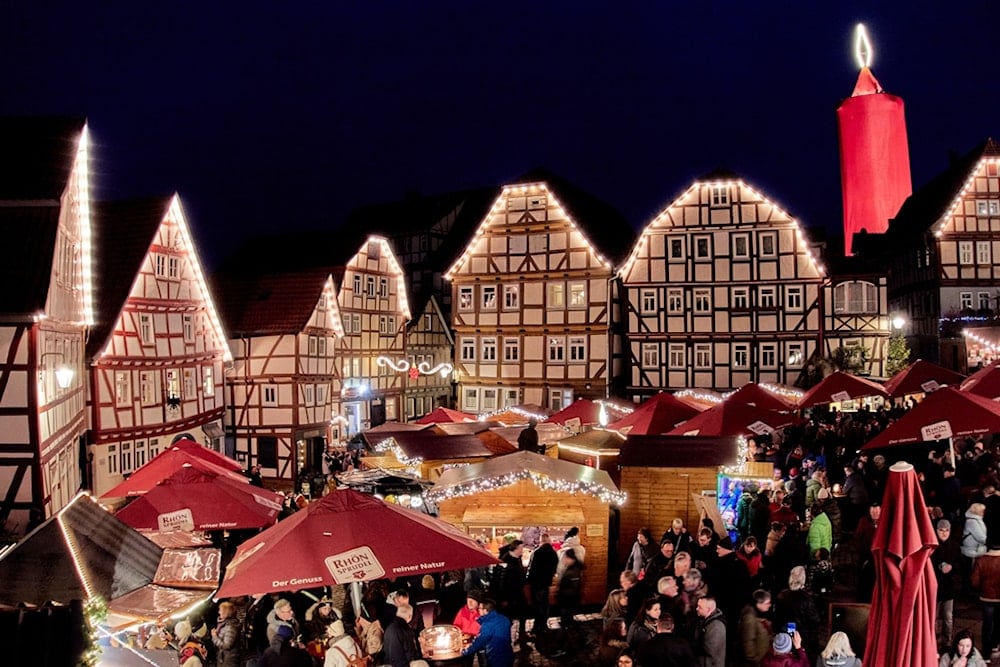
A 42-meter-high candle, which is an illuminated medieval tower covered with a red blanket, shines in the historic city centre of Schlitz, Germany, Saturday, Dec. 13, 2025. (AP Photo/Michael Probst)
A majority of people in Germany feel constrained when expressing their opinions, according to a new survey published by the Welt newspaper, pointing to growing unease over freedom of expression and widespread dissatisfaction with the country’s political direction.
The poll, conducted by the Swiss research firm Tenor, found that 57% of respondents believe it is better to exercise caution when voicing their views, reflecting a broad sense of self-restraint in public discourse. Only a minority said they felt able to speak freely without concern.
The sentiment was particularly pronounced among supporters of the right-wing Alternative for Germany (AfD) party. Just 11% of AfD voters said they feel free to express their opinions, while 89% said they do not. However, unease over speaking openly was not limited to one political camp.
Regional disparities also emerged. In eastern Germany, 64% of respondents said they feel reserved when sharing their views, compared with 55% in western states, underscoring a persistent east-west divide in political confidence.
Speech chill
Concerns over free expression have intensified in recent years amid debates over Germany’s handling of "Israel" and Palestine. German governments have repeatedly framed "Israel’s" security as a core state responsibility, a position that has translated into tighter scrutiny of pro-Palestinian activism.
Authorities have restricted or attempted to ban demonstrations, events, and slogans linked to Palestine solidarity, while activists, academics, and artists have faced investigations, funding cuts, or administrative penalties.
Critics argue these measures have contributed to a chilling effect, particularly for those expressing support for Palestinian rights, even as courts have at times ruled against blanket restrictions.
Broad discontent
Beyond concerns over expression, the survey highlighted deep dissatisfaction with Germany’s overall social and political trajectory. Only 18% of respondents said they approve of the country’s current course, while 82% expressed disapproval.
Negative assessments were widespread across all age groups, with at least 80% of respondents aged 16 to over 60 describing themselves as dissatisfied. The strongest opposition was recorded among those aged 45 to 49.
Discontent crossed ideological lines. While 94% of AfD voters rejected Germany’s current direction, 91% of supporters of the Left Party also described the socio-political course as “not good,” indicating frustration that extends well beyond the political right.
Falling support
The findings come amid declining public support for Chancellor Friedrich Merz. An earlier poll conducted in October by the Forsa Institute for n-tv and RTL showed that only 26% of Germans were satisfied with Merz’s performance, his lowest approval rating since taking office. Disapproval rose to 71%, up sharply from 52% in May, when he was appointed chancellor.
The Tenor survey was conducted online between November 26 and December 3, with a sample of 1,500 respondents.
Read more: Freedom of speech 'gone and it won’t come back': former Austrian FM


