
Pope Leo XIV from Annaya: We pray for peace for Lebanon, entire Levant
 9 Min Read
Pope Leo XIV visits Saint Charbel’s tomb in Jbeil's Annaya and urges unity, prayer, and renewal, praising Lebanon’s spiritual heritage and role in the Christian world.
-
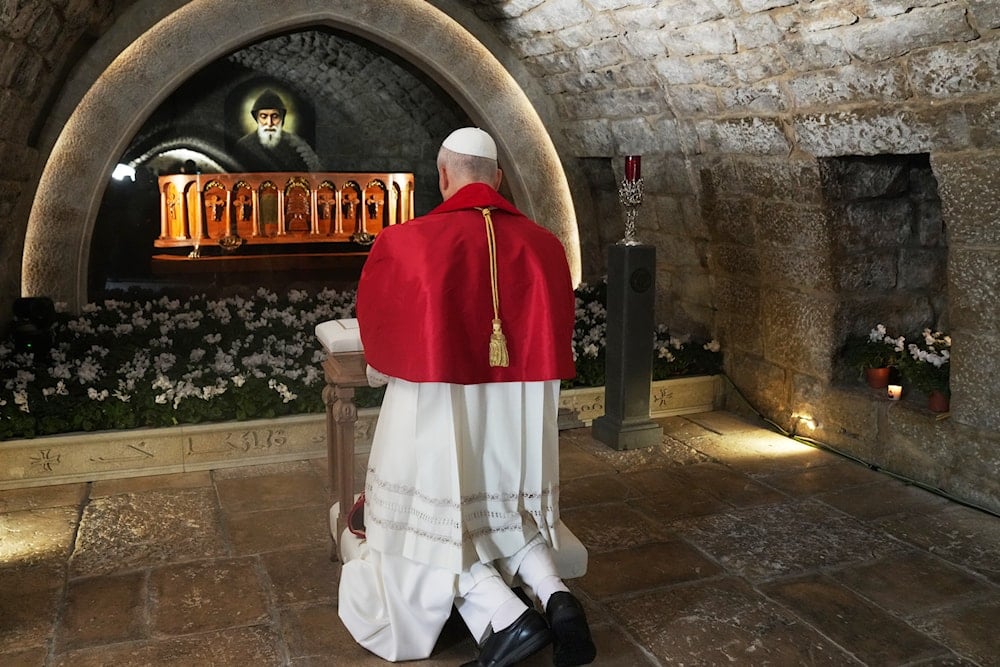
Pope Leo XIV prays in front of the tomb of Saint Charbel Makhlouf at the Monastery of Saint Maroun, in Annaya, Lebanon, Monday, Dec. 1, 2025 (AP)
Pope Leo XIV expressed deep reverence for Lebanon’s spiritual heritage on Sunday during his visit to the tomb of Saint Charbel in St. Maroun's Monastery in Annaya, Jbeil, calling on the Lebanese people and Christians worldwide to draw strength from the Maronite saint’s legacy of prayer, humility, and perseverance.
Hundreds of Lebanese have gathered across Jbeil to welcome #PopeLeo XIV as he begins his second day in #Lebanon with a visit to St. Maron's Monastery, the home of St. Charbel Makhlouf's tomb.
, Al Mayadeen English (@MayadeenEnglish) December 1, 2025
Crowds wave Lebanese and Vatican flags in eager anticipation of his arrival. pic.twitter.com/h7PbOqOJ48
Addressing worshippers gathered at the monastery, the Pope said he was grateful “to come as a pilgrim” to St. Charbel’s resting place, noting that previous popes had long hoped to make the same journey. Surrounded by the monastery’s peaceful landscape, he said its “austere beauty” draws believers closer to God.
In his remarks, Pope Leo highlighted St. Charbel’s powerful example, although the monk “wrote nothing” and lived a life of silence and seclusion, with his fame spreading throughout the world. The saint’s enduring influence, he said, speaks to a world that “lives without God,” teaching its people how to pray.
"The Holy Spirit formed him so that he could teach those who live without God how to pray, those who live immersed in noise how to be silent, those who live ostentatiously how to be modest, and those who seek riches how to be poor," the Pope addressed the attendees, saying.
“These behaviors are counter-cultural,” the Pope said, adding that St. Charbel’s spiritual clarity continues to inspire those searching for meaning, emphasizing that the saint’s devotion offers a reminder to clergy of the “evangelical demands” of their mission, while serving as a universal message for all Christians.
Prayers for Lebanon, Levant
The Pope praised the continuous flow of pilgrims to the monastery, describing Saint Charbel’s intercession as “a river of mercy” that comforts and heals people of all nations. Every month on the 22nd, thousands travel to Annaya to pray and “renew their souls and bodies,” he noted.
The pontiff dedicated prayers to Lebanon, “the entire Levant,” and the global Church, asking for unity within Christian communities and peace in a region long affected by conflict. “We know well that there is no peace without conversion of hearts,” he cautioned, urging spiritual renewal as a first step toward reconciliation.
As a symbol of hope, Pope Leo presented a lit lamp to the monastery, entrusting Lebanon and its people to Saint Charbel’s protection. He encouraged the faithful to “keep walking in the light of the Lord,” thanking them for preserving the saint’s legacy and urging them toward prayer, silence, modesty, and simplicity.
The visit marks a significant moment in Pope Leo XIV’s pilgrimage to Lebanon, underscoring the country’s role as a vital center of Middle Eastern Christianity and a beacon of spiritual endurance.
Following is the full text of the Pope's address:
"Dear brothers and sisters!
I would like to thank the Superior General for his kind words and for welcoming us to this beautiful monastery in Annaya. The natural environment around this house of prayer also draws us in with its austere beauty.
I give thanks to God for allowing me to come as a pilgrim to the tomb of Saint Charbel. I think that my predecessors – especially Saint Paul VI, who beatified and canonized him – would have greatly desired to do the same.
Dear friends, what does Saint Charbel teach us today? What is the legacy of this man who wrote nothing, who lived a hidden and silent life, yet whose fame spread throughout the world?
I would like to offer the following summary of his legacy. The Holy Spirit formed him so that he could teach those who live without God how to pray, those who live immersed in noise how to be silent, those who live ostentatiously how to be modest, and those who seek riches how to be poor. All of these behaviors are counter-cultural, yet, that is precisely why they attract us, just like fresh, pure water draws those walking in the desert.
In particular, Saint Charbel reminds us, bishops and ordained ministers, of the evangelical demands of our vocation. At the same time, his steadfastness, as radical as it was humble, is a message for all Christians.
There is another crucial aspect of his legacy. Saint Charbel has never ceased to intercede for us before our Heavenly Father, the source of every good and grace. Even during his earthly life, many went to him to receive comfort, forgiveness and advice from the Lord. After Saint Charbel’s death, his work multiplied and became like a river of mercy. For this reason, on the twenty-second of every month, thousands of pilgrims from different countries come here to spend a day in prayer and to renew their souls and bodies.
Sisters and brothers, today we entrust to Saint Charbel’s intercession the needs of the Church, Lebanon and the world. For the Church, we ask for communion and unity, beginning with families who are small domestic churches, then parish and diocesan communities, and finally for the universal Church. Communion and unity. For the world, we ask for peace. We especially implore it for Lebanon and for the entire Levant. But we know well – and the saints remind us – that there is no peace without conversion of hearts. May Saint Charbel, therefore, help us to turn to God and ask for the gift of conversion for all of us.
Dear friends, as a symbol of the light that God has enkindled here through Saint Charbel, I have brought a lamp as a gift. In offering this lamp, I entrust Lebanon and its people to the protection of Saint Charbel, so that they may always walk in the light of Christ. We give thanks to God for the gift of Saint Charbel! I also thank all of you for preserving his memory. Keep walking in the light of the Lord!"
Pope Leo XIV reasserts 'peacemakers' calls in Harissa
Pope Leo XIV urged Lebanon’s Christians to persevere in faith and to serve as “peacemakers” amid the country’s ongoing crises, during a meeting with bishops, priests, consecrated persons, and pastoral workers at the Shrine of Our Lady of Lebanon in Harissa.
Opening his remarks, the Pope highlighted the relevance of the visit’s motto, “Blessed are the peacemakers,” recalling Saint John Paul II’s affirmation that the Church in Lebanon carries the responsibility of sustaining hope. He said the testimonies shared during the gathering reflected how this mission continues to be upheld through concrete acts of service and resilience.
The Pope drew attention to what he described as the roots of Lebanon’s Christian witness, the silent prayer embodied by Saint Charbel and the ability of the Harissa Shrine to unite the Lebanese people. He stressed that perseverance in difficult times often emerges from prayer, “the invisible bridge which unites hearts,” and from remaining close to Christ despite war, hardship, and “the sound of weapons.”
Reflecting on the anchor depicted in the journey’s logo, Pope Leo quoted late Pope Francis, saying that faith provides direction and stability, much like an anchor fixed in heaven. Building peace, he added, requires choosing love and generosity over fear.
Pope Leo XIV outlines testimonies of coexistence in Lebanon
The personal stories shared by pastoral workers shaped much of the Pope’s address. He praised the example of the village of Debbabiyé, highlighted in the testimony of Father Youhanna, where Christians and Muslims, Lebanese and refugees, continue living side by side despite bombardments and scarcity. A Syrian coin placed among Lebanese ones in the parish alms box, he noted, symbolized how everyone can give and receive in charity.
Recalling Pope Benedict XVI’s 2012 visit to Lebanon, Pope Leo said the Christian response to crisis must continue to prioritise forgiveness over revenge, unity over division, and service over domination. Yet he acknowledged that many still face exploitation and lack opportunities, emphasizing the need to offer young people genuine prospects for growth, including within Church institutions.
The Pope also referred to the testimony of Loren, an immigrant supporting those displaced by conflict or economic necessity. Her story, he said, reflected the heavy toll of war on civilians and underscored the Church’s duty to welcome migrants who seek help. He further commended Sister Dima, who kept her school open during violent outbreaks, turning it into a place of learning and refuge. Education, he said, has long been a priority of the Church in Lebanon and must continue “especially for those in extreme situations.”
In speaking of St. Charbel’s prison ministry, Pope Leo underlined the need to recognize the dignity of every person, saying that even in places marked by suffering, the Church must see signs of God’s mercy and the potential for renewal.
Before presenting a Golden Rose to the Shrine, he said the gesture symbolized the call to radiate the “fragrance of Christ” through daily acts of charity and unity, a gift, he added, accessible to all.
Pope Leo concluded by encouraging the Church in Lebanon to continue cultivating peace through steadfast faith, inclusive community life, and practical solidarity, calling these essential foundations for rebuilding trust and hope in the country’s future.


