
Pro-Palestine Greens rise; elections reshape UK's local political map
 6 Min Read
Green candidates secure significant local victories across parts of the UK, with several campaigns reflecting growing public concern over the Gaza genocide and Palestinian rights.
-
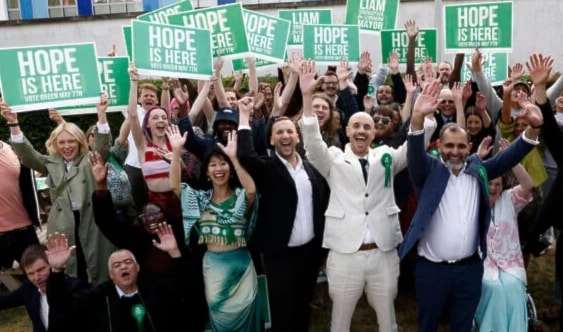
Green Party leader Zack Polanski (C) celebrates with the party's newly elected Mayor of Lewisham, Liam Shrivastava (centre R), and supporters, outside the count centre in Lewisham, south London, on May 8, 2026 (AFP)
Britain’s political landscape appeared increasingly fractured after local election results delivered sweeping gains for the hard-right Reform UK party and significant advances for the pro-Palestine Green Party across England.
Led by nationalist politician Nigel Farage, Reform UK recorded major victories in local councils throughout England while also making gains in Scotland and Wales. The results reinforced growing dissatisfaction with Britain’s traditional political establishment and suggested a continuing collapse of the country’s long-dominant two-party system.
Reform would emerge as the largest force in Parliament if a general election were held now, according to projections by Sky News.
Meanwhile, Prime Minister Keir Starmer faced a bruising setback as Labour lost hundreds of council seats and surrendered control of several local authorities.
“The right lesson is to listen to voters,” Starmer said Saturday, adding that this “doesn’t mean tacking right or left.”
Greens expand influence in urban strongholds
The Green Party of England and Wales also achieved unprecedented success, capturing two London mayoralties, taking control of four councils, and gaining hundreds of seats in major urban centers including London, Manchester, Sheffield, Newcastle, and Cambridge.
The party secured its first directly elected mayoralty in Hackney, east London, where councillor Zoë Garbett defeated Labour in a borough long considered one of the party’s urban strongholds. Later, Liam Shrivastava claimed victory in Lewisham, southeast London.
'A historic victory'
The Greens additionally won control of Hackney Council, which includes Stamford Hill, home to a large ultra-Orthodox Jewish population, along with Waltham Forest in London, Hastings in England’s south coast, and Norwich in eastern England.
Speaking after the Hackney result, Green leader Zack Polanski described the outcome as a “historic victory".
“My message to Keir Starmer is that he needs to go. But I don’t think that’s my message; I think that’s the country message,” Polanski stressed.
War on Gaza shapes local campaigns
British media reported that "Israel’s" war on Gaza became a major issue in several urban races, particularly in Hackney, where dissatisfaction with Labour’s position on the war appeared to influence voters.
Garbett said residents had become frustrated with Labour over both local issues and the party’s stance on Gaza.
Elsewhere, newly elected Green councillor Laura-Louise Farley reportedly called for the Israeli occupation forces to be designated a terrorist organization.
In Sheffield, Green councillor Mustafa Ahmed celebrated his election by waving a Palestinian flag and chanting “Free Palestine".
Labour suffers sharp decline
Labour lost nearly 1,400 council seats nationwide and surrendered control of multiple authorities, even though its losses in London were less severe than many analysts had predicted.
The elections were widely viewed as an informal referendum on Starmer’s leadership, less than two years after Labour returned to power by defeating the Conservatives.
Starmer acknowledged responsibility for “very tough” results but rejected calls to resign.
“The voters have sent a message about the pace of change, how they want their lives improved,” he said. “I was elected to meet those challenges, and I’m not going to walk away from those challenges and plunge the country into chaos.”
Several Labour lawmakers nevertheless urged the prime minister to step aside following the defeat.
“I don’t think Keir Starmer should survive these results,” Labour MP Jonathan Brash said. “We have to be bolder, and we have to go further. And quite frankly, we need new leadership in order to achieve that.”
Reform capitalizes on anti-immigration sentiment
Reform UK performed especially well in working-class areas across northern England that had historically backed Labour, while also eroding Conservative support in parts of southern England, including Essex.
The party campaigned heavily on anti-immigration and anti-establishment messaging, finding strong backing in regions that supported Brexit during the 2016 referendum.
Farage called the results a “historic change in British politics.”
Despite Reform’s national momentum, the party underperformed in some heavily Jewish constituencies, where Conservative support remained resilient in areas such as Golders Green and Hendon.
In Barnet, Britain’s largest Jewish constituency, neither Labour nor the Conservatives secured overall control.
Scotland and Wales shift further toward nationalism
Nationalist parties also recorded significant victories in devolved elections held in Scotland and Wales.
In Scotland, the Scottish National Party remained the largest party but fell short of a majority, weakening expectations that it would aggressively pursue another independence referendum during the next parliamentary term.
In Wales, Plaid Cymru achieved a historic breakthrough by ending Labour’s uninterrupted 27-year dominance of Welsh politics.
The party is now expected to lead the next Welsh government despite failing to secure an outright majority.
Outgoing Welsh First Minister Eluned Morgan described the outcome as disastrous for Labour.
“Welsh Labour has today suffered a catastrophic result,” she said. “It ends a century of Labour winning in Wales and the party will have to take a really hard look at itself.”
Britain enters more fragmented political era
Political analysts said the elections underscored the rapid fragmentation of British politics and the growing appeal of parties outside the traditional Labour-Conservative divide.
Tony Travers of the London School of Economics said mainstream parties were struggling to respond to populist movements offering “simple solutions” to deep-rooted economic and political challenges.
John Curtice of the University of Strathclyde told the BBC that Britain was entering a fundamentally different political era.
“Even Reform are probably not quite at 30% of the vote, so the fracturing of British politics is underlined by these results,” he said.
The outcome is likely to intensify speculation over Starmer’s political future, with senior Labour figures such as Wes Streeting, Angela Rayner, and Andy Burnham now seen as potential successors should pressure on the prime minister continue to grow ahead of the next general election, which must be held by 2029.


