
Rallies held outside Beirut military court against Resistance arrests
 3 Min Read
A protest was held at Beirut’s military court, demanding an end to political pressure and defending Resistance fighters against government arrests.
-
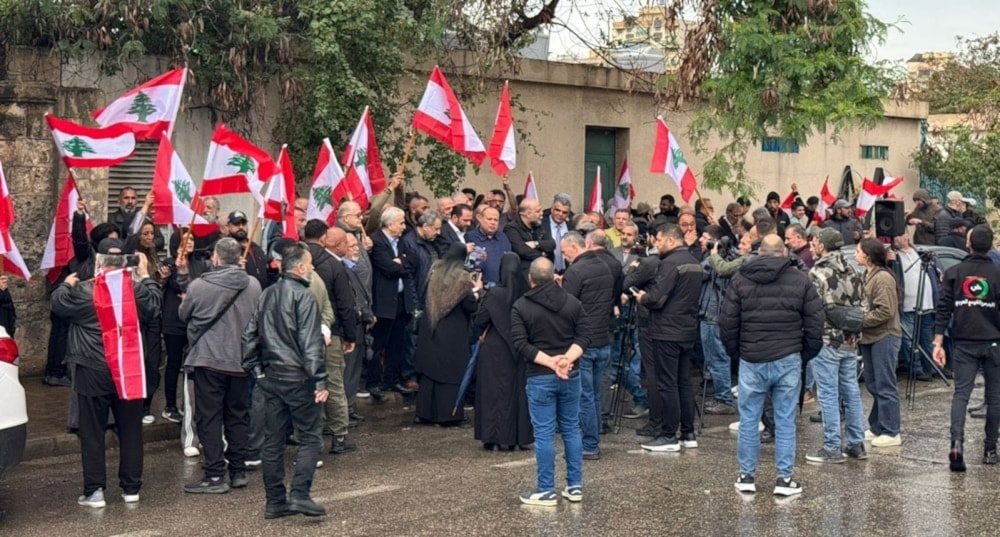
Protesters outside the Military Court in Beirut in rejection of the prosecution of Resistance fighters, Tuesday, April 7, 2026 (Social media)
A protest was held in Beirut on Tuesday outside the military court, in rejection of political interference in the judiciary and the prosecution of Resistance fighters.
In remarks to Al Mayadeen, Syrian Social Nationalist Party leader Rabih Banat stressed the need to avoid detaining any Resistance members, calling for the judiciary to remain independent and away from any political influence.
On his part, National Banner Party leader Ali Hijazi warned against mounting pressure on the judiciary, saying such actions threaten the principle of justice.
He emphasized opposition to prosecuting Resistance fighters, arguing that such measures contradict the Taif Agreement, and added that targeting Resistance members aligns with the actions of the enemy.
"We say clearly that whoever pursues and holds a Resistance fighter accountable is no different from what the Israeli enemy does," Hijazi said.
"We will not accept that the judiciary be used to settle political scores."
🔹نقول بوضوح إن من يلاحق مقاوماً ويحاسبه لا يختلف عمّا يقوم به العدو الإسرائيلي
— الميادين لبنان (@mayadeenlebanon) April 7, 2026
🔹لن نقبل بأن يُختطف القضاء أو أن يُستخدم لتصفية الحسابات السياسية
رئيس حزب الراية الوطني، علي حجازي، خلال وقفة احتجاجية أمام المحكمة العسكرية في بيروت.#الميادين@Ali_YHijazi pic.twitter.com/qGEJ0aNNxZ
Previously, Lebanese Prime Minister Nawaf Salam had announced the detention of fighters from the Islamic Resistance in Lebanon who were reportedly heading south while carrying rockets.
More context on the government's stance on Resistance
In early March, the Council of Ministers in Lebanon had issued a formal ban on the Lebanese Resistance's military activities following its decision to retaliate against "Israel's" 15 months of violations of the ceasefire, during which hundreds of Lebanese civilians were killed. The Lebanese Army was also ordered to withdraw rather than defend the border.
In a statement, Nawaf Salam said the Cabinet's measures were taken "in accordance with the Constitution, the National Reconciliation Document, and the government’s ministerial statement."
The Council of Ministers condemned the defensive retaliatory strikes as a "violation of Lebanon's constitutional authority over decisions of war and peace." It warned that such actions risk dragging Lebanon into the ongoing regional war, in contradiction with Cabinet decisions, undermining the credibility of the state.
The decisions adopted by the Cabinet included the following measures:
- Immediate ban on military activities;
- Weapons confinement north of the Litani River;
- Press guarantor states to halt Israeli attacks;
- Intensify diplomacy;
- Displacement response.
Hezbollah's parliamentary chief, Mohammad Raad, addressed the contradiction directly. While acknowledging the state's constitutional authority over war and peace, Raad argued that such authority cannot be meaningfully exercised against an enemy that has spent over a year violating national sovereignty with impunity.
"There is no justification," he said, "for President Salam and his government to take bold and confrontational measures against Lebanese citizens who reject occupation," while the enemy itself has refused to uphold any semblance of calm.
Read more: Lebanon PM vows no retreat on state authority over war and peace


