
Republicans on edge as 14 House seats shift toward Democrats
 7 Min Read
Cook Political Report downgrades key Republican-held House races as Democrats gain ground, intensifying the battle for control of Congress ahead of November 3.
-
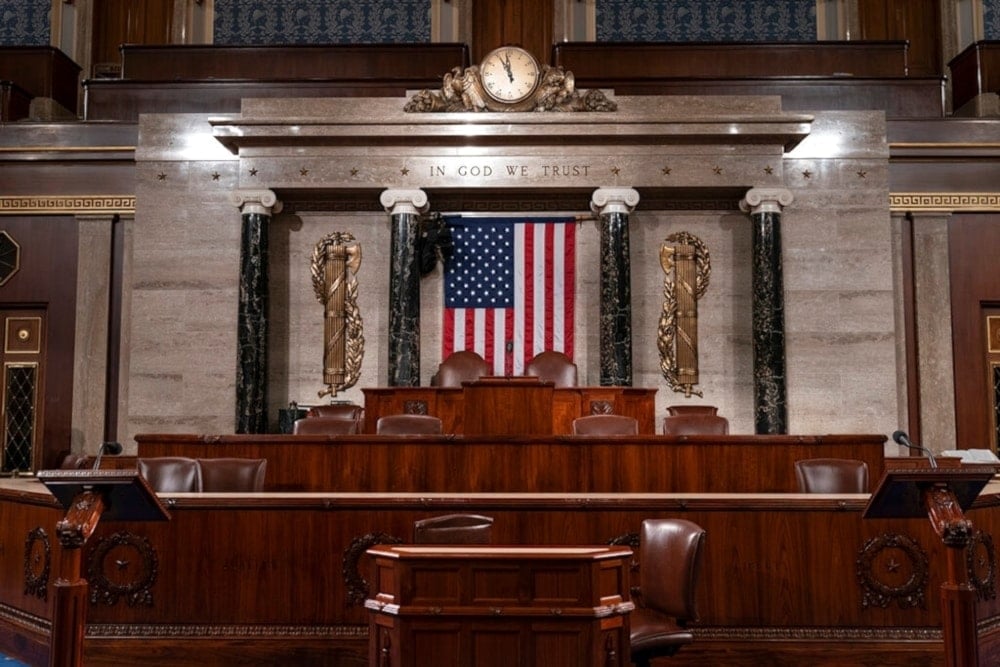
The chamber of the House of Representatives is seen at the Capitol in Washington, Feb. 3, 2020 (AP)
Republicans are facing fresh warning signs ahead of the November 3 midterm elections, with ratings compiled by the Cook Political Report indicating that 14 Republican-held House seats across 10 states are moving in the Democrats’ favor.
The latest assessments suggest that several contests once viewed as relatively safe for the GOP could become more competitive as Election Day approaches, Newsweek reported.
The shifting outlook comes as Republicans attempt to preserve their narrow control of both chambers of Congress. Economic pressures, persistent inflation, US President Donald Trump’s performance in office, and the ongoing US war against Iran are among the issues shaping the political landscape.
Increasingly competitive environment
Republicans currently hold a 218-214 advantage in the House of Representatives and a 53-47 majority in the Senate. With both margins leaving little room for defections, Democrats see an opportunity to reclaim one or both chambers, including through contests in states that have traditionally favored Republicans.
Despite the increasingly competitive environment, the Republican National Committee insists that it remains focused on defending its congressional majority.
“Republicans remain laser-focused on winning, protecting and expanding President Trump’s House majority,” RNC Press Secretary Natalie Baldassarre told Newsweek.
She added that Republicans were directing resources toward battleground districts to promote Trump’s record, support GOP candidates, and challenge historical trends in the November 3 elections.
Several Republican-held seats face tighter races
A Cook Political Report assessment released Friday identified 11 House races shifting toward Democrats, including five Republican-held seats across four states. All five remained in the “lean Republican” category, indicating that the GOP was still favored but faced a more difficult path than previously anticipated.
An earlier assessment published on October 9 had also identified nine Republican-held districts moving in the Democrats’ direction, including seats in states Trump carried comfortably in the 2024 presidential election.
Although the changing ratings do not guarantee Democratic victories, they point to a more uncertain electoral landscape for Republicans.
Minnesota and Ohio
In Minnesota, the race in the 1st Congressional District, represented by Republican Brad Finstad, has moved from “likely Republican” to “lean Republican.” Finstad is challenging Democrat Jake Johnson, with some polls showing the contest effectively tied. Trump carried the district by 12 percentage points in 2024.
Ohio has also seen two Republican-held seats downgraded from “likely Republican” to “lean Republican.” They are the 10th District, represented by Mike Turner, and the 15th District, represented by Mike Carey.
Turner faces Democrat Kristina Knickerbocker, while Carey is running against Don Leonard. Trump won Ohio by nearly 12 percentage points in 2024.
The state is also a focus of the Senate battle, where Republican Senator Jon Husted faces former Democratic Senator Sherrod Brown in a contest that could help determine control of the upper chamber.
Kansas and Nebraska
In Kansas, the 2nd Congressional District, represented by Republican Derek Schmidt, has shifted from “solid Republican” to “likely Republican.” Democrat Don Coover is challenging Schmidt in a district Trump won by 20 percentage points in 2024.
A similar change occurred in Nebraska’s 1st Congressional District, where Republican Mike Flood’s race moved from “solid Republican” to “likely Republican.” Flood faces Democrat Chris Backemeyer. Trump also carried Nebraska by 20 percentage points in 2024.
The revised classifications still favor Republicans in both districts, but they suggest that the races may be less secure than earlier assessments indicated.
Iowa emerges as a major battleground
Iowa presents a more immediate challenge for Republicans. The races involving Representatives Mariannette Miller-Meeks in the 1st Congressional District and Zach Nunn in the 3rd have shifted from “toss-up” to “lean Democratic.”
Miller-Meeks faces Democrat Christina Bohannan, while Democrat Sarah Trone Garriott is challenging Nunn. Trump won Iowa in all three of his presidential campaigns, including by nearly 14 percentage points in 2024.
The state is also central to the Senate contest following Republican Senator Joni Ernst’s decision to retire. Republican Ashley Hinson and Democrat Josh Turek are competing for the seat, adding to the state’s significance in the battle for congressional control.
Pennsylvania races move toward Democrats
Three Republican-held districts in Pennsylvania have also seen changes in their electoral outlook.
The races in the 7th and 10th Congressional Districts, represented by Republicans Ryan Mackenzie and Scott Perry, respectively, have moved from “toss-up” to “lean Democratic” in Cook’s ratings. The 1st District, represented by Republican Brian Fitzpatrick, has shifted from “likely Republican” to “lean Republican.”
Democratic challengers include Bob Brooks in the 7th District, Janelle Stelson in the 10th, and Bucks County Commissioner Bob Harvie in the 1st. Stelson has led Perry in recent polling.
Pennsylvania remains a crucial battleground: Trump won the state by less than two percentage points in 2024.
Michigan and Virginia contests tighten
In Michigan, Republican Representative Bill Huizenga’s 4th Congressional District race has moved from “lean Republican” to “toss-up.” His Democratic challenger is state Senator Sean McCann. Trump carried Michigan by 1.4 percentage points in 2024.
The state’s Senate race is also competitive, with Democrat Abdul El-Sayed facing Republican Mike Rogers, a former congressman, in the contest to replace retiring Democratic Senator Gary Peters.
Virginia has produced another setback for Republicans. The 1st Congressional District, represented by Republican Rob Wittman, has been downgraded from “lean Republican” to “toss-up.”
Democrat Shannon Taylor led Wittman by four percentage points in a recent Washington Post poll. Trump lost Virginia to Kamala Harris by five percentage points in 2024.
Republican advantages weaken in Arkansas and Indiana
Even in states that strongly backed Trump in 2024, some Republican-held districts have received less favorable ratings.
In Arkansas, the 2nd Congressional District, represented by Republican French Hill, has shifted from “solid Republican” to “likely Republican.” Democrat Chris Jones, a nuclear engineer who ran for governor in 2022, is challenging Hill. Trump won Arkansas by more than 30 percentage points in 2024.
Indiana’s 5th Congressional District has undergone the same downgrade, moving from “solid Republican” to “likely Republican.” Republican Representative Victoria Spartz faces Democratic state Senator JD Ford in a district Trump carried by 19 percentage points in 2024.
The changes indicate that Republicans are encountering potential vulnerabilities beyond the most closely contested battleground states, although the GOP remains favored in both districts.
Early voting raises the stakes
With Election Day scheduled for November 3, early voting has already begun in most states and will continue in the run-up to the vote.
The latest ratings underscore the challenge facing Republicans as they seek to maintain their congressional majorities. Democrats, meanwhile, have an opportunity to capitalize on increasingly competitive House races and a series of closely contested Senate contests.
The outcome will depend on whether Democrats can convert the shifts in electoral ratings into victories at the ballot box, while Republicans seek to hold their ground through the final weeks of campaigning.


