
Russia, DPRK open first road bridge across shared border
 3 Min Read
The crossing is named after Soviet officer Yakov Novichenko, credited with saving DPRK founding leader Kim Il-sung from an assassination attempt.
-
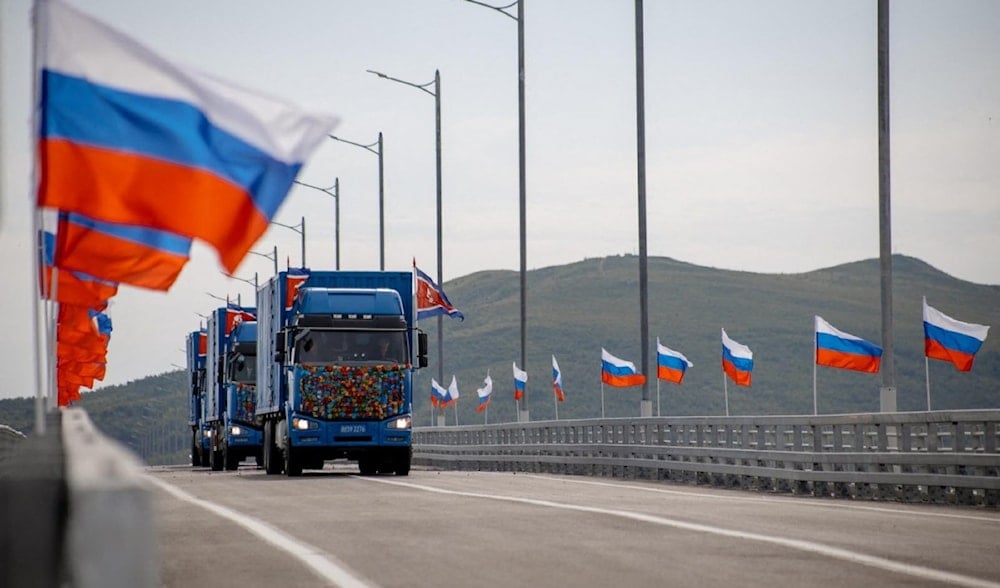
Handout image released by the Russian Transport Ministry, September 7, 2026, shows Russian flags flying as DPRK trucks cross the new Russia-DPRK road bridge over the Tumen River during its opening ceremony. (Handout / Russian Transport Ministry / AFP)
Russia and the Democratic People's Republic of Korea (DPRK) have opened the first road bridge across their shared border, marking the latest step in the rapidly deepening ties between the two countries since the onset of the war in Ukraine.
The one-kilometer bridge spans the Tumen River, connecting Khasan in Russia's far east with Tumangang in the DPRK, along a remote stretch of the border close to the coast.
Speaking by video link at Monday's opening ceremony, Russian Prime Minister Mikhail Mishustin said the new crossing would drive development across several sectors, including tourism, and generate new jobs.
"The expansion of cross-border transport infrastructure will provide a powerful impetus for the further development of trade, economic, scientific, technological and cultural cooperation," he said.
Convoys of vehicles crossed the bridge from both sides following the ceremony.
North Korea and Russia opened their first road bridge over the Tumen River, marking another step in their growing strategic ties. pic.twitter.com/deP9MJdKaO
— Clash Report (@clashreport) September 7, 2026
Bridge named after Soviet officer
The crossing is named after Soviet officer Yakov Novichenko, credited with saving DPRK founding leader Kim Il-sung from an assassination attempt by a pro-South Korean group. The naming reflects the historical framing Pyongyang has increasingly attached to its relationship with Moscow, tracing the alliance back to the Soviet role in Korea's liberation from Japanese colonial rule.
Russia and the DPRK are already linked by a railway bridge across the Tumen, along with regular flights between Vladivostok and Pyongyang.
Alliance has deepened sharply since 2022
Ties between Moscow and Pyongyang have strengthened considerably since the start of the Russia-Ukraine war in 2022. The DPRK sent thousands of troops to Russia's Kursk region to help repel a Ukrainian incursion launched there in 2024, an intervention Putin has previously credited as decisive to the region's liberation.
In return, Russia is believed to have supplied the DPRK with air-defense missiles, electronic warfare equipment, drones and spy-satellite technology, according to South Korean intelligence.
Russian and DPRK officials have also promoted the DPRK as a new holiday destination since the country reopened to Russian tourists in 2024, with thousands visiting its newly opened beach resorts and ski slopes since then.
Part of a broader strategic partnership
The bridge adds to a pattern of institutionalized cooperation that has accelerated since the two countries signed their Treaty on Comprehensive Strategic Partnership in June 2024, which includes provisions for mutual assistance should either country come under armed attack.
That partnership has since been marked by a string of high-level exchanges. In April, Pyongyang inaugurated a memorial museum honoring KPA soldiers killed fighting in Russia, attended by Russian Defense Minister Andrei Beloussov, who indicated Moscow was prepared to sign a military cooperation framework covering 2027 to 2031.
In August, Kim Jong Un reaffirmed the alliance in a message to Putin marking the anniversary of Korea's liberation, describing the Soviet role in that liberation as an enduring foundation for DPRK-Russia relations today.
Both governments have repeatedly characterized the relationship as having entered a new stage, built around strategic coordination, sovereignty, and joint opposition to external pressure.


