
Sanaa airport reopens after damage from Saudi attacks repaired
 2 Min Read
Sanaa International Airport has resumed operations following repairs to extensive runway damage caused by recent Saudi airstrikes.
-
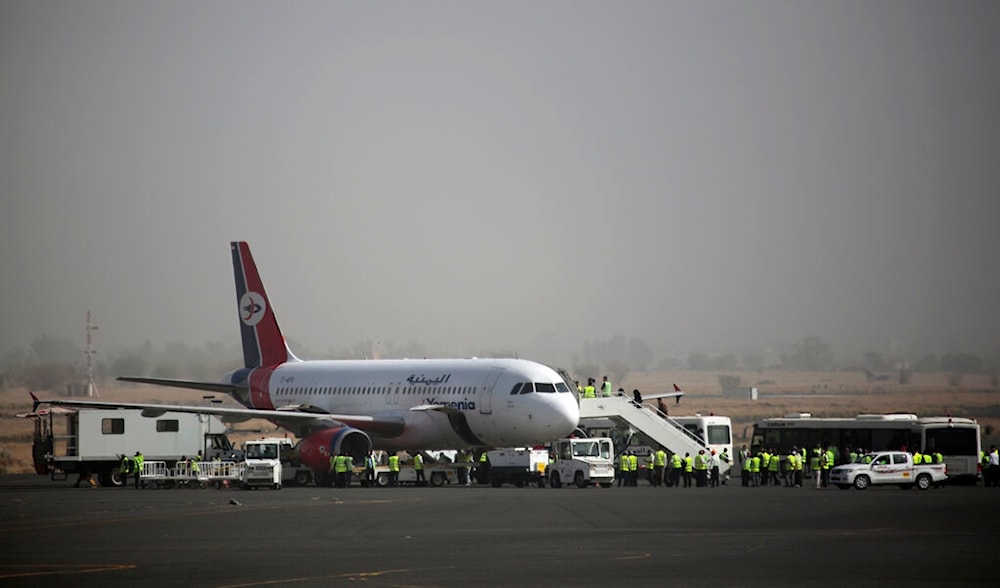
A Yemen Airways plane is prepared for departure as the first commercial flight at Sanaa airport, Yemen, Monday, May, 16, 2022. (AP Photo/Hani Mohammed)
Sanaa International Airport is back up and running after crews finished repairing extensive damage from the latest round of Saudi attacks, Yemen's Ministry of Transport and Public Works said Wednesday, according to the Saba News Agency.
The airport had been hit two days earlier in a series of Saudi bombings that knocked out both runways, in an attempt to stop an Iranian Mahan Air passenger jet from landing. That plane was bringing an official Yemeni delegation home from Tehran, where they had attended the funeral of Martyred Iranian Leader Sayyed Ali Khamenei.
The aircraft ended up diverting to Hodeidah International Airport, which had sat idle for more than a decade, and landed there safely.
'Airport for airport, blockade for blockade'
The airport's reopening comes a day after the Yemeni Armed Forces put every airline on notice, warning them to steer clear of Saudi airspace until the blockade on Sanaa Airport is lifted.
The warning follows an escalation that began Monday, when Saudi warplanes struck Sanaa International Airport, prompting a retaliatory operation by the Yemeni Armed Forces against Abha International Airport using ballistic missiles and drones.
In the aftermath, Yemeni Military Media released footage titled "The response is coming," mapping potential Saudi targets should the aggression continue, including King Khalid International Airport in Riyadh, King Abdulaziz International Airport in Jeddah, King Fahd International Airport in Dammam, Jazan Port, Jeddah Islamic Port, King Fahd Industrial Port, and the Ras Tanura refinery and export complex.
Sanaa Airport has been shut to commercial traffic since the Saudi-led coalition imposed a blanket ban on Yemeni airspace on August 9, 2016. It remains the country's main lifeline, serving close to 80 percent of Yemen's population, roughly 20 million people.


