
SAS accused of planting weapons, executing detainees in Afghanistan
 5 Min Read
A UK inquiry reveals attempts by top military officials to cover up SAS war crimes in Afghanistan, including unlawful killings of civilians and children.
-
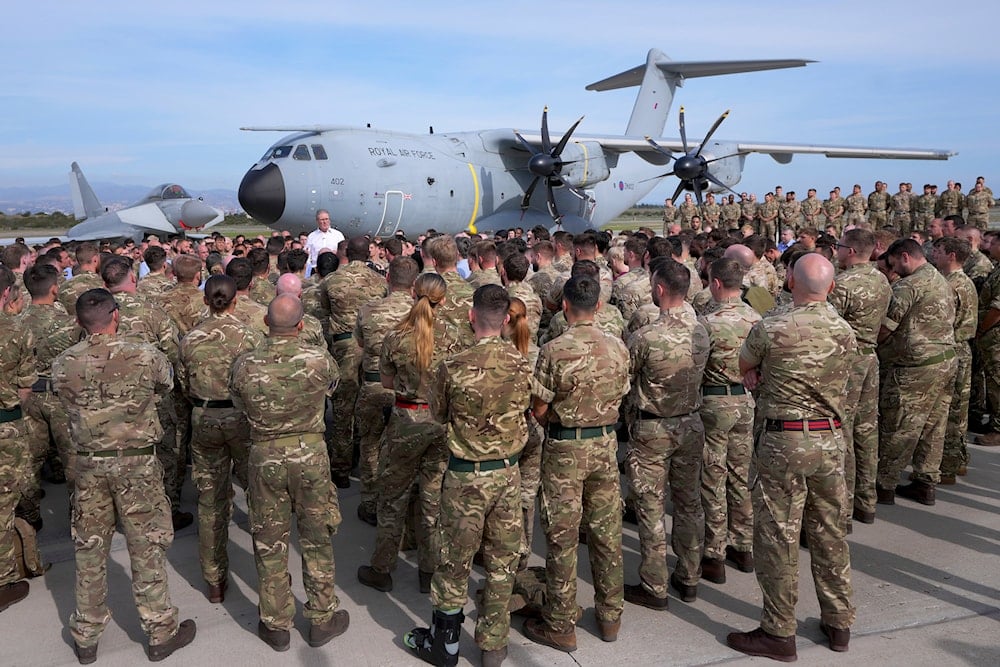
Britain's Prime Minister Keir Starmer speaks to soldiers at the RAF base in Akrotiri, Cyprus, Tuesday, Dec. 10, 2024 (AP)
The former director of UK special forces, along with other senior military officials, attempted to suppress warnings that SAS units in Afghanistan were carrying out unlawful killings, an inquiry has heard, as reported by The Guardian.
A senior special forces whistleblower said the chain of command neglected to halt extrajudicial shootings, including the killing of two young children, after concerns were first raised in early 2011, allowing such incidents to continue until 2013.
The cover-up allegations are among the most serious raised at the inquiry into claims that British SAS units summarily killed 80 people in Afghanistan, with the investigation led by Lord Justice Haddon-Cave after being launched in 2023.
Whistleblower raised concerns of potential war crimes in 2011
The whistleblower, identified only as N1466, stated that he first raised concerns about potential “war crimes” with the director of special forces and other officials in February 2011.
According to recently released redacted transcripts of evidence provided in secret last year, the officer stated, “We could have stopped it in February 2011. Those people who died unnecessarily from that point onwards, there were two toddlers shot in their bed next to their parents … all that would not necessarily have come to pass if that had been stopped.”
The officer’s allegation seems to relate to the severe injuries suffered by the children of Hussain Uzbakzai and his wife, Ruqquia Haleem, Imran and Bilal, who are reported to have been shot while sleeping in their beds during a nighttime raid in the village of Shesh Aba in Nimruz province in 2012, in which both of their parents were also killed.
“Even to this day, they are grieving the incident that happened to us … We are asking for the court to listen to these children and bring justice," the children's uncle, Aziz, stated, speaking to the inquiry in 2023.
N1466 claimed that the director at the time, along with others, attempted to conceal details of the alleged criminal acts, telling the inquiry that the director deliberately chose to suppress the information, stage a misleading exercise, and create the appearance of taking action without actually addressing the wrongdoing.
He told the inquiry that the director initiated a review of tactics, techniques, and procedures (TTP) to deflect external scrutiny, stating, “It was blatantly clear from the statistics and the patterns that there was something wrong here … I believe he knew it wasn’t … a problem with the TTP,” and added: “The root problem was the intent [to kill]”.
Whistleblower found evidence illegal killings continued
After a period away from the special forces, N1466 returned in 2014 and discovered that the killings had persisted, with a summary of his evidence indicating that it was clear the actions had continued at least into 2013, which he found deeply shocking. When he raised his concerns with the military police in 2015, N1466 stated that he felt he was “part of an organisation which allowed rogue elements to act as they did outside the law.”
Referring to a specific raid, he told the military police that special forces fired at a mosquito net until there was no movement, explaining that when the net was lifted, it revealed women and children, and that the incident was subsequently concealed while the soldier responsible was given an award to create the appearance of legitimacy.
He also expressed remorse for not reporting his suspicions about unlawful killings to the Serious Investigations Branch in 2011, telling the inquiry that he had lost all confidence that the chain of command would support a transparent and accountable investigation.
N1466 stated that many individuals wanted the issue to be suppressed, and he expressed that he was both surprised and disappointed that a special forces lawyer had not advised reporting the concerns to the Serious Investigations Branch.
Sharp rise in ratio of killings to weapons retrieved
While reviewing reports of SAS raids, N1466 became alarmed by a marked increase in the number of killings compared to the weapons recovered, noting one raid in which nine Afghans were killed but only three rifles were recovered and observing repeated instances where detainees were taken during raids and then shot dead.
“We are talking about war crimes … taking detainees back on target and executing them, with the pretence being that they conducted violence against the forces … As detainees, UKSF owed a duty of care to them under the Geneva conventions. To have repeated breaches of the Geneva conventions was clearly not acceptable," the whistleblower stated.
N1466 also raised suspicions that weapons were being planted on the victims, and he highlighted photographic evidence indicating that some victims had been shot in the head at close range, including while they were asleep.
“I was deeply troubled by what I strongly suspected was the unlawful killing of innocent people, including children, and that the success of the whole campaign with the heavy investment of lives lost by UK and Afghan forces was being jeopardised by these killings," he added, describing the killings as a "stain" on the reputation of the SAS.
He told the inquiry, “We didn’t join UKSF for this sort of behaviour – toddlers to get shot in their beds or random killing. It’s not special, it’s not elite, it’s not what we stand for and most of us, I don’t believe, would either wish to condone it or to cover it up.”


