
Sayyed Ali Khamenei farewell ceremony concludes in Tehran
 5 Min Read
Iran concluded a two-day public farewell ceremony for Sayyed Ali Khamenei in Tehran ahead of Monday's funeral procession and the continuation of six-day funeral rites.
-
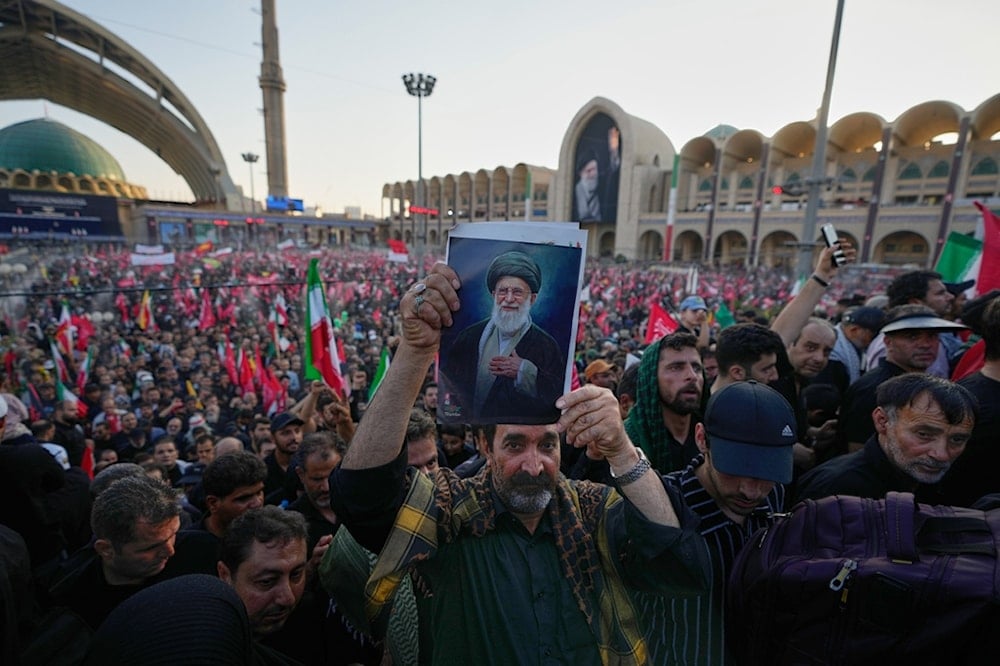
A man holds a picture of martyred Iranian Leader Ayatollah Sayyed Ali Khamenei as mourners gather during funeral ceremonies at the Imam Khomeini Mosalla Grand Mosque in Tehran, Iran, Sunday, July 5, 2026 (AP)
The public farewell ceremony for the martyred international leader Sayyed Ali Khamenei concluded on Sunday evening in Tehran after nearly two days of continuous public attendance at Imam Khomeini Mosalla, ahead of the official funeral procession scheduled for Monday.
An Al Mayadeen correspondent in Tehran, the final moments of the ceremony saw the curtain drawn for the last time over the coffin of Sayyed Khamenei, illuminated in red as a symbol of mourning while the anthem "Be Aman Allah Ya Shahid Allah" ("Go in God's protection, O Martyr of God") was played.
The farewell ceremonies began on Saturday morning and drew large crowds from across Iran, including families of martyrs, resistance fighters, civilian and military officials, and foreign delegations. Organizers extended the event to accommodate the continuous arrival of mourners.
Throughout the two-day ceremony, Imam Khomeini Mosalla served as the focal point for public mourning, with visitors reciting the Holy Quran, performing prayers, and offering elegies while renewing their commitment to the principles of the Islamic Revolution and its martyrs.
Funeral procession to continue across Iran and Iraq
The farewell ceremony concluded after the last groups of mourners paid their respects, after which Sayyed Khamenei's body was transferred from Imam Khomeini Mosalla to continue the remaining stages of the funeral rites.
The official funeral procession is scheduled to take place on Monday morning in Tehran with broad public participation alongside senior Iranian officials and international guests.
The funeral ceremonies are set to continue over six consecutive days across several Iranian cities as well as stops in Iraq. Organizers estimate that between 15 and 20 million mourners could participate, potentially making it the largest state funeral in Iran's history.
According to the official schedule, following the Tehran procession, the body will be transferred to Qom before traveling to the holy Iraqi cities of Najaf and Karbala. It will then return to Iran for burial on July 9 at the shrine of Imam Reza in Mashhad.
Iranian commanders vow revenge
On the last day of the ceremony, Iranian military commanders issued a series of statements pledging continued loyalty to the late Leader Sayyed Ali Khamenei, vowing retaliation against his killers, and reaffirming commitment to his ideological and strategic path.
Iranian Army Commander Major General Amir Hatami said in a public address that the late Sayyed Khamenei “drew a path of dignity and independence, and prepared for us all the means to follow it,” adding that the armed forces “will continue the path behind our commander Sayyed Mojtaba Khamenei with unwavering strength and determination.”
Hatami further pledged that the Iranian public “will not allow the enemies to escape punishment” and that “they will be held accountable for their crimes.”
Separately, Deputy Commander of the Armed Forces Admiral Habibollah Sayyari said the commander “will remain alive in our minds forever” and that Iranian forces “will follow his recommendations.”
Sayyari added that Iran had “made a pledge to remain with our martyred leader and we renew that pledge today,” stressing that “the idea of vengeance is always present in our minds.”
Millions attend mass funeral in Tehran
The statements by Iranian military commanders come amid ongoing mass funeral ceremonies in Tehran, where millions of mourners have gathered to bid farewell to the late Leader Sayyed Ali Khamenei in one of the largest public gatherings in the country’s modern history.
The funeral ceremonies represent a major demonstration of national unity and strength, as millions of mourners gathered across Tehran for one of the largest public commemorations in the country’s modern history.
Iranian government spokesperson Fatemeh Mohajerani said the scale of participation in the funeral ceremonies reflects the country’s internal cohesion and resilience, noting the large influx of participants from outside the capital.
Speaking to the Iranian state news agency IRNA while attending the funeral, she said: “It is clear, given the level of public interest in attending, that the most significant aspect is the large number of people present, because this is one of the manifestations of our national strength.”
She added that the “enthusiastic turnout” showed that “our dignity and our system continue to endure,” pointing to widespread public participation in both the funeral prayer and farewell ceremonies.
Mohajerani said a special committee had been formed to oversee the funeral arrangements, holding regular meetings to coordinate logistics. She added that responsibilities were distributed at the national level, with routes designated and provincial governors involved in the preparations.


