Sayyed Khamenei funeral carries global significance, gathers millions
 3 Min Read
Millions gathered in Tehran for the funeral of martyred Iranian Leader Sayyed Ali Khamenei, in a ceremony Iranian officials say is a defining political and historical moment reflecting national unity and regional resolve.
-
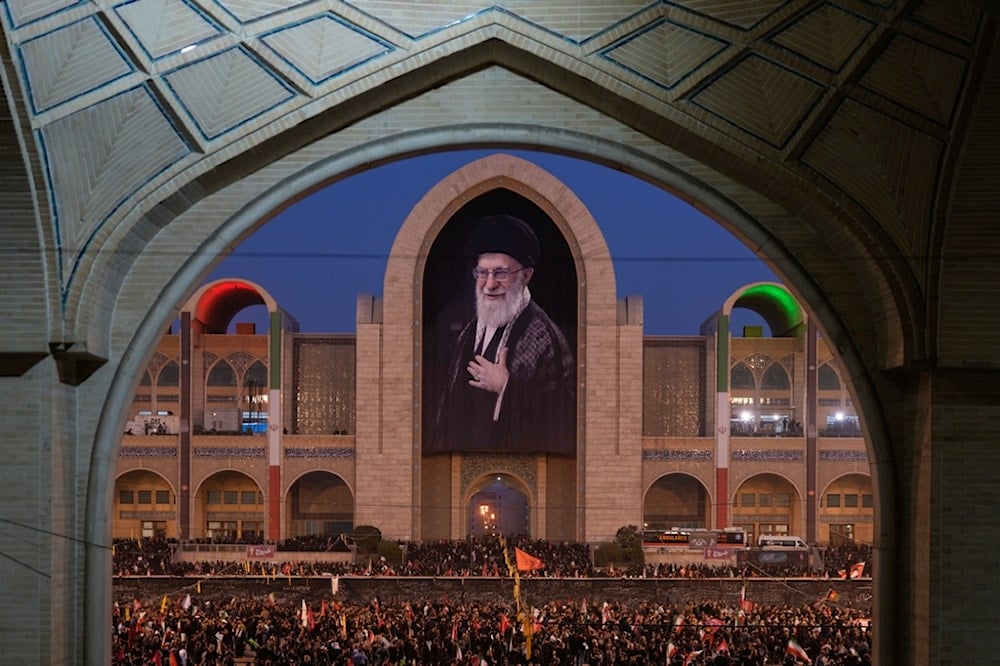
Mourners gather beneath a portrait of Iran's martyred leader Sayyed Ali Khamenei during the funeral ceremonies for him and members of his family at the Imam Khomeini Mosalla Grand Mosque in Tehran, Iran, Saturday, July 4, 2026 (AP Photo/Altaf Qadri)
Millions of mourners converged on Tehran on Saturday for the second day of funeral ceremonies for the martyred Iranian Leader, Sayyed Ali Khamenei, in what is set to be one of the largest public gatherings in the history of the Islamic Republic.
Participants traveled from across Iran and from more than 100 countries, according to Iranian estimates, joining official delegations, Resistance figures, and religious scholars in paying tribute to the Leader martyred in the joint US-Israeli aggression on Iran.
The streets of the capital were filled with mourners dressed in black, carrying Iranian flags, red banners, and portraits of Sayyed Khamenei, alongside images of his successor, Sayyed Mojtaba Khamenei. Slogans expressing loyalty to the Islamic Republic and calls for retaliation echoed throughout the procession.
Crowds repeatedly chanted, “Our word is one: revenge, revenge,” and “Death to America,” reflecting demands for accountability over the assassination.
Speaking during the procession, Hananeh Mousavi, 27, said, “I am here to bid farewell to my beloved leader, Ali Khamenei. I never imagined I would witness a day like this.”
Ali Kazemi, who traveled more than 530 kilometers from Tabriz, said, “We came to show that we remain committed to defending our country and our religion.”
Hamid Teymouri from Hamedan said the loss of Sayyed Khamenei affected him more deeply than any personal family tragedy.
Read more: On America's 250th, the world mourns the man who humiliated it
Tehran frames funeral as message of resilience
Iranian officials have stated that the funeral defines a political and historical moment, emphasizing national cohesion and continuity amid regional tensions.
They argue that the scale of participation demonstrates the failure of attempts by Washington and the Israeli occupation to weaken or isolate Iran. Instead, the event is portrayed as a public affirmation of institutional stability and support for the Islamic Republic and the Axis of Resistance.
The transition of leadership is being framed as a continuation of the revolutionary path rather than a rupture, reinforcing Tehran’s position during a sensitive regional phase.
Regional tensions unfold alongside ceremonies
The funeral has coincided with escalating regional developments following the US-Israeli aggression against Iran.
Iran warned the United Kingdom and France against military moves in the Strait of Hormuz after both countries announced plans to support what they claim to be freedom of navigation operations.
CNN reported, citing US officials, that Washington had attempted to warn Iran during indirect negotiations over concerns that the Israeli occupation could target mediators involved in talks.
Iran’s Intelligence Ministry reiterated that retaliation for Sayyed Khamenei’s assassination is inevitable, holding the United States and the Israeli occupation responsible and calling for broad participation in the funeral as a demonstration of unity.
Read more: Tehran airspace to close during Sayyed Khamenei funeral