
Senate to vote on curbing Trump's war on Iran
 5 Min Read
The US Senate is preparing to vote on a War Powers resolution aimed at preventing Trump from ordering further strikes on Iran without congressional approval.
-
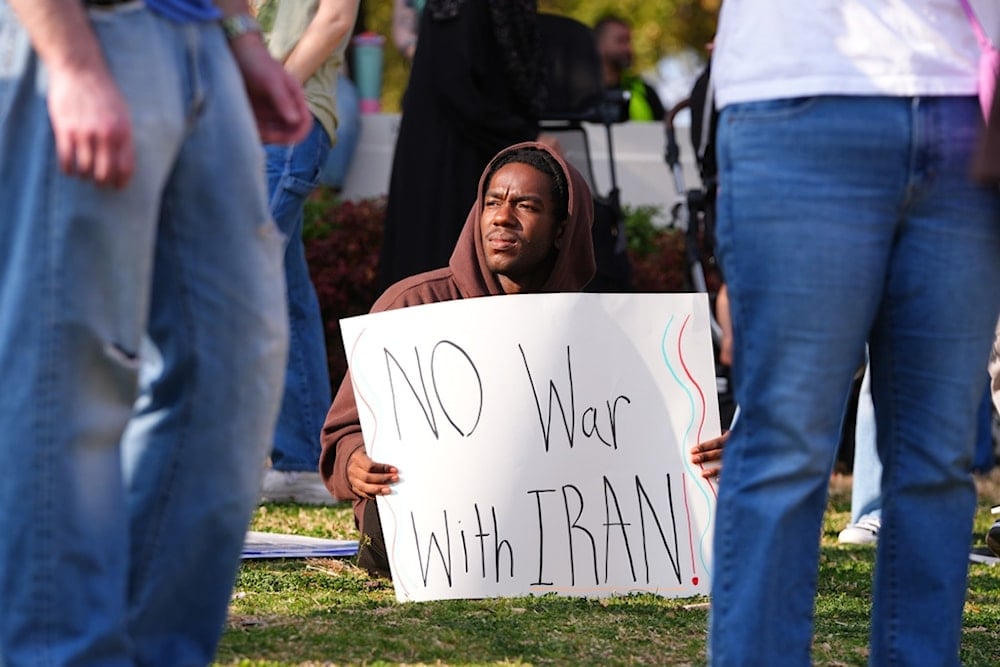
Shemar Franklin holds a sign protesting war against Iran during an antiwar demonstration at Dealey Plaza in downtown Dallas, Sunday, March 1, 2026 (AP)
The US Senate is preparing to hold an initial vote on legislation aimed at preventing President Donald Trump from ordering further military strikes against Iran without congressional authorization, in what lawmakers describe as an effort to rein in an escalating and controversial war launched without Congress’s consent, The Washington Post reported.
The push, led by Democratic senators and supported by Republican Senator Rand Paul of Kentucky, centers on a War Powers resolution intended to halt additional US military action unless lawmakers formally approve it. Critics argue that Trump’s decision to initiate the campaign against Iran has bypassed the constitutional process required to authorize war.
Democrats are urging a small group of Republican senators to break with their party and support the resolution, warning that the administration’s unilateral decision risks dragging the United States into a prolonged and destabilizing war.
“I pray so hard for my colleagues to exercise the judgment that this is not the right time for more war,” Senator Tim Kaine of Virginia said Monday on the Senate floor.
Congress divided over Iran war
The vote comes as Washington faces mounting criticism over a military offensive launched alongside "Israel" that has rapidly expanded across the region and raised fears of a broader war. Some lawmakers say the operation mirrors earlier US interventions that escalated into long and costly conflicts.
Senate Minority Leader Chuck Schumer warned that continuing the offensive could repeat the mistakes of previous wars in the Middle East.
“I pray that my colleagues will vote to end this dangerous and unnecessary war that has already resulted in the loss of six servicemembers and injured others,” Schumer said in a statement. “We owe it to those in uniform, their families, and all Americans to not make the same mistakes that we made in Iraq and Afghanistan.”
Republican leaders, however, have largely defended the administration’s actions and signaled they will oppose efforts to limit the president’s authority. Senator Lindsey Graham argued that Trump should be allowed to continue the military campaign.
“We should let him finish the job,” Graham told reporters. “We should cheer him on, in my view.”
House vote looms
The House of Representatives is expected to consider a similar measure later this week, though its prospects appear equally uncertain. House Speaker Mike Johnson indicated he believes there are sufficient votes to defeat the effort.
“The idea that we would take the ability of our commander in chief … to finish this job is a frightening prospect to me,” Johnson said. “It’s dangerous, and I am certainly hopeful — and I believe we do — have the votes to put it down.”
In the Senate, the resolution would require at least four Republicans to join Democrats in order to pass if all senators vote. At least one Democrat, Senator John Fetterman of Pennsylvania, has already said he plans to oppose it.
Even if the measure were approved by both chambers of Congress, Trump could veto the legislation. Overriding such a veto would require a two-thirds majority in both the Senate and the House, a threshold that has never been reached for a War Powers resolution.
Procedural vote opens debate
The vote scheduled for Wednesday is procedural and would only advance the measure toward a final vote. Lawmakers could still change their positions before its ultimate passage, as has happened with similar efforts in the past.
Democrats had hoped to force a vote before the latest round of hostilities began, but did not do so while talks between Washington and Tehran were still ongoing.
Some lawmakers have drawn comparisons between the current escalation and the lead-up to the 2003 invasion of Iraq, noting that former president George W. Bush sought congressional approval before launching that war, something Trump has not done in the case of Iran.
Under the War Powers Resolution adopted in 1973 following the Vietnam War, Congress can force votes to end hostilities or block military action when conflict appears imminent. The law also requires the president to terminate military operations within 60 days, or 90 days if an extension is requested, unless Congress declares war or grants authorization for the use of military force.
Republicans back Trump
Despite those provisions, Republican leaders have argued that the president already has the authority to continue the campaign.
“I think the president has the authority that he needs to conduct the activities, the operations that are currently underway there,” Senate Majority Leader John Thune told reporters.
Administration officials, including Secretary of State Marco Rubio and Defense Secretary Pete Hegseth, briefed lawmakers behind closed doors on Tuesday about the unfolding war.
Following the briefing, Senator Chris Murphy suggested the administration had little intention of seeking congressional approval even if the war deepens.
“I think they have contempt for Congress,” Murphy told reporters. “They have no plans to come to Congress for any authorization, even if they were to insert ground forces.”
Read more: US troops being told war on Iran is 'God's divine plan'


