
Seven killed, 34 wounded in Jordan church attack during funeral
 3 Min Read
King Abdullah II vows "harsh retaliation" following the church attack that killed and injured dozens.
-
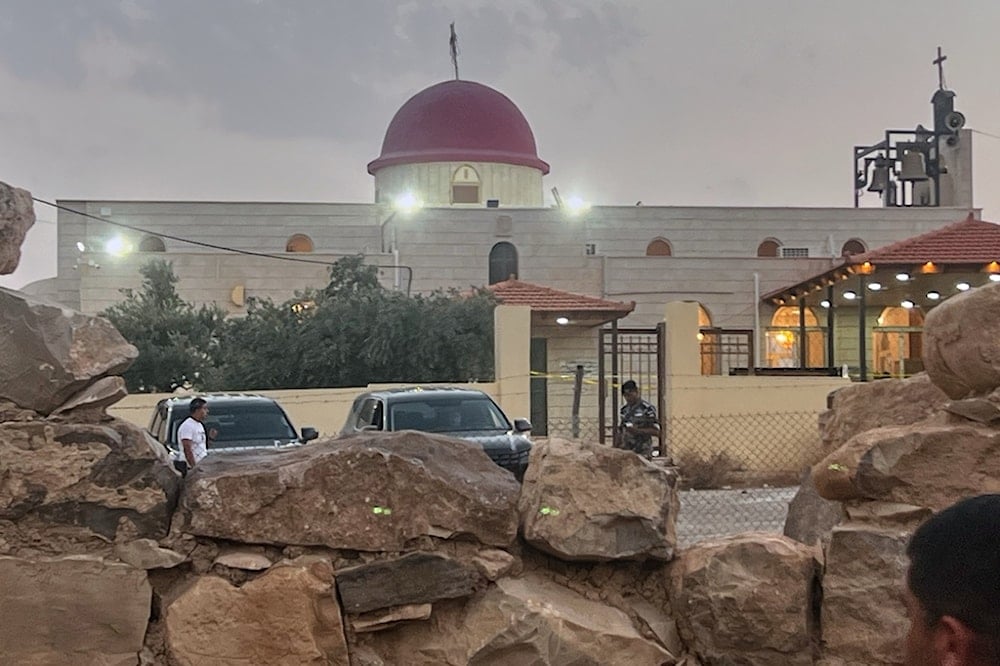
A security officer stands guard outside a Greek Orthodox Church where gunmen opened fire during a funeral earlier in Hamoud village, in Jordan's Karak governorate, Friday, Oct. 23, 2026 (AP)
At least seven people were killed and 34 were wounded when gunmen opened fire during a funeral at a Greek Orthodox church in Jordan’s southern Karak governorate on Friday, authorities said.
Interior Minister Mazen al-Faraya described the shooting as a "terrorist attack" carried out by a “group of extremists,” while King Abdullah II promised "harshest retaliation".
The Public Security Directorate said the gunmen opened fire inside the church in Karak, about 180 kilometers south of Amman. Government spokesman Mohammad al-Momani confirmed that security services were investigating the attack.
“Jordan has been targeted by a terrorist attack carried out by a group of extremists,” al-Faraya said at a press conference. His remarks did not identify a specific organization behind the shooting.
Al Mayadeen’s correspondent in Amman reported that Jordan’s interior minister said a "terrorist group" was behind the attack on a church in Karak. The correspondent added that the death toll from the attack had risen to seven, with 34 others injured, according to a preliminary toll. #AlMayadeen #Jordan #WestAsia
— Al Mayadeen English (@MayadeenEnglish) October 23, 2026
King Abdullah vows ‘harshest retaliation’
“The terrorist attack against Karak will be met with the harshest retaliation,” Abdullah wrote in an English-language post on X.
“We will strike with an iron fist against those who dare to threaten our nation.”
The king also emphasized national unity, saying those seeking to divide Jordanians through violence would fail.
The terrorist attack against Karak will be met with the harshest retaliation. Those who delude themselves into thinking that they can divide Jordanians with their bullets have no chance in the face of our unity. All Jordanians, from north to south, are partners in land and fate, and nothing stands between them. Our deepest condolences to the families of the martyrs and we wish a speedy recovery to those injured. Every Jordanian life is precious, and we will strike with an iron fist against those who dare to threaten our nation
— عبدالله بن الحسين (@KingAbdullahII) October 23, 2026
King Abdullah’s emphasis on security and national unity could reinforce the monarchy’s image as a protector of Jordan’s communities. His response comes amid longstanding criticism of Jordan’s ties with "Israel", including calls from Jordanian lawmakers to annul the "peace treaty" with the Zionist entity.
The attack raises questions about how gunmen were able to target a funeral gathering.
History of deadly attacks
Jordan has experienced several major attacks targeting civilians and security personnel over the past two decades.
On November 9, 2005, coordinated suicide bombings struck three hotels in Amman, killing 60 people. Al-Qaeda in Iraq claimed responsibility for the attacks, which struck gatherings that included wedding celebrations.
Karak itself witnessed a deadly assault in December 2016, when gunmen attacked security forces before taking refuge in the city’s Crusader-era castle. Ten people, including seven police officers and a Canadian tourist, were killed. Security forces killed four attackers following a prolonged standoff, and ISIS claimed responsibility.
On June 6, 2016, an armed attack on an intelligence office at the Baqaa Palestinian refugee camp near Amman killed five personnel. Later that month, on June 21, a suicide car bombing near the Rukban refugee camp on the Syrian border killed seven Jordanian border guards. ISIS subsequently claimed responsibility for the border attack.
In August 2018, a bombing targeted a security patrol near a music festival in Fuheis, west of Amman. One officer was killed immediately, while another later died of his wounds. A subsequent raid on the suspected perpetrators’ hideout in nearby Salt left four security personnel and three suspected militants dead.
Read more: Israeli gangs smuggle drugs into Jordan using drones and balloons


