
Systematic torture accounts increase in 'Israel' prisons
 4 Min Read
Palestinian prisoners continue to report torture and abuse in Israeli prisons as rights groups accuse occupation authorities of systematic violations and impunity.
-
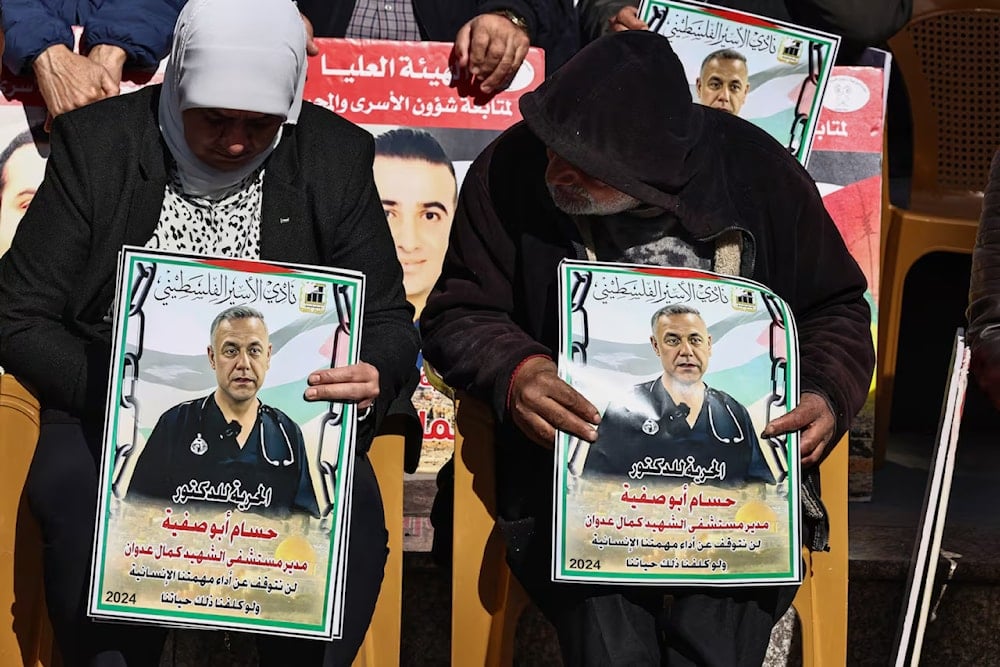
People hold placards bearing portraits of Palestinians currently detained by "Israel", including the director of the Kamal Adwan Hospital, Dr. Hussam Abu Safiya, during a protest in the occupied West Bank on Jan. 14, 2025 (Zain Jaafar/AFP/Getty)
The case of Dr. Hussam Abu Safiya has drawn renewed attention to the conditions facing Palestinian prisoners held by the Israeli occupation, with testimonies of abuse, torture, and degrading treatment highlighting what rights groups describe as a broader system targeting Palestinians in detention, Nesrine Malik writes for The Guardian.
Abu Safiya, the director of Kamal Adwan Hospital in northern Gaza, was detained by Israeli forces in December 2024 and has remained detained without charge or trial. According to accounts from his lawyer, Abu Safiya reported repeated beatings, including being struck with hammers and batons, daily assaults, and losing consciousness during detention.
"This is the end. I don’t see myself surviving. They brought me here to kill me," Abu Safiya told his lawyer earlier this month.
Recent images of the physician showed a significantly thinner figure compared with the doctor who became one of the most prominent voices documenting the collapse of Gaza’s healthcare system during the war.
Read more: Dr. Abu Safiya's life in imminent danger, rights advocate warns
Rakefet prison and the expansion of detention measures
Malik writes that in June, Abu Safiya was transferred to Rakefet prison, an underground facility previously used to hold senior organized crime figures before being closed due to concerns over its conditions.
The facility was reopened in late 2023 by far-right Israeli Police Minister Itamar Ben-Gvir as part of expanded detention measures following the start of the war on Gaza.
Izdihar Abu Safiya, the sister of renowned Gaza physician Dr. Hussam Abu Safiya, speaks out following the release of a recent photograph exposing the severe physical and psychological toll of his nearly 18-month imprisonment.
— Al Mayadeen English (@MayadeenEnglish) June 20, 2026
Arrested by Israeli occupation forces directly from… pic.twitter.com/RJHnKyVA7a
Palestinian rights groups have repeatedly raised concerns over conditions inside occupation prisons, including restrictions on sunlight, isolation, and physical and psychological abuse.
Thousands of Palestinians are held under administrative detention, a system that allows occupation authorities to imprison individuals without formal charges or trial through renewable detention orders.
Rights organizations have criticized the practice as a mechanism that enables indefinite imprisonment without judicial safeguards. Among those held under administrative detention are Palestinian children.
Released prisoners describe abuse and humiliation
Malik cites testimonies of released Palestinian prisoners that have added to the growing documentation of mistreatment inside occupation detention facilities.
Palestinian journalist Ali al-Samoudi, who was released earlier this year, said his detention had left him physically transformed after losing around 60 kilograms, nearly half his body weight.
"Prison today is hell in every sense of the word," al-Samoudi told CNN. "Everything they practised with us was punishment and revenge."
Rights organizations have documented numerous cases involving reports of beatings, deprivation, humiliation, and other forms of abuse against Palestinian prisoners, particularly since the beginning of the war on Gaza.
Earlier this month, an image circulated showing a Palestinian prisoner from Gaza stripped to his underwear, restrained face down to a structure, and photographed. The image, reportedly shared by an Israeli soldier, drew comparisons with the infamous Abu Ghraib photographs documenting US military abuses in Iraq.
A Palestinian ABDUCTED in Gaza by soldiers from Israel’s Netzah Yehuda Battalion, part of the Kfir Brigade, was photographed bound and blindfolded in an extremely degrading manner.
— Suppressed News. (@SuppressedNws1) July 1, 2026
The image was published by Israeli soldier Josef Benamou, who later deleted the photo and removed… pic.twitter.com/74thZkpARS
Detention system accused of targeting Palestinian society
Rights groups have argued that the treatment of Palestinian prisoners cannot be separated from the broader framework of occupation and control over Palestinian society.
The Israeli organization HaMoked has warned that Palestinians detained from Gaza and whose whereabouts remain unknown may constitute cases of enforced disappearance, with the organization working to locate thousands of missing individuals.
The issue also extends to Palestinians who have died in occupation custody. Rights organizations have raised concerns over cases in which bodies were not returned to families for burial and over the lack of transparency surrounding deaths in detention.
Among those detained are journalists, medical workers, and civil society figures whose roles place them at the center of Palestinian community life.
Read more: Palestinian detainees face deteriorating conditions in Ganot Prison
Calls for accountability continue as abuses persist
Despite extensive documentation by Palestinian and international rights organizations, accountability for abuses and violations inside occupation prisons remains limited.
The continued reports of torture, disappearances, and degrading treatment have intensified accusations that detention practices form part of a broader system aimed at suppressing Palestinian society rather than isolated misconduct by individual personnel.


