
Taiwan reports PLA aircraft, naval activity near island
 3 Min Read
Taiwan said it detected Chinese PLA aircraft and naval vessels operating near the island over the past 24 hours.
-
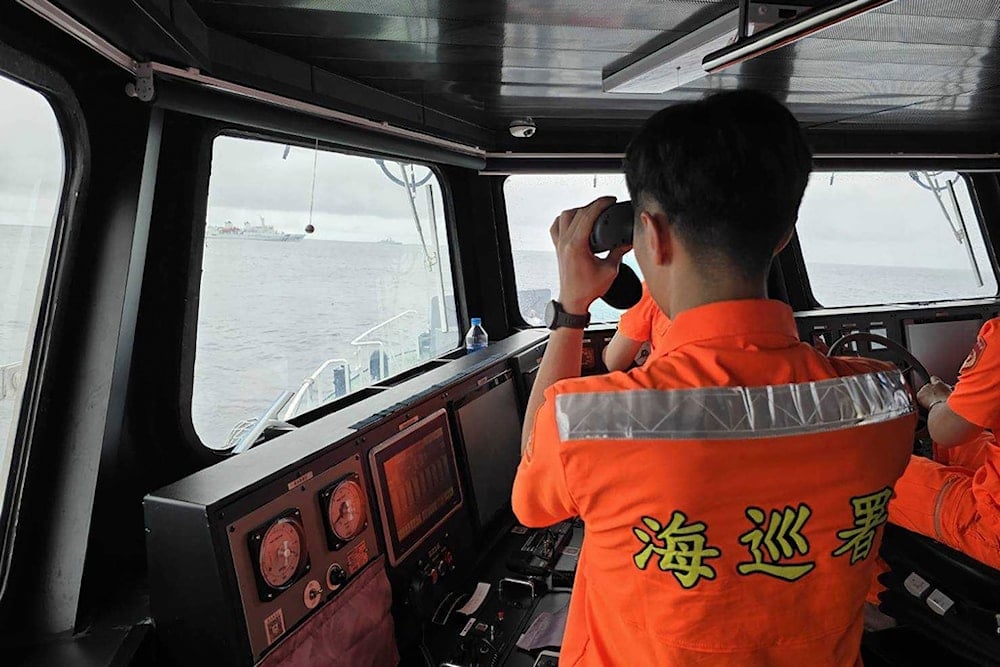
In this photo released by the Taiwan Coast Guard, a Taiwan Coast Guard member monitor Chinese navy vessel operating near the Pengjia Islet north of Taiwan on Thursday, May 23, 2024. (AP)
Taiwan on Thursday said it detected renewed Chinese military activity around the island over the past day.
In a statement posted on X, Taipei’s defense ministry said it had tracked multiple aircraft and vessels linked to the Chinese People’s Liberation Army operating near Taiwan between Wednesday morning and early Thursday.
"6 sorties of PLA aircraft, 8 PLAN vessels and 1 official ship operating around Taiwan were detected up until 6 a.m. (UTC+8) today. 2 out of 6 sorties crossed the median line and entered Taiwan’s southwestern ADIZ. We have monitored the situation and responded," the ministry said, confirming that Taiwanese forces were deployed to observe and react to the movements.
6 sorties of PLA aircraft, 8 PLAN vessels and 1 official ship operating around Taiwan were detected up until 6 a.m. (UTC+8) today. 2 out of 6 sorties crossed the median line and entered Taiwan’s southwestern ADIZ. We have monitored the situation and responded. pic.twitter.com/sbezYQTnew
— 國防部 Ministry of National Defense, ROC(Taiwan) 🇹🇼 (@MoNDefense) December 25, 2025
No Median Line
From Beijing’s perspective, the so-called median line has no legal or political standing. It was never formally recognized by either side and has increasingly been dismissed by Chinese officials as an artificial construct dating back to the Cold War. Analysts note that regular crossings by Chinese aircraft are intended to reinforce the long-held position that there is no division of sovereignty across the Taiwan Strait and to challenge narratives that treat the waterway as an international boundary.
Chinese aircraft activity in the southwestern air defense identification zone (ADIZ) has also followed a consistent and near-daily pattern in recent years. The ADIZ is not equivalent to sovereign airspace, and Beijing has repeatedly stated that its operations there are lawful, defensive, and aimed at countering separatist activity and foreign military interference rather than provoking confrontation. Chinese officials have framed such patrols as necessary readiness measures, particularly as external actors expand arms transfers and security cooperation with Taiwan.
US Arms Escalation
The latest movements come against the backdrop of sharply rising US arms sales to Taipei, which Beijing has warned are undermining stability and increasing the risk of conflict. Chinese defense officials have argued that Washington’s supply of advanced weapons systems and expanded military coordination with Taiwan fundamentally alters the status quo and forces China to take visible steps to safeguard its territorial integrity.
Taiwan has been administered separately since 1949 following the Chinese civil war. However, China maintains that Taiwan is an inalienable part of its territory and firmly opposes any move toward formal independence or official foreign military and political engagement with the island. Adherence to the One-China principle remains a core requirement for states seeking diplomatic relations with Beijing, which has repeatedly stressed that lasting stability in the Taiwan Strait depends on rejecting separatism and halting external interference rather than restricting China’s own security operations.
Read more: Japan’s Takaichi plans first US visit amid rising tensions with China


