
Tehran signals readiness for fair US deal, but sets red lines
 4 Min Read
Iran signals openness to renewed negotiations with Washington while emphasizing that any agreement must safeguard its core national interests and address concerns over fairness in the diplomatic process.
-
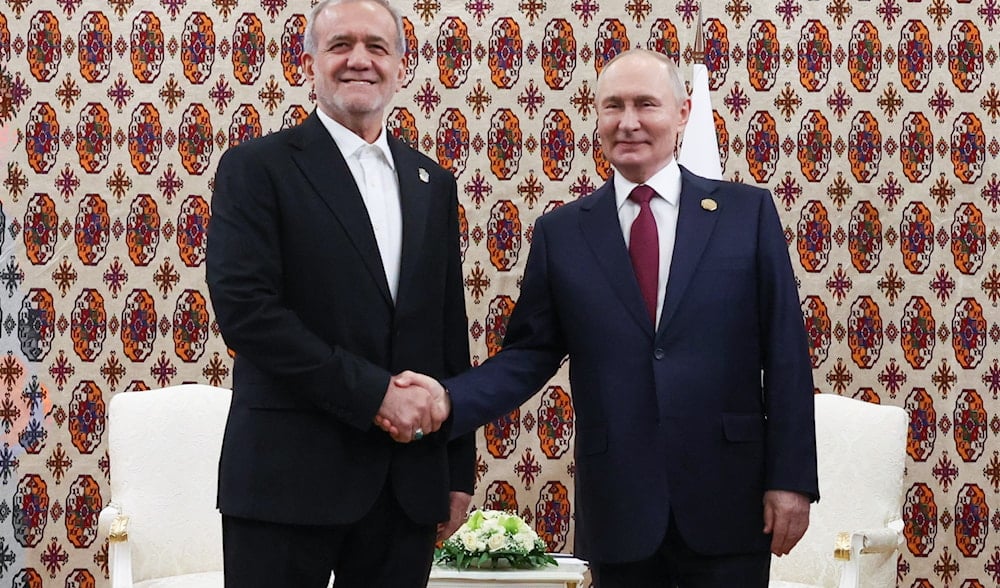
In this photo released by the Iranian Presidency Office, President Masoud Pezeshkian, left, shakes hands with his Russian counterpart Vladimir Putin during their meeting on the sidelines of an international forum in Ashgabat, Turkmenistan, Dec. 12, 2025 (Iranian Presidency Office via AP)
Iranian President Masoud Pezeshkian said on Sunday that Tehran is prepared to pursue a balanced and fair agreement with the United States, while stressing that national interests remain non-negotiable. His remarks came during a phone call with Russian President Vladimir Putin.
According to statements shared by the Iranian presidency on social media, Pezeshkian said Iran is “fully prepared” to reach a fair deal with Washington that could help secure lasting peace and stability in West Asia. He framed such an agreement as one that would benefit regional security while remaining acceptable to all parties.
The Iranian president underlined that Iran’s core interests and the rights of its people represent clear boundaries in any negotiations with the US. He emphasized that these principles cannot be compromised in the diplomatic process.
During his conversation with Putin, Pezeshkian also updated the Russian leader on the status of ongoing discussions with Washington. He suggested that the main obstacle to progress is “double standards” in the US approach to talks.
US-Iran talks end without agreement due to excessive US demands: Iran
Iranian state TV announced early on Sunday that “despite the numerous initiatives presented by the Iranian side, the excessive and illogical demands of the American side prevented progress in the negotiations.” It added that the Iranian delegation engaged in continuous and intensive negotiations that lasted 21 hours with the aim of safeguarding the national interests of the Iranian people.
For its part, Iran’s Tasnim News Agency reported that Washington sought to secure concessions it had failed to achieve through military escalation, including demands related to Iran’s enriched uranium and control over the Strait of Hormuz.
According to Tasnim, the Iranian delegation attempted to advance a joint negotiating framework, but US demands ultimately stalled progress.
Tasnim reported that upon arriving in Islamabad, the Iranian delegation met with Pakistan’s army chief and prime minister to coordinate positions and raise concerns over US breaches of commitments. It said talks with the Pakistani leadership preceded negotiations with the US side, which began at the level of main delegations before shifting to technical teams and lasted more than 21 hours.
The agency added that Tehran presented reasonable proposals, stressing that responsibility now rests with Washington to respond realistically. It also said the US administration has miscalculated both militarily and in its negotiating approach, noting that the status of the Strait of Hormuz will not change without a “reasonable agreement”.
No date or venue has been set for a potential new round of talks.
Trump announces Hormuz blockade
Earlier today, US President Donald Trump announced that Washington would impose a naval blockade on the Strait of Hormuz following the collapse of negotiations with Iran, signaling a renewed risk of US escalation.
The move follows high-level talks in Islamabad that ended without agreement, with Iranian officials rejecting what they said were excessive US demands, particularly regarding their nuclear program. In a post on Truth Social, Trump said discussions had yielded progress on several fronts but ultimately broke down over Washington’s insistence that Tehran halt uranium enrichment, which Iran maintains is a sovereign right under international law. “So, there you have it, the meeting went well, most points were agreed to, but the only point that really mattered, NUCLEAR, was not,” he wrote.
Iran has consistently maintained that its nuclear program is for peaceful purposes and that uranium enrichment falls within its sovereign rights, a position that remains central to the ongoing deadlock.
Trump nevertheless framed the outcome as grounds for immediate escalation, announcing that US naval forces would begin enforcing sweeping restrictions in one of the world’s most critical maritime corridors. “Effective immediately, the United States Navy, the Finest in the World, will begin the process of BLOCKADING any and all Ships trying to enter, or leave, the Strait of Hormuz,” he stressed.


