
Trump: '50/50' on Iran deal or resumed attacks as talks intensify
 5 Min Read
Trump says it's "50/50" between a deal and resumed attacks on Iran, as Washington and Tehran edge closer to a memorandum of understanding.
-
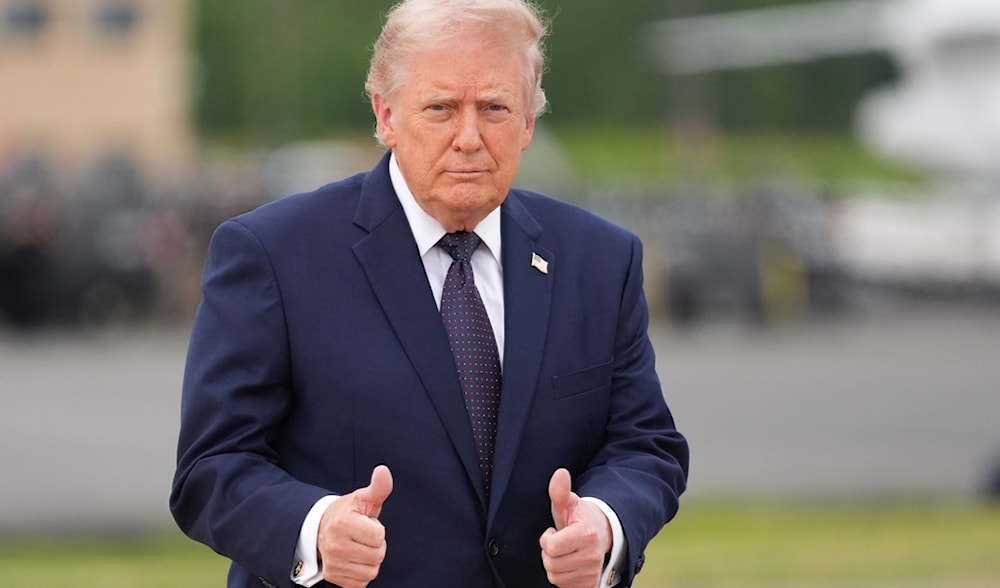
President Donald Trump walks from Marine One to board Air Force One at Morristown Airport, Friday, May 22, 2026, in Morristown, N.J. (AP Photo/Alex Brandon)
As negotiations between Washington and Tehran enter a critical juncture, US President Donald Trump said Saturday that he sees it as a "solid 50/50" whether he will reach a deal with Iran or resume the war, telling Axios he would either make a "good" deal or "blow them to kingdom come."
"I think one of two things will happen: either I hit them harder than they have ever been hit, or we are going to sign a deal that is good," Trump said.
Trump acknowledged that "some people would much rather have a deal and others would rather resume the war," but pushed back on suggestions that Israeli Prime Minister Benjamin Netanyahu was "worried" he might reach an unfavorable agreement with Tehran, according to Axios.
Trump said he would meet later Saturday with senior envoys Steve Witkoff and Jared Kushner, with Vice President JD Vance also expected to join, to review Iran's latest offer before making a decision he suggested could come as early as Sunday.
Trump consults Arab, Muslim leaders
Trump is also reaching out to regional powers. An Arab official told Reuters that Trump would hold calls Saturday with leaders from Saudi Arabia, Qatar, the UAE, Egypt, Turkey, and Pakistan, in order to consult with them on the draft agreement and gauge their positions ahead of any final decision.
Several regional sources also told CNN there was cautious optimism surrounding the negotiations. "Things are moving in a positive trajectory," one regional source said. Another source with knowledge of the talks said "the deadlock is over," though it was not immediately clear whether this referred to movement on key sticking points or simply on the text of a memorandum of understanding.
What Trump says he wants
Speaking to CBS News, Trump said negotiators are "getting a lot closer" and that "every day it gets better and better."
He insisted he would "only sign a deal where we get everything we want," adding that any agreement must prevent Iran from obtaining a nuclear weapon and result in its enriched uranium being "satisfactorily handled."
Secretary of State Marco Rubio echoed that position, saying Iran must give up its enriched uranium and that the Strait of Hormuz must be fully reopened "without tolls." Rubio added that there "may be news later today or in the coming days," describing the situation as one that "needs to be solved, one way or another."
What the draft agreement contains
Sources familiar with the negotiations told CBS News that the latest proposal includes a process to reopen the Strait of Hormuz, the unfreezing of some Iranian assets held in foreign banks, and a continuation of negotiations.
Axios claimed that the draft memorandum of understanding would commit both sides to ending the war and entering 30 days of more in-depth negotiations.
A regional source told CNN that the US and Iran are moving closer to an agreement to work toward a more detailed deal in the future, with work also underway on a potential unfreezing of Iranian assets.
Pakistan's role as mediator
The draft MOU emerged from Iran-Pakistan talks. Pakistani Field Marshal Asim Munir, who has been mediating between the two sides, left Tehran on Saturday after meeting with top Iranian officials.
A Pakistani official told Reuters that final touches are being put on a memorandum of understanding to end the war between the US and Iran. Pakistan described the outcome as reflecting "encouraging progress toward a final understanding," though no deal was finalised.
Iran's three conditions
An informed source close to Iran's negotiating team told Fars News Agency that three fundamental points of contention remain unresolved, warning that talks will not proceed unless they are addressed.
First, Iran will not enter negotiations on the nuclear file in this round. Nuclear issues will only be discussed in a subsequent round, and only after the other side implements confidence-building measures.
Second, Iran's frozen funds must be transferred and released before Tehran enters any negotiations, a non-negotiable prerequisite.
Third, on the Strait of Hormuz, Iran says it is only committed to restoring the number of ships passing through to previous levels, but under Iranian management and through routes Iran itself determines.
The source added that Iran has "prepared itself for all options." The Fars source also noted that while the Americans have retreated from their initial approach based on threats, they have not yet bridged the remaining gaps.
Iran pushes back on nuclear reports
Tasnim News Agency cited an informed source as flatly denying reports that Iran had submitted a proposal to freeze uranium enrichment above 3.6% for ten years, calling such reports "completely baseless" and stressing that current talks focus exclusively on ending the war with no nuclear file details under discussion.
Iran's Foreign Ministry spokesperson Esmaeil Baghaei described the state of talks as a delicate balance between being "very far and very close" to an agreement simultaneously.
He warned that Washington's contradictory positions make it impossible to predict a clear breakthrough, and cautioned against expecting rapid results, describing the negotiation process as a long one. On the Strait of Hormuz, Baghaei reaffirmed that it is exclusively a matter between Iran and the waterway's coastal states, saying Washington has no role in it.


