
Trump declares Hormuz blockade lifted, adds claims Iran never accepted
 4 Min Read
Trump declares the US naval blockade of the Strait of Hormuz "will now be lifted" and outlined a sweeping deal framework, but he's made sweeping deal claims before, only to be publicly contradicted by Tehran every time.
-
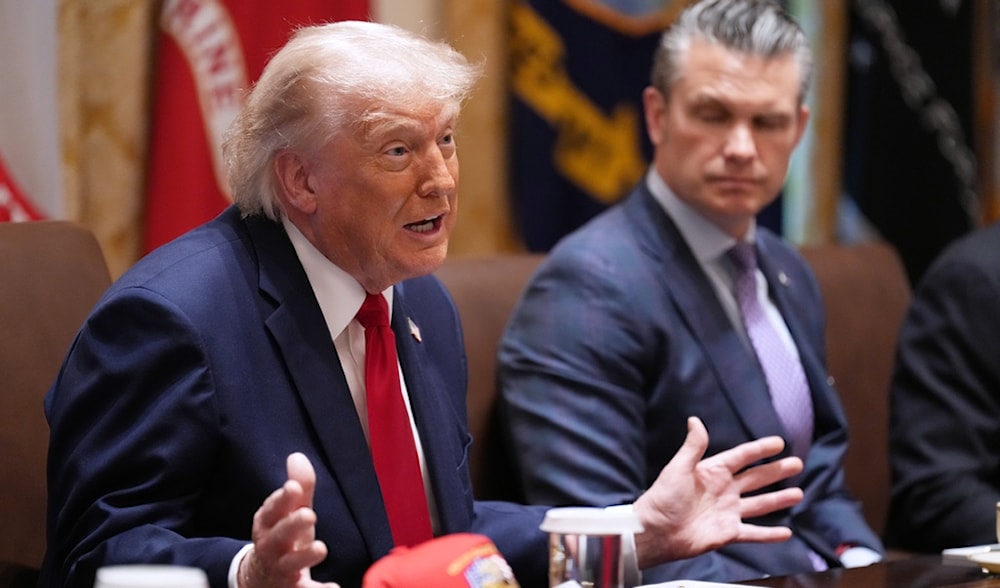
President Donald Trump speaks during a Cabinet meeting at the White House, Wednesday, May 27, 2026, in Washington, as Secretary of War Pete Hegseth, looks on. (AP Photo/Jacquelyn Martin)
US President Donald Trump announced on Friday that the US naval blockade of the Strait of Hormuz "will now be lifted," declaring that ships caught in the waterway may "start the process of heading home" and outlining what he alleged is an agreed framework between Washington and Tehran.
In a Truth Social post, Trump said water mines in the Strait, including those already cleared by US minesweepers, would be fully removed, with Iran responsible for the "immediate removal and/or detonation of any mines that are left."
He also described a mechanism for dealing with Iran's enriched uranium stockpile, which he referred to as "Nuclear Dust," buried underground following a US B2 bomber strike. Trump said the material would be unearthed jointly by the US and Iran in coordination with the International Atomic Energy Agency and destroyed, describing the US and China as the only two countries with the "mechanical capability" to carry out the operation.
He added that Iran must agree it "will never have a nuclear weapon or bomb," and that the Strait must be open "with no tolls" for unrestricted shipping in both directions. "No money will be exchanged, until further notice," Trump wrote, adding he would be meeting in the Situation Room to make a "final determination."
A familiar pattern
This is not the first time Trump has made sweeping announcements about the state of negotiations, only to be publicly contradicted by Tehran. The pattern has repeated itself with striking consistency since the US war on Iran began on February 28, 2026.
In the most dramatic instance, on April 16-17, Trump conducted a media blitz across multiple outlets claiming Iran had "agreed to everything," including an indefinite suspension of its nuclear programme and a US retrieval of enriched uranium at a "nice leisurely pace."
Iranian Parliament Speaker Mohammad Bagher Ghalibaf responded that Trump had "made seven claims in one hour, all seven of which were false," while Foreign Ministry spokesperson Esmaeil Baghaei stated flatly that Iran's enriched uranium "is not going to be transferred anywhere."
Just weeks later, on May 23, Trump again declared a deal had been "largely negotiated" with details to be announced "shortly," only to post the following day, instructing negotiators "not to rush into a deal."
By May 28, US and Iranian negotiators had reportedly reached a tentative 60-day memorandum of understanding, but it was Trump who withheld final approval, telling mediators he needed "a few days to contemplate it."
Officials within Trump's administration have privately acknowledged that his public announcements have been "counterproductive to the negotiations," with one source telling CNN that Iranian officials "were not pleased with the President negotiating through social media and making it seem as though they had agreed to points they had not yet accepted."
Iran's red lines
Tehran's position, consistently maintained throughout the war, rests on several firm red lines.
Iran has demanded the release of approximately $24 billion in frozen sovereign assets, with half available immediately upon any agreement's announcement, as a prerequisite entirely separate from the nuclear file.
On enriched uranium, Baghaei has stated the material is "sacred to us like the soil of Iran" and that its transfer abroad has been "completely and irreversibly" ruled out. Iranian officials have repeatedly stressed that the nuclear dossier is not on the table at this stage, with the current phase of diplomacy focused exclusively on ending the war and lifting the blockade.
Tehran has also asserted full sovereignty over the Strait of Hormuz under international law, with Iran's UN envoy stating that its measures in the waterway are "legal and in line with international law" and that Tehran "cannot allow this vital waterway to be turned into a passage for hostile acts."
Read more: US aircraft carriers left West Asia following Iran's operations: Azizi


