
Trump's secret Turkey exit raises doubts over Iran war claims: CNN
 6 Min Read
Trump's covert departure from Turkey over a reported Iranian threat has deepened questions over Washington's claims of victory and restored deterrence in the war on Iran.
-
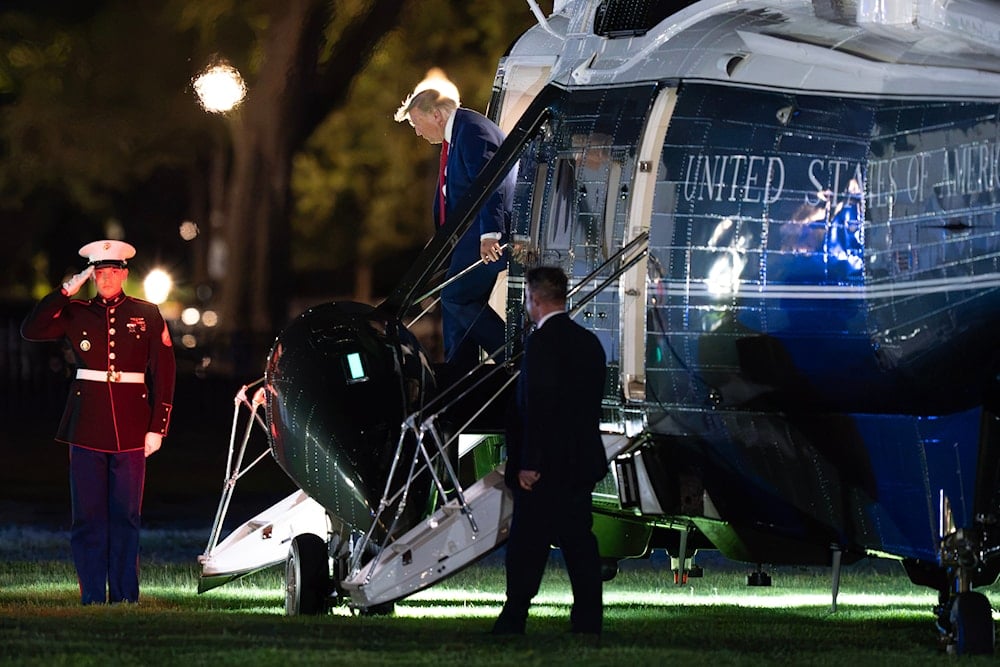
US President Donald Trump arrives on Marine One on the Ellipse near the White House, Tuesday, Aug. 11, 2026, in Washington (AP)
US President Donald Trump’s secret departure from Turkey last month following intelligence about a possible Iranian threat has raised fresh questions over Washington’s claims that Tehran’s military capabilities have been decisively weakened, according to a CNN analysis.
Writing for CNN, Stephen Collinson argued that the extraordinary security operation at Ankara airport has become politically significant because it sharply contradicts Trump’s portrayal of the war on Iran as a US victory.
The Secret Service reportedly transferred Trump from the aircraft he had publicly boarded to another military jet, using a catering truck to conceal his movements after receiving intelligence concerning a possible Iranian attempt to target him.
CNN stressed that the existence of such a threat does not, by itself, demonstrate that the US military campaign has failed. Yet the episode carries broader strategic significance: months after Washington claimed to have devastated Iran’s military capabilities and restored deterrence, US security agencies apparently considered an Iranian threat credible enough to alter the president’s movements on the territory of a NATO ally.
Iran has not claimed responsibility for any alleged plot or publicly commented on the Ankara operation.
From Tehran’s perspective, however, the episode could reinforce an argument Iranian officials and media have advanced throughout the conflict: that overwhelming US military power has failed to eliminate Iran’s ability to impose political, economic and security costs on Washington.
Departure clashes with Trump’s victory narrative
Collinson said the incident adds to a growing list of developments that have contradicted Trump’s optimistic portrayal of the war.
Trump has repeatedly claimed that the Strait of Hormuz is open, saying again Monday that it was “open now,” despite Iran continuing to exercise substantial control over the strategic waterway and commercial shipping remaining severely disrupted.
CNN noted that US forces have spent months attempting to restore maritime conditions that existed before the war.
Trump has also repeatedly predicted that an agreement with Tehran is imminent, but talks have remained stalled.
Meanwhile, CNN reported last week that nearly 80% of interceptors for a critical US missile defense system had been expended during the fighting, underscoring the strain the war has placed on American weapons inventories.
Taken together, the depletion of US missile stocks, the continuing dispute over Hormuz and the extraordinary security precautions surrounding Trump complicate Washington’s attempts to portray Iran as a militarily neutralized adversary.
The Ankara episode is particularly damaging symbolically. Rather than demonstrating restored American deterrence, it can be read as evidence that the possibility of Iranian retaliation continues to influence the behavior of the highest levels of the US government.
Trump evacuation sparks political criticism
The operation has also prompted criticism over Trump’s decision to publicly board one aircraft before secretly transferring to another.
Former Trump White House communications director Alyssa Farah Griffin said the extraordinary precautions suggested the threat was considered serious.
“Donald Trump absolutely hates anything like this,” Griffin told CNN’s Phil Mattingly on “The Lead” Tuesday. “He hated when he had to go to the bunker because of the threat environment in the White House … He wanted to go back immediately to show he’s not scared, he’s not running.”
“This speaks to me that this was a very real threat. If he’s willing to take these measures and to do it. It speaks to the moment we’re in, in the Middle East,” she added.
Questions have also emerged over the safety of journalists, staff and crew who departed aboard the aircraft Trump had publicly appeared to board.
Asked why it was unsafe for him to use that aircraft while others remained aboard, Trump said, “The plane that I flew on was at greater risk … because that would be the plane, I think, that they would be more likely to go for.”
Illinois Governor JB Pritzker accused Trump of having “put people in harm’s way to save himself — that’s who Donald Trump is.”
“He’s willing to put troops in harm’s way … he slinked away literally in a catering truck while the reporters and his own staff were on a plane that apparently was under threat,” Pritzker added.
Beyond the domestic political controversy, the catering-truck transfer offers Iran a powerful propaganda image. Trump has repeatedly presented himself as the leader who forced Tehran onto the defensive, yet the reported operation depicts a US president whose own security arrangements were altered because of the possibility of Iranian retaliation.
That does not establish that Iran was behind any specific threat. But in deterrence terms, forcing an adversary to change behavior because of what it believes you may be capable of can itself carry strategic value.
Threats could persist
CNN said potential Iranian threats against Trump could continue beyond the current war, noting that tensions date back to his decision during his first term to order the assassination of Iranian General Qassem Soleimani and escalated further after the martyrdom of Sayyed Ali Khamenei in US and Israeli strikes.
Retired US Army Lieutenant General Karen Gibson said such threats were plausible.
“I do find it entirely plausible that there might be a serious threat to the president by some Iranian-backed entity. The US, the UK, a number of European states have foiled or disrupted Iranian-backed attacks over the last several years, frankly going back decades,” Gibson said.
“They’ve demonstrated an intent and a capacity to do this.”
The longer-term significance of the Ankara incident therefore extends beyond Trump’s personal security.
From a strategic perspective, it can be presented as evidence that the costs of the war are being felt not only by US forces and commercial interests, but at the highest political level in Washington.
Collinson concluded that the episode exposes a wider contradiction for the United States: despite months of fighting and repeated declarations of victory, Iran continues to exert pressure through the Strait of Hormuz, retain meaningful retaliatory capacity, and impose security calculations on Washington itself.
That contradiction goes to the heart of the dispute over how the war should be judged. Washington may possess overwhelming conventional military power, but the continuing need to protect Trump from a perceived Iranian threat suggests that military superiority has not translated into the uncontested deterrence or strategic dominance the White House has repeatedly claimed.
Read more: Trump covertly moved to another jet amid Iranian attack fears


