
Trump seeks $88 billion for Iran war costs, other spending
 4 Min Read
Trump asks Congress for nearly $88 billion in supplemental funding for Iran war costs, agriculture aid, Ebola response, and infrastructure projects amid political opposition in Washington.
-
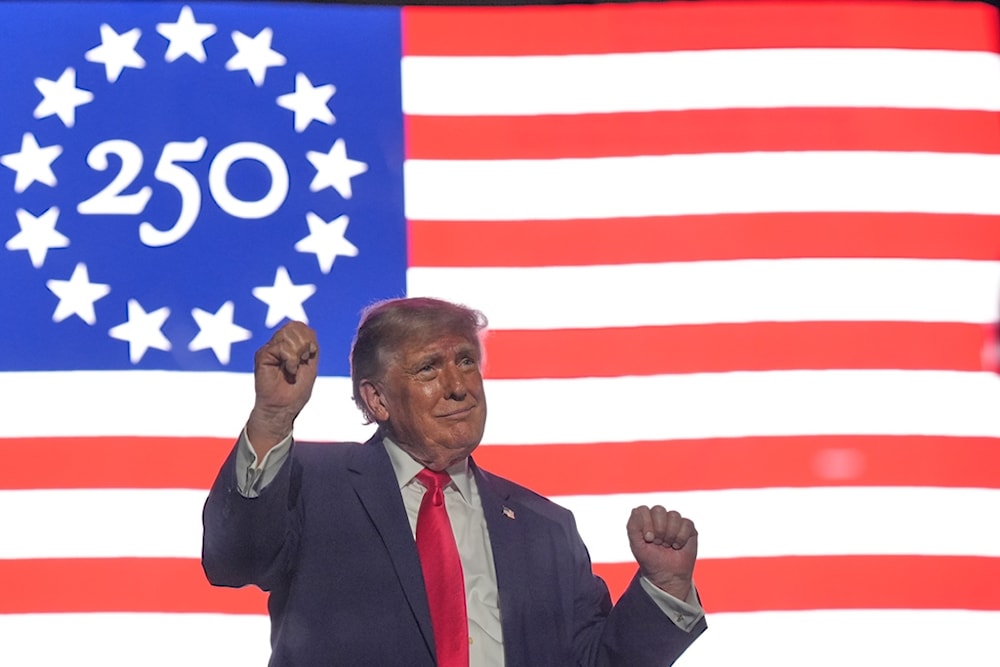
United States President Donald Trump wraps up his speech at the opening of the Great American State Fair, on June 24, 2026, on the National Mall in Washington. (AP)
United States President Donald Trump has formally asked Congress for nearly $88 billion in supplemental funding to cover costs linked to the war on Iran, agricultural assistance, and global health responses, in a move expected to ignite a contentious debate on Capitol Hill.
The request, submitted on Wednesday, comes after a four-month military aggression in West Asia and amid ongoing political disputes over federal spending priorities. The package requires bipartisan support in the Senate but is already facing resistance from lawmakers in both parties, many of whom have expressed concern over escalating defense expenditures and domestic budget constraints.
Major defense allocation tied to Iran war
The largest portion of the request, $67.1 billion, is directed toward the Pentagon, including $21 billion to replenish munitions stockpiles depleted during the war. The proposal also allocates $17.3 billion for military operations, $1.7 billion for readiness, and $1.5 billion for fuel costs.
Additional defense spending includes $2.4 billion for drones, $5.1 billion for cybersecurity and autonomy programs, and $12.1 billion designated for classified projects.
The White House argues the funding is necessary to restore military capacity and sustain operational readiness following a prolonged and resource-intensive war that failed to achieve its stated goals.
However, the request is expected to face strong opposition from Democrats, many of whom have criticized the war as illegal and raised concerns about further military escalation and oversight.
Domestic and global funding components
Beyond arms, the supplemental package includes $11.1 billion in agricultural support aimed at assisting US farmers affected by tariffs, rising input costs, and weather-related disruptions, including in Florida. Farm-state Republicans are reportedly seeking to expand that figure to $17.2 billion, signaling potential intra-party negotiations ahead of a Senate vote.
The proposal also includes $1.4 billion to respond to an Ebola outbreak in Central Africa, alongside $500 million for restoration and construction projects in Washington, D.C., and $1 billion for the modernization of New York City’s Penn Station.
Political tensions over spending priorities
The request comes as Trump continues to promote a broader $1.5 trillion military budget proposal, representing a significant increase over current levels. Democrats have sharply criticized the plan, describing it as excessive and inconsistent with efforts to reduce domestic spending programs.
At the same time, Republican lawmakers remain divided over the administration’s broader fiscal agenda, particularly as Congress considers additional defense-focused spending legislation.
The supplemental package could also complicate Republican efforts to advance a separate party-line spending bill centered on defense funding, further straining negotiations in an already divided Congress.
Policy shifts on agriculture and fuel
The legislative request also includes a proposal to revise the statutory definition of hemp-derived cannabinoid products, establishing a regulatory framework that would allow broader access to full-spectrum CBD products while tightening enforcement against illicit market actors.
Separately, Trump is urging Congress to pass legislation permitting year-round sales of E15 fuel, a measure supported by farm-state Republicans seeking to boost demand for corn-based ethanol. While the House has already approved the bill, divisions remain in the Senate between agricultural and oil industry interests.
The proposal arrives as the administration seeks to balance competing domestic priorities while sustaining its foreign policy agenda, including efforts to present a potential diplomatic framework with Iran following the recent memorandum of understanding signed with Tehran.
Read more: Maximum Danger: How 'Israel' can sabotage the Iran-US deal


