
UAE draws down Yemen forces as coalition fractures in the South
 3 Min Read
The UAE announced the withdrawal of its remaining counterterrorism forces from Yemen as clashes between rival Saudi- and Emirati-backed factions intensified in the south.
-
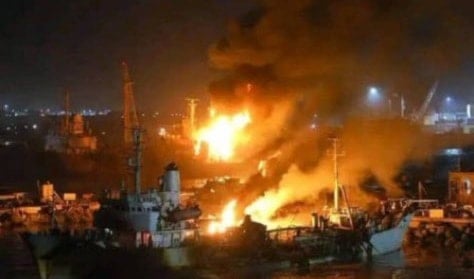
Fire and heavy smoke rise from Yemen’s Mukalla Port after Saudi airstrikes targeted vessels from the UAE allegedly carrying armored vehicles and weapons intended for UAE-backed Southern Transitional Council (STC) separatist forces (Agencies)
The United Arab Emirates announced on Tuesday a voluntary reduction of its military footprint in Yemen, citing security and operational considerations linked to recent developments on the ground.
In a statement carried by the state-run WAM, the Emirati Defense Ministry said, "Given recent developments and their implications for the security and effectiveness of counterterrorism forces, the Defense Ministry announces the voluntary withdrawal of all counterterrorism units in Yemen."
The move comes days after a sharp escalation between Abu Dhabi and Saudi Arabia, including Saudi airstrikes on Yemen’s eastern port city of Mukalla. Riyadh claimed the strikes targeted unauthorized military shipments allegedly destined for UAE-backed forces, prompting emergency measures by Saudi-aligned authorities, a temporary blockade of the port, and public demands for Emirati forces to leave Yemeni territory. The confrontation marked one of the most serious ruptures between the two former coalition partners since the war began.
The announcement also follows weeks of rapid advances by the UAE-backed Southern Transitional Council (STC), whose expansion across Hadhramaut, Shabwa, and Abyan has triggered armed clashes with Saudi-aligned tribal forces and led Saudi aircraft to strike STC positions in eastern Yemen. These developments have laid bare the collapse of cohesion within the anti-Sanaa camp, as rival foreign agendas increasingly turn their weapons against each other on Yemeni soil.
Encirclement strategy collapses
Officials in Sanaa have consistently described the UAE-constructed militia network in the south as part of a broader foreign encirclement strategy aimed at weakening the resistance, seizing energy assets, and securing permanent footholds along Yemen’s coastline and islands, including Socotra and Mayyun. From this perspective, Abu Dhabi’s partial withdrawal does not signal de-escalation, but rather a tactical repositioning after its proxy forces became embroiled in open conflict with Saudi-backed factions and exposed the depth of coalition disintegration.
Leaders of Ansar Allah have warned that any attempt to entrench a foreign military or intelligence presence near Bab al-Mandeb constitutes a direct threat to Yemen’s sovereignty and regional security. They argue that Resistance operations have already reshaped the balance of power, constraining external actors’ freedom of maneuver and forcing occupying forces to retreat or redeploy. In this context, the UAE’s decision underscores, they say, the failure of military occupation, proxy warfare, and foreign-backed partition schemes to impose lasting control over Yemen.
Read more: Saudi MoFA warns UAE actions in Yemen threaten regional security


