
UK sends more troops to Gulf as Trump mocks Britain over Iran war
 4 Min Read
Britain is deploying additional troops and missile defenses to the Gulf even as President Trump mocks the UK for refusing to join offensive operations against Iran.
-
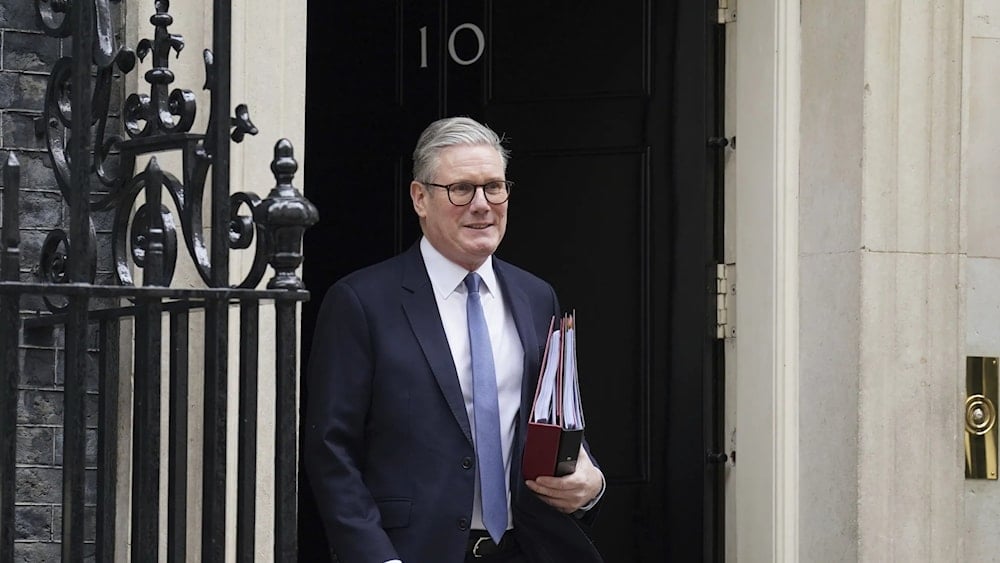
Prime Minister Sir Keir Starmer departs 10 Downing Street to attend Prime Minister’s Questions at the Houses of Parliament in London, England, Wednesday, March 12, 2025 (AP)
The United Kingdom is sending additional military support to the Gulf, taking its total deployment to 1,000 troops, amid fresh jibes from US President Donald Trump about Britain's refusal to join offensive operations against Iran.
Speaking from Qatar, where he met UK troops, Defense Secretary John Healey said the extra deployment was in response to an "expanding threat" from Iran. He confirmed that the UK would send more Typhoon jets to Qatar, as well as the Sky Sabre anti-drone and missile system to Saudi Arabia, Bahrain, and Kuwait.
"What's struck me being here over the last couple of days is how clear it is in the Middle East that Iran is expanding its attacks, which I totally condemn as it's continuing to menace the region," Healey said.
He declined to specify how many additional troops were being deployed but said "across the Middle East now, a thousand British troops" were involved in reinforcing UK bases and those of its Gulf allies.
Trump's taunts
Earlier, Trump lashed out at the UK for refusing to "get involved in the decapitation of Iran." Writing on his Truth Social platform, he told the UK and other allies: "You'll have to start learning how to fight for yourself, the USA won't be there to help you anymore, just like you weren't there for us."
Asked about Trump's comments, Healey said, "We won't get drawn into the wider war. Throughout this conflict, we've been consistently taking decisions in Britain's interests because we need to defend our people, and we want to defend allies in the region."
He added that Gulf leaders would "judge us by our actions and not our words. We continue to do with the US, defensive operations in the Middle East."
Defensive posture
Healey said the extra deployments to the Gulf were only for defensive operations. Having met officials in Saudi Arabia, Qatar, and Bahrain during his visit, he said, "My message to Gulf partners is: Britain's best will help you defend your skies."
The Ministry of Defense said the Sky Sabre system and a team of operators from the Royal Artillery would move to Saudi Arabia this week. The system, composed of radars, a control node, and missile launchers, can intercept munitions and aircraft and will be integrated into broader Saudi and regional air defenses.
The RAF's joint Typhoon squadron with Qatar was deployed to the Gulf in January amid rising tensions in the region. After US and Israeli strikes on Iran prompted retaliatory strikes in the Gulf, Prime Minister Keir Starmer announced the deployment of four more fighter jets to Qatar.
A growing gap between allies
Healey's visit to the Gulf comes as Washington grows increasingly frustrated with European allies who have refused to join its war effort. While the UK has allowed US operations from British bases, such as RAF Fairford and Diego Garcia, it has stopped short of direct military participation in offensive strikes against Iran.
During his tour, Healey revealed he had discussed options for reopening the Strait of Hormuz, noting there was "a determination that Iran cannot be allowed to hold the Strait of Hormuz hostage and blackmail the world by stopping shipping in the way that it's doing."
Talks with Gulf leaders had "focused on what options can be developed to secure safe shipping," he added, noting that there was "a recognition that it cannot just be military and that it must involve the widest possible range of nations alongside the US."
Yet the contradiction in Britain's position is difficult to ignore. The UK is deploying more troops and missile defenses to the Gulf at a time when Washington is demanding its allies take on greater military responsibility for a war that was launched without their consent. Meanwhile, Trump mocks Britain for not doing enough, even as British troops are sent into a warzone to defend Gulf states that host American bases used to bomb Iran.
Britain finds itself caught between its historic alliance with Washington and a war its own public does not support. Sending more troops to the region may satisfy the demand for action, but it does not answer the question that increasingly haunts Western capitals: whose war is this, and when will it end?


