
UN slams Israeli execution law as 'discriminatory', possible war crime
 3 Min Read
The United Nations rights chief notes that the law's application to residents of the occupied Palestinian territory “would constitute a war crime.”
-
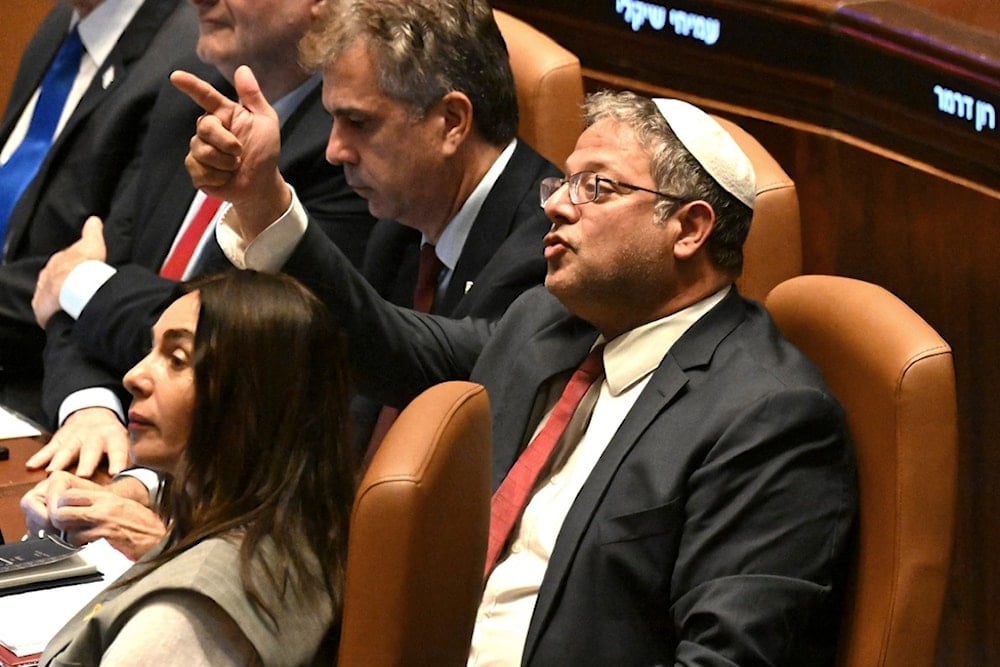
Israeli police minister Itamar Ben-Gvir at the opening of a Knesset session, al-Quds, occupied Palestine, October 28, 2024 (AP)
The United Nations has strongly condemned a new Israeli law allowing the death penalty for Palestinian detainees solely, calling it "particularly cruel and discriminatory" and warning that its application in occupied territory would constitute a war crime.
UN spokesperson Stephane Dujarric told reporters on Tuesday that the UN and Secretary-General Antonio Guterres have a "very clear" stance on "Israel's" legislation imposing the death penalty on Palestinian detainees.
"We stand against the death penalty in all its forms," he said, adding that "the nature of this particular law makes it particularly cruel and discriminatory." He called on the Israeli government to rescind the law and not implement it.
A violation of international law
UN High Commissioner for Human Rights Volker Turk echoed the condemnation, urging Tel Aviv to step back from the controversial law, which applies "almost exclusively to Palestinians."
"It is deeply disappointing that this bill has been approved by the Knesset," Turk said, highlighting that it is patently inconsistent with "Israel's" international law obligations, including in relation to the right to life.
"It raises serious concerns about due process violations, is deeply discriminatory, and must be promptly repealed."
Noting that the law provides that death sentences, once imposed, must be carried out within 90 days, Turk warned that its application to residents of the occupied Palestinian territory "would constitute a war crime."
"The death penalty is profoundly difficult to reconcile with human dignity, and it raises the unacceptable risk of executing innocent people," he added.
A systematic assault on Palestinian prisoners
According to Israeli public broadcaster KAN 11, the legislation introduces sweeping amendments that expand judicial authority to impose capital punishment, including provisions that executions would be carried out by hanging.
The bill grants courts broader discretion by allowing judges to issue death sentences without requiring a formal request from prosecutors. It also removes the requirement for unanimous judicial decisions, enabling a simple majority of judges to impose capital punishment.
The legislation further extends jurisdiction to military courts operating in the occupied West Bank, authorizing them to sentence Palestinian detainees to death. In such cases, the Israeli war minister would be permitted to present an opinion to the panel overseeing proceedings.
More than 9,300 Palestinians, including 350 children and 66 women, are currently held in Israeli prisons, according to prisoner rights groups and the Israeli Prison Service. Reports indicate detainees suffer from torture, starvation, and medical neglect, leading to dozens of deaths.
A pattern of impunity
The UN rights chief also expressed alarm at proposals in another bill before the Knesset to establish a Special Military Court exclusively to prosecute actions it sees as "crimes" committed during and after Operation Al-Aqsa Flood.
The new death penalty law is the latest in a long line of Israeli measures designed to formalize the oppression of Palestinians under occupation.
As the UN has made clear, the law is discriminatory, cruel, and fundamentally incompatible with human dignity. Yet "Israel" has shown, time and again, that international condemnation does little to deter its violations.
Read more: Israeli Knesset approves bill for execution of Palestinian prisoners


