
US 'pushes Israel' to de-escalate in Lebanon, as IOF kills 97 in 24 hr
 4 Min Read
Trump is pressing 'Israel' to scale back attacks in Lebanon ahead of direct talks Tuesday, as Iranian pressure reshapes the diplomatic landscape.
-
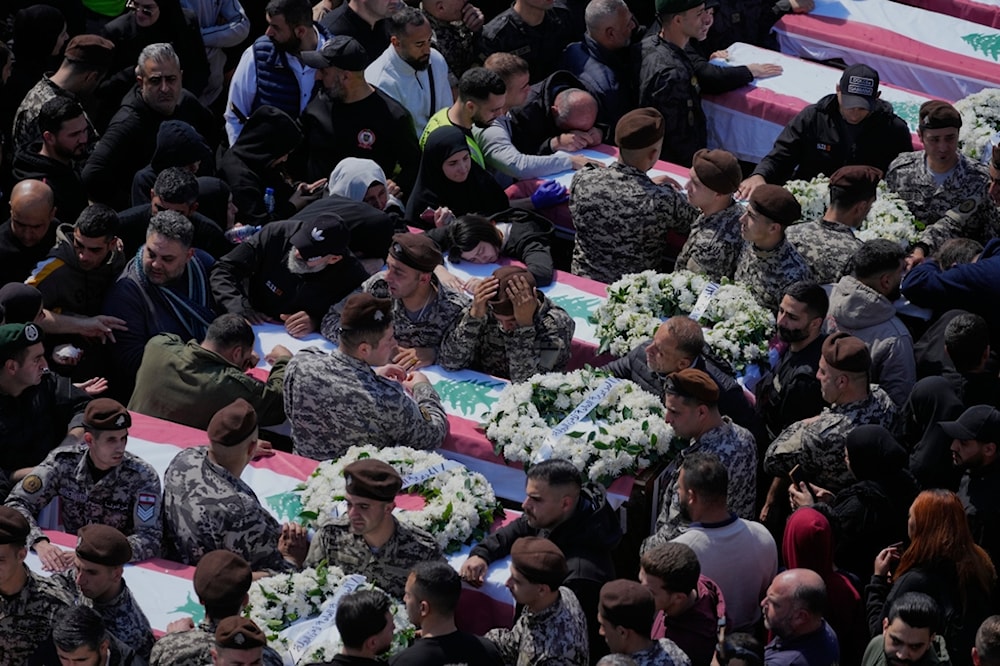
Colleagues mourn during the funeral of 13 state security officers killed the previous day in an Israeli attack on Nabatieh serail in the Lebanese southern coastal city of Sidon, Saturday, April 11, 2026. (AP Photo/Mohammed Zaatari)
US President Donald Trump has been pressing "Israel" to scale back its aggression against Lebanon ahead of direct talks scheduled for Tuesday at the US State Department in Washington, according to a report by Channel 12, citing political affairs correspondent Yaron Avraham.
The report said Trump had pressured Israeli Prime Minister Benjamin Netanyahu to reduce attacks in southern Lebanon, pressure that Netanyahu reportedly could not refuse, with claims that "Israel" has since "significantly reduced the pace of fire" and halted strikes on Beirut's southern suburb in recent days.
Yet, the de-escalation in question has resulted in the martyrdom of 97 people and the injury of 133 in the past 24 hours due to Israeli bombardment, per the Lebanese Ministry of Public Health. Since the beginning of the Israeli aggression, the total toll has reached 2,020 martyrs and 6,436 wounded. Among the latest attacks, an Israeli attack on the town of Taffahta in the Sidon district of southern Lebanon killed 8 and wounded 9, as the rescuers were also bombed after attempting to evacuate the dead and wounded.
'Israel' at the table, only after being cornered
The direct talks between Lebanon and the Israeli regime scheduled for Tuesday represent a remarkable reversal. For weeks, "Israel" flatly dismissed the Lebanese government as having "nothing to offer" and lacking any credibility.
Israeli Foreign Minister Gideon Sa'ar said dialogue with Beirut "cannot stop the fire from Lebanese territory." Ambassador Danny Danon told the UN Security Council that "Israel" could not negotiate while "rockets are flying into our northern border."
When Lebanon attempted to reach US officials, it was turned away and told that "2025 was our window to confront Hezbollah, and we didn't."
Analysts note that "Israel" is coming to Tuesday's talks because a ceasefire in Lebanon delivered through Iranian pressure would constitute a tangible diplomatic victory for Tehran, validating Iran's red lines, strengthening its hand in the broader negotiations, and demonstrating that the Resistance axis can extract concessions from "Israel."
By contrast, a ceasefire brokered through direct Lebanese-Israeli talks under US sponsorship strips Iran of that credit entirely and reframes the outcome as a bilateral arrangement between Beirut and Tel Aviv.
Iranian pressure made talks of ceasefire possible
The de-escalation now being urged by Washington did not emerge from a vacuum. Iran had made a ceasefire in Lebanon a fundamental condition of its participation in the US-Iran negotiations held in Islamabad this week.
Tehran's 10-point proposal explicitly demanded a cessation of hostilities on all fronts, and the Iranian delegation arrived in Pakistan making clear it would not sit at the negotiating table unless "Israel" first agreed to halt its attacks on Lebanon.
President Masoud Pezeshkian told Pakistani Prime Minister Shehbaz Sharif that a Lebanon ceasefire was an "essential condition" for any Iran-US agreement to hold. When "Israel" continued its massacres, Iran re-closed the Strait of Hormuz as direct leverage to enforce that condition.
It was Iranian pressure, not Lebanese diplomatic manoeuvring, that placed a Lebanon halt on the international agenda.
What Beirut agreed to, and what it surrendered
According to Axios, citing two informed sources, the Lebanese government and the Trump administration have jointly asked "Israel" for a temporary halt to its attacks ahead of Tuesday's meeting. Lebanon, through US mediators, requested that "Israel" agree to a "gesture," halting airstrikes, and proposed that "Israel" return to the November 2024 ceasefire understandings, limiting strikes to alleged cases of imminent Hezbollah threat.
An Israeli official told Axios that "there is no ceasefire." A second source said Netanyahu may agree to a short tactical pause, though the Israeli government's preference is to conduct negotiations "under fire."
More so, the Israeli Ambassador to Washington, Yechiel Leiter, made clear that the Israeli regime seeks a normalization deal with Lebanon, not a ceasefire.


