
US acknowledges deployment of space-based weapons for first time
 4 Min Read
The United States has confirmed for the first time that it has deployed space-based weapons, prompting warnings that the move could accelerate an arms race with Russia and China over military dominance in orbit.
-
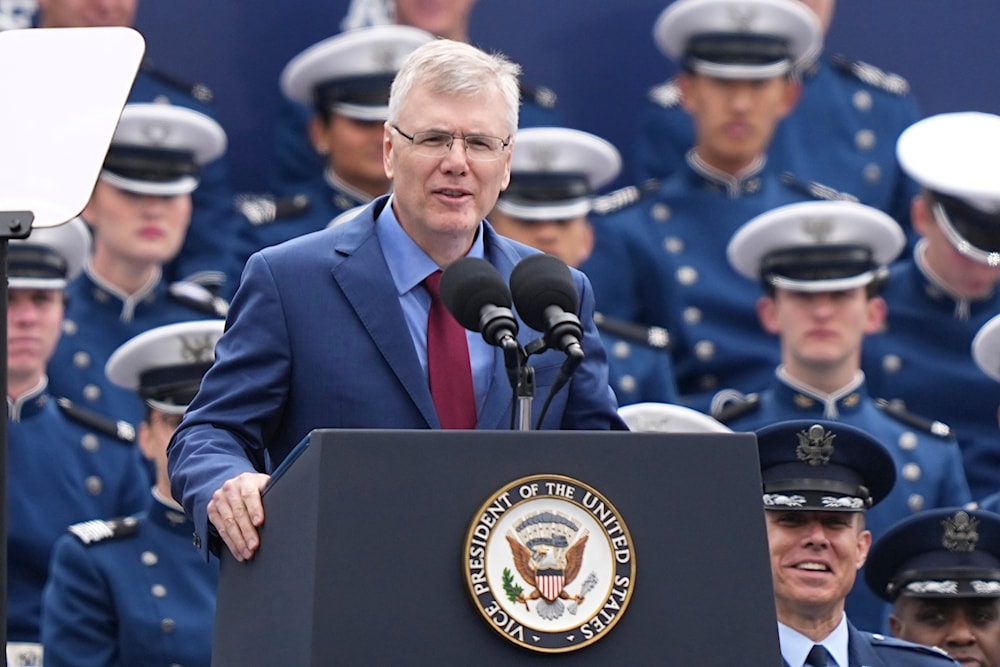
Secretary of the Air Force Troy Meink speaks during the United States Air Force Academy Graduation Ceremony at Falcon Stadium, Thursday, May 28, 2026, at the United States Air Force Academy in Colorado Springs, Colo. (AP)
The United States has publicly confirmed for the first time that it has deployed weapons in orbit, a move experts warn could intensify military competition in space between Washington, Russia, and China.
According to The Guardian, US Secretary of the Air Force Troy Meink revealed that the country currently has active “on-orbit” space-control capabilities, meaning military systems already positioned around Earth.
“Today, we continue to ensure we remain ready to meet the challenges of evolving threats wherever they exist,” Meink said on Monday during the annual Air, Space, Cyber Conference. “This is why the United States now has, on-orbit, space-control weapons.”
Meink did not provide details about the nature of the systems, citing security concerns. However, the US Space Force said space-control operations can involve both kinetic and non-kinetic methods aimed at affecting an adversary’s space capabilities.
“These capabilities can be employed for offensive and defensive purposes,” the Space Force said.
China, Russia warn against militarization of orbit
The announcement drew criticism from Beijing and Moscow, which accused Washington of accelerating the militarization of space.
China’s Foreign Ministry said the United States was “preparing for war in outer space” and warned against transforming space into a battlefield or triggering a new arms race.
Kremlin spokesperson Dmitry Peskov said Russia believes “that space must be free of any weapon” and called for “the complete demilitarisation of space.”
Although major powers have long developed technologies capable of disrupting satellites, experts said Washington’s public acknowledgment marks a significant shift.
Jonathan McDowell, an astronomer who has tracked global space launches for decades, said it was reasonable to assume the United States had already developed such capabilities, likely including systems designed to interfere with satellite operations.
He warned that Russia and China would likely respond by developing or deploying similar systems.
“In the long run, I find it questionable whether this is in the US national interest, and for sure we will see comparable systems from China, if they don’t already have them,” McDowell said.
Space emerges as new military frontier
Military competition in space dates back to the Cold War, when the United States and the Soviet Union explored ways to target each other’s satellites.
The 1967 Outer Space Treaty prohibited placing weapons of mass destruction in orbit but did not ban conventional weapons, leaving room for the development of space-based military technologies.
Concerns over a potential conflict in orbit increased after Russia destroyed one of its own satellites in a 2021 anti-satellite missile test, creating thousands of pieces of debris.
Experts warn that any future confrontation in space could have wider consequences, as debris from damaged satellites could threaten critical systems used for communications, navigation, and scientific research.
Victoria Samson, chief director of space security and stability at the Secure World Foundation, said the announcement represented a major departure from previous US policy.
“Well, that’s huge, because I don’t think any US government official has ever said that before,” she said.
McDowell argued that Washington’s approach to space security had changed significantly, with conflict in orbit becoming increasingly normalized.
“The US sees conflict in space as something that is conceptually normalised, whereas 20 years ago it was ‘no, we will never want to do that’,” he said.
“I think this is wrong,” he added. “I also think it is still not too late to change course on this. To work mainly with China, because they are the real competitors in space now. I hope the US establishment takes a step back and rethinks some of this.”


