
US AI push strained by reliance on Chinese batteries: NYT
 5 Min Read
The New York Times (NYT) reports that the United States’ push to lead in artificial intelligence is increasingly constrained by its reliance on Chinese-made batteries, which are critical to data centers, military systems, and energy infrastructure.
-
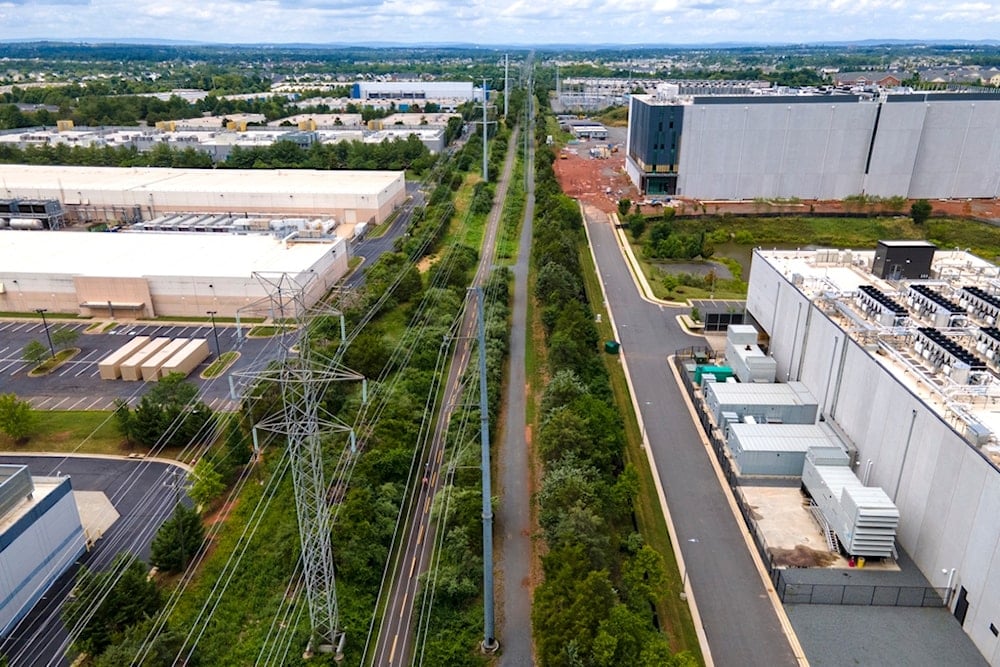
High-voltage transmission lines provide electricity to data centers in Ashburn in Loudon County, Virginia, on July 16, 2023. (AP Photo/Ted Shaffrey, File)
The New York Times (NYT) on Tuesday published an in-depth report warning that the United States' artificial intelligence ambitions are increasingly constrained by its reliance on China for advanced battery technology, exposing a growing national security and infrastructure vulnerability. The report situates the issue within the broader US-China strategic competition, where control over energy systems and industrial inputs is becoming as decisive as dominance in semiconductors.
The report focuses on Northern Virginia's "Data Center Alley," where sprawling, windowless facilities power much of the US AI industry. These centers consume electricity on the scale of small cities and require uninterrupted power to avoid system failures and data corruption. To ensure reliability, operators are turning to massive lithium-ion battery systems, a sector overwhelmingly dominated by China.
Industry engineers warn that even brief voltage fluctuations can trigger cascading failures across AI workloads, underscoring the growing dependence on battery-backed power stabilization. "China is leading in almost every industrial component," said Dan Wang, an expert on China's technology sector at Stanford's Hoover Institution. "They're ahead, both technologically and in terms of scale."
The issue extends well beyond the tech sector. At the Pentagon, defense officials are raising parallel alarms as modern warfare, reshaped by drone combat, lasers, and electronic systems, becomes increasingly battery-dependent. According to defense analytics firm Govini, US weapons programs rely on Chinese supply chains for roughly 6,000 individual battery components.
Military planners increasingly view batteries as mission-critical hardware, comparable to precision-guided munitions or advanced sensors. "The reality is very stark," Govini chief executive Tara Murphy Dougherty told defense and industry officials, adding, "There are foreign parts in 100 percent of our weapon systems and military platforms."
Battery power dilemma
China has shown it understands the strategic leverage this provides. In October, Beijing threatened to restrict exports of advanced lithium-ion battery technologies, including core components such as graphite anodes and cathodes, amid escalating trade tensions with Washington. Chinese officials have framed such measures as lawful export controls designed to safeguard national security, while analysts see them as a calibrated response to US technology restrictions targeting semiconductors, AI, and outbound investment.
These moves came as part of a wider pattern in which Beijing has tightened oversight over critical minerals and dual-use technologies, reinforcing its position at the center of global battery supply chains.
China currently dominates not only battery cell production but also the refining of lithium, graphite, and other essential inputs, giving it significant leverage during trade disputes.
While President Donald Trump has publicly dismissed electric vehicles, calling them a "scam", his administration has increasingly recognized that batteries are indispensable for AI systems, data centers, and military capabilities. After initially freezing billions of dollars in Biden-era clean energy grants, the White House has quietly allowed many battery-related projects to move forward, reframing them as strategic rather than environmental investments.
Recent measures include high-level White House meetings on battery supply chains, new funding for battery materials and recycling, investment in battery startups, and restrictions on Pentagon purchases from "foreign entities of concern," primarily China. Also, the administration has pushed allies such as Japan to invest in US battery manufacturing, reflecting a broader effort to "friend-shore" sensitive industrial production.
"The administration is saying 'we don't like electric vehicles, but we do need batteries for drones and data centers and AI,'" said Samm Gillard, executive director of the Battery Advocacy for Technology Transformation Coalition. "They're recognizing that China's stranglehold on the battery supply chain is undermining our national security."
Energy bottleneck risk
Despite these efforts, experts warn that breaking China's dominance will be slow and costly. China currently produces nearly all lithium iron phosphate (LFP) battery cells globally and controls most refining and processing of critical battery materials. Analysts estimate it would take US manufacturers at least five years to meet domestic demand for LFP cells, and far longer to replicate the underlying supply chains, particularly for upstream components such as cathodes and anodes.
Environmental regulations, higher labor costs, and the absence of China-scale industrial subsidies further complicate US efforts to compete. Even projects already underway are expected to displace only a fraction of Chinese materials in the near term, according to industry executives cited in the report.
International Energy Agency executive director Fatih Birol compared the situation to Europe's former reliance on Russian gas, cautioning that dependence on a single country for a strategic technology carries inherent risks.
The report argues that the AI race is evolving beyond chips and algorithms, hinging instead on electrical infrastructure and energy resilience. Data centers increasingly depend on batteries to smooth power fluctuations caused by AI workloads, prevent "silent data corruption," and replace diesel backup generators. Companies such as Google and Microsoft have already installed tens of millions of battery cells across their facilities as part of both reliability and decarbonization strategies.
The New York Times (NYT) concludes that while the United States still leads in AI computing capacity, China's control over battery production and energy infrastructure could become a decisive advantage, one that reshapes both technological leadership and global power in the years ahead.
Read more: US to enforce restrictions on firms linked to Chinese military: Report


