
US AWACS loss signals strategic shift in dynamics in war on Iran
 5 Min Read
Destruction of a US E-3 Sentry aircraft in an Iranian strike raises concerns over US military surveillance capabilities in the US-Israeli war on Iran.
-
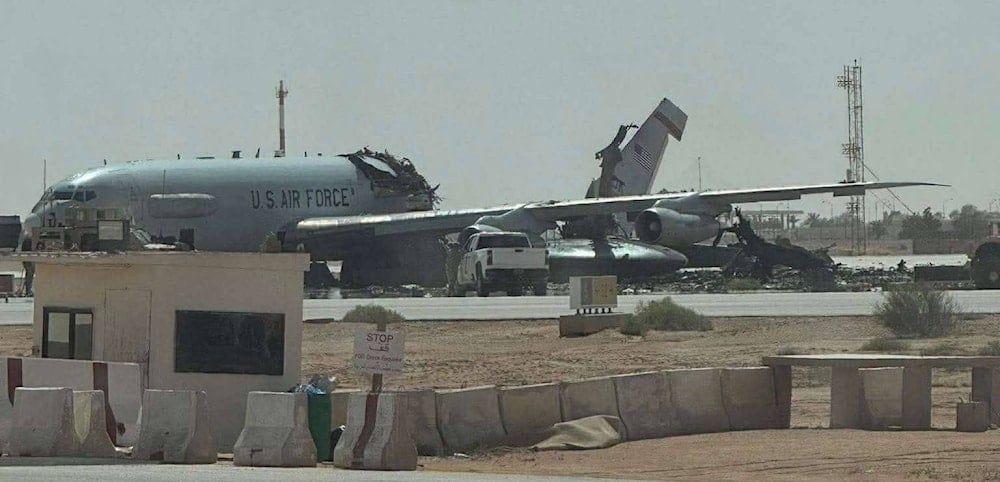
Photo showing the extensive damage to US Air Force E-3 Sentry following an Iranian retaliatory strike against the US-linked Prince Sultan Air Base on March 27, 2026 (X/@TheIntelFrog)
The destruction of a US Air Force E-3 Sentry aircraft in Saudi Arabia marks a significant development in the US-Israeli war on Iran, with CNN reporting that the strike directly hit a high-value surveillance platform at Prince Sultan Air Base.
According to CNN, geolocated images of the site show the aircraft severely damaged, with its tail section broken off and its radar dome, central to its airborne warning and control system (AWACS), lying detached on the ground.
The attack also injured at least 10 US service members, while a US tanker aircraft sustained damage, underscoring the scale of the strike on the base.
Disrupting US battlefield awareness
The E-3 Sentry aircraft is a cornerstone of US military operations, functioning as an airborne command center that enables real-time coordination across vast areas of combat.
“It can potentially impact (US) ability to control combat aircraft and vector them to their targets or protect them from engagements of hostile aircraft and missile systems,” CNN military analyst Cedric Leighton said.
The platform allows the US military to monitor up to 120,000 square miles of battlespace and track hundreds of targets simultaneously, including missiles, drones, and ground formations.
The aircraft plays a critical role in relaying real-time intelligence to commanders, naval forces, and the Pentagon. Its loss is a key operational setback in the US-Israeli war on Iran, and major advantage in Tehran's fight against hostile forces seeking to collapse the state.
The Center for a New American Security released a report earlier this month calling the AWACS the "quarterback" of the battlefield, stating that it was “nimbly providing critical situational awareness and real-time coordination that turns individual sorties into a dominant force.”
The report said that the AWACS is “an indispensable asset for US military operations today and for the foreseeable future.”
Iran’s strategy: targeting enabling systems
Analysts cited by CNN suggest the strike reflects a broader Iranian strategy focused on disabling the systems that sustain US air superiority rather than engaging in direct large-scale attacks.
“Iran’s going after the radars that detect threats, the tankers that keep jets flying, and the AWACS that direct the battle,” Kelly Grieco, a fellow at the Stimson Center, wrote in a post on X.
“Iran’s going after the radars that detect threats, the tankers that keep jets flying, and the AWACS that direct the battle. That’s a counter-air campaign. Adapted to what Iran can actually do. And the damage is real,” Grieco said.
This approach points to a campaign aimed at degrading hostile surveillance, coordination, and refueling capabilities, key components of US military effectiveness.
By targeting such assets, Iran appears to be maximizing impact through selective strikes on critical infrastructure.
Concerns over security breaches and targeting precision
The incident has raised questions among analysts regarding how such a high-value asset was left exposed.
“Extraordinary measures are often taken to protect it from hostile enemy fire while in-flight,” Leighton said, describing the destruction on the ground as “a serious breach of our Force Protection efforts.”
Leighton also suggested that the precision of the strike could indicate the use of external intelligence support, potentially involving satellite imagery and geographic targeting data, once again proving that Tehran is more capable than what Washington expected.
Read more: Trump's 'gut', lack of strategy, failed him in Iran: ex-NATO amb.
A limited and aging fleet under pressure
As CNN reported, the US operates a relatively small fleet of E-3 Sentry aircraft, with only 17 in service at the start of the year.
The fleet has steadily declined from previous decades and includes aircraft that entered service as early as 1978, raising concerns about sustainability amid ongoing aggressions in the US-Israeli war on Iran.
While alternatives such as the E-2 Hawkeye exist, CNN noted that they lack the range, altitude, and capacity of the E-3, limiting their ability to fully replace it.
Implications for the trajectory of the conflict
The destruction of the E-3 Sentry aircraft highlights a broader shift in the dynamics of the US-Israeli war on Iran, where strategic infrastructure is becoming a primary target.
By focusing on surveillance and coordination systems, Iran is seeking to impose operational constraints on the US military, affecting its ability to project power and respond to retaliatory threats across the region.
The loss of such a platform is not merely tactical; it underscores the growing vulnerability of critical US military assets as a result of playing down Iran's capabilities.
Read more: US, Israeli targets hit from al-Naqab to Gulf in Wave 86


