
US claims on Hormuz clash with reality at sea: FP
 4 Min Read
Commercial vessels remain far below prewar traffic levels in the Strait of Hormuz as Washington’s military escalation continues to unsettle maritime trade.
-
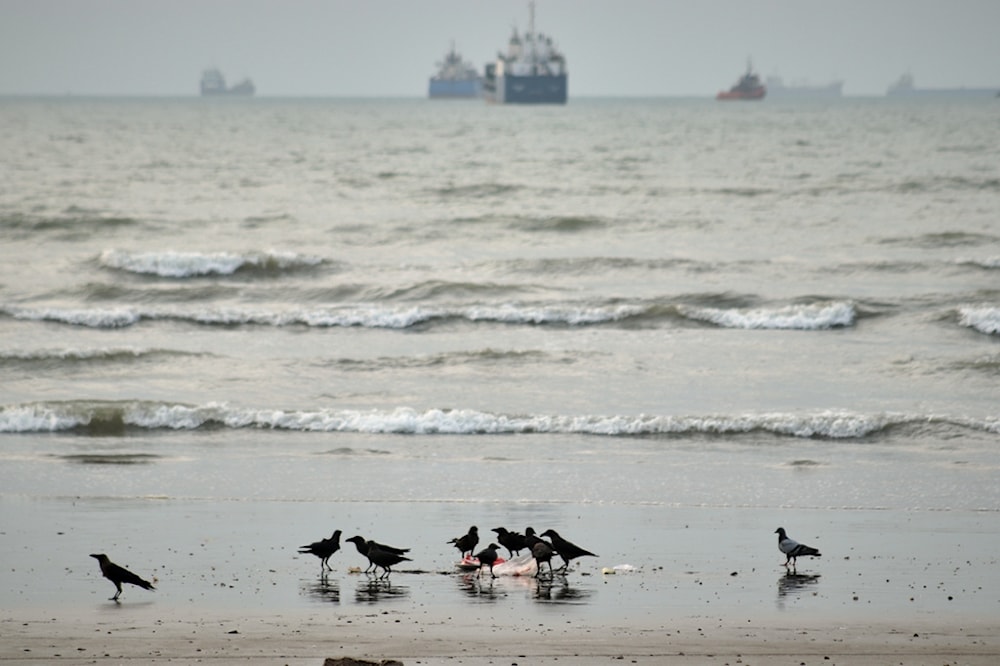
Birds gather around litter on a beach as commercial vessels lie anchored in the Strait of Hormuz off Bandar Abbas, Iran, Wednesday, Sept. 2, 2026. (Razieh Poudat/ISNA via AP)
US claims that the Strait of Hormuz has been cleared of mines and is operating normally have failed to convince the shipping industry, as commercial traffic remains far below prewar levels amid Washington’s continuing war on Iran.
In an analysis published by Foreign Policy, Elisabeth Braw, a columnist at the publication and a senior fellow at the Atlantic Council, examined the widening gap between statements from US officials and the conditions confronting ships navigating the strategic waterway.
Braw noted that US President Donald Trump announced on August 25 that the US Navy had removed or detonated all mines in the international waters of the Strait of Hormuz. Trump subsequently insisted that the waterway was open, while US Central Command commander Brad Cooper said US forces had cleared sea mines from internationally recognized shipping lanes.
Yet, she writes, commercial shipping has not returned to anything resembling prewar levels.
Read more: US Strategic Petroleum Reserve falls to lowest level since 1982
Washington’s claims fail to reassure shipping industry
According to Braw, ship traffic remained at roughly 30 transits per day, compared with a prewar daily average of 129. Moreover, many vessels continued using routes along the Iranian and Omani coasts, following the maritime laws introduced by Iran, rather than the central Traffic Separation Scheme that Washington said had been cleared.
The discrepancy underscores the limits of US assurances in determining whether international shipping considers the waterway safe.
While Washington has sought to portray its military presence as providing security for commercial vessels, the continuation of the conflict has itself become a major source of instability. The United States has carried out repeated attacks against Iran while simultaneously presenting itself as the guarantor of maritime security.
For shipping companies, however, the consequences are measured in actual risks and disruptions rather than official declarations from Washington.
In late August, Bloomberg reported that allies were privately casting doubts about Trump's claims, fearing that the Strait of Hormuz remains laden with mines.
US allies note that mines identified by Washington's forces and initially laid in clusters may have shifted due to sea currents, complicating efforts to locate and neutralize them.
"It is highly unlikely that all the mines in the strait have been cleared," Bloomberg Economics' defense lead, Becca Wasser, said. "Even if the mine threat was reduced, Iran could still escalate. Numerous commercial vessels are well in range of Iranian drones and short-range missiles — and many are outside the range of US air defense cover."
Read more: Dozens of Iranian drones target US bases in UAE, Bahrain: Army
US aggression keeps Hormuz under pressure
The situation deteriorated further on August 30, when the United States launched missiles and rockets against Iran’s Larak Island, with Washington allegeding that its hostilities were connected to preparations by Iran to lay additional mines in the Strait of Hormuz.
The Strait of Hormuz is one of the world’s most strategically important energy corridors, making any sustained disruption consequential for global oil markets. The continued reduction in shipping traffic therefore reflects not simply concerns over mines, but the wider risks generated by an expanding US-Iran conflict.
The situation also illustrates how difficult it is for Washington to impose its preferred conditions on a strategic waterway through military power alone.
Reality on the water challenges US narrative
The gap between US declarations and shipping behavior has become increasingly difficult to overlook.
Trump’s assertion that Hormuz is open does not itself restore commercial confidence, just as the deployment of US military forces does not eliminate the risks created by an active conflict. The continued caution of shipowners provides a more concrete measure of conditions in the waterway than political statements.
Braw’s analysis ultimately highlights a broader issue, Washington’s ability to shape the narrative surrounding the conflict does not necessarily translate into control over events on the ground or at sea.
As the United States continues its war on Iran, the Strait of Hormuz remains a strategic pressure point. The persistence of reduced shipping traffic suggests that the waterway cannot simply be declared “open” while the wider conflict remains unresolved.
Read more: Azizi warns US: 'Test our will' and pay a heavier price


