
US claims first successful test of ‘Golden Dome for America’ system
 4 Min Read
The United States "Golden Dome for America" missile defense system is designed to counter drones and cruise missiles.
-
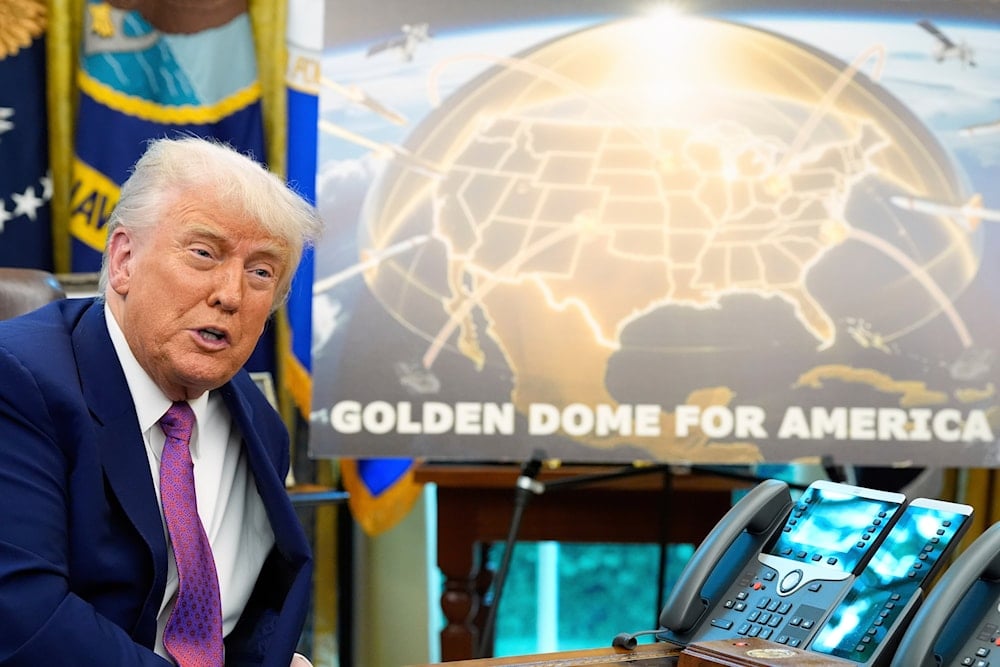
US President Donald Trump speaks in the Oval Office of the White House on May 20, 2025, in Washington (AP)
The United States has conducted the first successful test of its new "Golden Dome for America" (GDA) missile defense system, according to an announcement by Secretary of War Pete Hegseth on Tuesday.
In a post on the social media platform X, Hegseth characterized the test as a "full mission success" and stated that he witnessed the event personally. The exercise marked a significant milestone in the development of the next-generation defense architecture, which is designed to protect the continental United States from a range of aerial threats.
Today, the first milestone test of Golden Dome for America (GDA) was a full mission success — and I was honored to witness it firsthand.
— Secretary of War Pete Hegseth (@SecWar) June 24, 2026
Cutting edge directed energy was harnessed and the Dynamic Defense Autonomous Defeat (DDAD) system flawlessly and autonomously cued, targeted,…
"This cutting-edge directed energy was harnessed and the Dynamic Defense Autonomous Defeat (DDAD) system flawlessly and autonomously cued, targeted, and eliminated a multitude of incoming threats," Hegseth wrote.
According to the Secretary, the system successfully neutralized every target engaged during the trial, which included simulated incoming drones and cruise missiles. He emphasized that the test was executed according to the scheduled timeline and dynamically defeated all threats.
US goes all in on the 'Golden Dome'
The "Golden Dome for America" (initially named "Iron Dome for America") is a second Trump Administration initiative to develop an integrated air and missile defense system, introduced via Executive Order 14186 on January 27, 2025.
The program aims to create a comprehensive "system of systems" using a layered architecture of ground and space-based capabilities to protect the US homeland from ballistic, hypersonic, and advanced cruise missiles.
Congress has allocated approximately $24 billion toward the effort, with Trump aiming for the system to be fully operational by 2029, a timeline industry executives have described as requiring an "all-industry commitment" to achieve.
Inspired by 'Israel's' Iron Dome
The project is led by US Space Force General Michael A. Guetlein and is inspired by "Israel's" multi-tiered defense network, though scaled for far more complex strategic threats. Cost estimates have risen to $185 billion, up $10 billion from initial projections, following an acceleration of space-based capabilities approved in March 2026.
The primary contracting vehicle is the Scalable Homeland Innovative Enterprise Layered Defense (SHIELD) contract, a $151 billion multiple-award, indefinite-delivery/indefinite-quantity mechanism administered by the Missile Defense Agency. As of January 2026, over 2,440 companies and academic institutions have been approved as qualified SHIELD holders out of an original pool of 2,463 applicants, with the contract running through December 2035.
Major defense primes, including Lockheed Martin, Northrop Grumman, RTX, Boeing, and General Dynamics, have all been confirmed as awardees, though specific task orders and their dollar values remain undisclosed.
Golden Dome contracts total $6.45bln
SpaceX has emerged as a dominant force, securing two major Golden Dome contracts in May 2026 totaling $6.45 billion: a $2.29 billion award for a space data network backbone and a $4.16 billion contract for space-based advanced moving target indicator satellites. This figure exceeds the combined prototype awards given to all other program contractors, with SpaceX now positioned as the commercial backbone of the initiative.
Meanwhile, the Space Force has awarded 18 other transaction authority contracts for space-based interceptor development, a core component described by General Guetlein as a modernized "Brilliant Pebbles" concept requiring high magazine depth and low cost-per-shot.
In addition to the primes, nontraditional vendors are being actively courted, with the government aiming to "widen the aperture" and bring in commercial players. Notable partnerships include AeroVironment and Sierra Nevada Corporation teaming to develop limited-area "under-dome" protection for critical infrastructure, leveraging directed energy, electronic warfare, and cyber capabilities.
Anduril Industries, a rising defense tech firm, raised $5 billion at a $61 billion valuation after being selected for Golden Dome prototype work, while True Anomaly secured $650 million following its inclusion in the space-based interceptor program.


