
US court overturns ruling freeing pro-Palestinian activist Mahdawi
 4 Min Read
A US appeals court overturns a ruling that freed pro-Palestinian activist Mohsen Mahdawi, saying the lower court lacked jurisdiction over his immigration case.
-
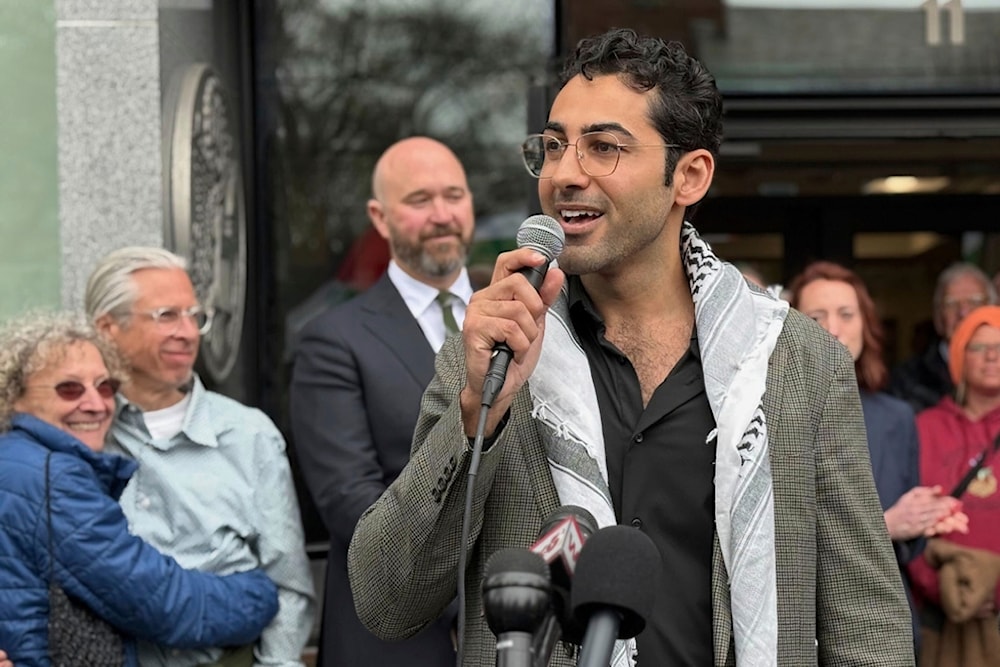
Mohsen Mahdawi speaks outside the courthouse after a judge released the Palestinian student activist on April 30, 2025, in Burlington, Vermont (AP)
A US appeals court on Tuesday overturned a ruling issued last year that had ordered the Trump administration to release pro-Palestinian activist Mohsen Mahdawi from immigration detention, ruling that the lower court lacked jurisdiction to consider his case.
The three-judge panel of the 2nd US Circuit Court of Appeals in Manhattan reversed the decision by a federal judge in Vermont, who had ordered Mahdawi's release on bond two weeks after his arrest and ruled that he was entitled to First Amendment free speech protections.
The appeals court did not rule on the merits of Mahdawi's constitutional claims, instead finding that his case should first proceed through the immigration court system. The decision could make it more difficult for non-US citizens held in immigration detention to secure quick release by challenging their detention on First Amendment grounds.
Who is Mohsen Mahdawi?
Mahdawi, 35, was born in the occupied West Bank and is a student at Columbia University. He was arrested in April 2025 while attending an interview related to his application for US citizenship, following his participation in protests against the war on Gaza.
A Vermont-based federal judge, Geoffrey Crawford, ordered Mahdawi's release on bond two weeks after his arrest, ruling that he enjoyed First Amendment free speech rights. The appeals court later overturned that decision on jurisdictional grounds.
Mahdawi is currently appealing a removal order issued against him. His attorneys, represented by the American Civil Liberties Union, argue that he cannot be detained or deported while the appeals process is ongoing.
The ruling did not order his immediate re-arrest, but could pave the way for his eventual re-arrest and continued deportation proceedings.
Decision raises concerns over free speech rights
The ruling comes amid a series of cases involving non-US citizen students who faced deportation proceedings after participating in pro-Palestinian protests.
The decision follows a similar ruling earlier this year in the case of Palestinian activist Mahmoud Khalil, another former Columbia University student. Taken together, the rulings could make it more difficult for non-citizens held in immigration detention to seek their release quickly on the grounds that their constitutional free speech rights have been violated.
Rights groups have criticized the Trump administration's immigration crackdown against non-citizens involved in protests against Israeli policies and the war on Gaza, arguing that the measures threaten freedom of expression.
Columbia University at heart of crackdown on pro-Palestine activism
The repression of pro-Palestine voices on US campuses did not begin with Mahdawi, nor is it limited to federal immigration actions. The suppression has been particularly aggressive at Columbia University in New York, where over the past two years administrators have repeatedly called in police, expelled dozens of students, and suspended entire student organizations.
In April 2024, Columbia permitted the New York Police Department to storm a peaceful Gaza Solidarity Encampment on campus, arresting over 100 students and faculty. Less than two weeks later, after students occupied a campus building in protest, Columbia authorized another police raid.
Officers in riot gear broke through windows, detained dozens, and physically brutalized those inside. Officers were seen beating protesters with batons and physically beating nonviolent demonstrators, including professors and journalists
The disciplinary crackdown continued into 2025. Last year, Columbia expelled nearly 80 students for their participation in pro-Palestine activities, including a library sit‑in held during final exams. The expulsions came with no criminal charges and followed what many condemned as sham disciplinary proceedings. The university also blocked several student groups from holding events, suspended chapter charters, and threatened to revoke diplomas.


